We need your help now

Support from readers like you keeps The Journal open.

You are visiting us because we have something you value. Independent, unbiased news that tells the truth. Advertising revenue goes some way to support our mission, but this year it has not been enough.

If you've seen value in our reporting, please contribute what you can, so we can continue to produce accurate and meaningful journalism. For everyone who needs it.

Now Streaming: Documentary explores journey of Ukrainian Irish-speaker to Ireland

“The last thing I wanted was a story where we are looked down on,” says Nadia Dobrianska.

AFTER RUSSIA INVADED Ukraine on 24 February 2022, human rights worker and researcher Nadia Dobrianska became one of the more than 110,000 Ukrainians who fled to Ireland for safety.

In order to get to Ireland, she and her parents Leo and Olga had to endure a gruelling three-day trip to the Polish border, which culminated in a 30-hour wait to get through.

Unusually, Dobrianska is not just an English speaker but also an Irish speaker. Having built up contacts in Ireland after studying Irish Studies at Queens University in Belfast from 2019 – 2021, she was able to get access to accommodation for her family in Cork city.

But while she was lucky with the arrangements, like all Ukrainians Dobrianska has had to watch as their country continues to be targeted by Russia. 

What it is it like to experience these almost incomprehensible circumstances? That’s what director Sinéad Ingoldsby set out to discover when she made Idir Dhá Bhaile: Ó Chív go Corcaigh, a documentary produced by Below the Radar about Nadia Dobrianska and her family. The film is available to watch now for free on The Seinnteoir TG4 (Player).

‘I had to adjust’ – ‘Bhí orm a choigeartú’

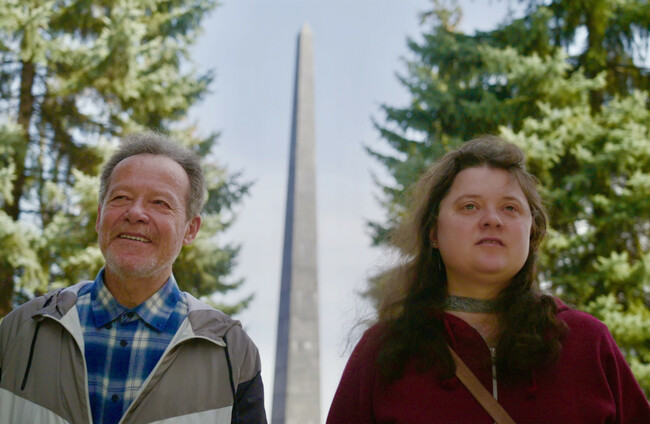
Nadia 1 Nadia with her father, Leo.

Dobrianska first came to attention through contributing to Irish-language radio shows in Ireland – TG4 even captured her arrival in Ireland. The family were settled in Cork for just over six months when they met director Sinéad Ingoldsby and her team.

Knowing that the documentary would be filmed as Gaeilge didn’t faze Dobrianska. “I’m still a learner so I felt that it would be really exciting,” she says, but adds: “I didn’t quite appreciate how personal it would become.”

What attracted her to Gaeilge in the first place? “It’s hard to explain. I just really, really like it. And I have this affinity to Irish traditional music,” she says. She first encountered Irish trad through her English teacher as a teenager and was soon hugely curious about the language people were singing in. 

While she was interested in filming an Irish-language documentary, Dobrianska also knew that given its topic it would have its tough moments. But the unexpected death of her mother Olga shortly after their move to Ireland lent a sombre air to the decision to film.

One of the biggest choices Dobrianska subsequently needed to make was whether to allow the family’s first trip back to Kyiv to be filmed. Knowing that Olga would not be with them meant that the trip was freighted with grief. Eventually, Dobrianska decided she would give the go-ahead.

For director Sinéad Ingoldsby, this significant moment needed to be dealt with sensitively.  

“So the way I approached it with Nadia was we had a very open conversation on the phone, and I said, ‘Look, I’m going to ask you something that’s a really big ask, but this is why’.”

After speaking to her family, Nadia agreed to allow the cameras (operated by a Ukrainian crew) accompany them for a period of time while they entered their flat.

The cameras capture their emotions as they assess what has changed in their lives since they were forced to flee. “I think it’s probably the best scene, because it’s so real,” says Ingoldsby.

Changes in Kyiv – Athruithe i gCív

The invasion continues in Ukraine, though a push for a peace deal is ongoing. For Dobrianska, the documentary is “a little bit of a history film now”, because of how it captures the first two years of the Russian invasion.

“In a way, air defense has been better in Ukraine for a while. Now it’s getting worse. Right now we’re going into the terrain of Russian nightly bombings becoming really bad again,” she says. “I’m really having flashbacks to 2022. So it’s a way to bring awareness about the story of Ukrainian refugees in Ireland, how it was in previous years and the changing political environment.”

After filming the documentary, it landed with Dobrianska just how intense the two years had been as the family adjusted to their new reality.

“But I felt that this is just how things are. We witnesses, we have to be out there and talking about it. If we just sat and simmered in our own trauma, what good does it do? We have to talk about this.”

 Life in Kyiv – Saol i gCív

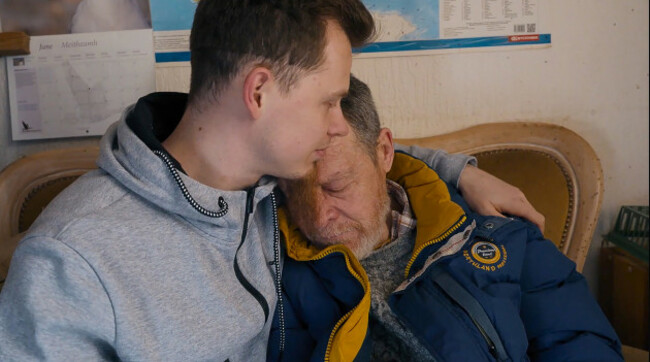
IDB5 2 Nadia's brother Petro with their father Leo.

Dobrianska’s brother Petro is still based in their home city of Kyiv. “It’s really sad to see the city change. I was there last year, and there are much fewer people compared to what it used to be before the invasion,” she says, but adds that people are adapting to life despite the threat of Russian attacks.

“I’m really, really, really thrilled how people are just changing their lives, because life goes on. So far, Russians have not been deterred by any sanctions – they’re ramping up production of their long-range missiles and drones, turning basically each night in Ukraine into a nightmare.

It’s just this amount of grief and loss and danger… it’s still present, even though people are carrying on as best as they can.

Dobrianska is grateful for the support she’s received from Irish people, and from the Irish-speaking and academic communities, and “knowing that people are able to see other people’s suffering, and also aspirations and hopes as well for a better life”.

She’s currently in her third year of a PhD and is in a writing-up stage. “It’s extremely lonely,” she says. “It’s really hard – it’s really rewarding on the other hand. All this work that I had done in the archives and other research is now coming together.”

Her work centres on the Belfast Pogroms, and she recently contributed to a TG4 documentary on the topic, which can be watched here on the Seinnteoir TG4 (Player). 

As director, Ingoldsby understood that she had to negotiate telling the story of the Dobrianska family without re-traumatising them. 

“I honestly find that just being really upfront is the best way of doing it, and to just say, ‘Look, this is what I want. This is why I’m doing it. And what do you think?’” she says. It’s a process of ongoing consent, so the family know they have a say in how they are filmed.

The documentary took two years, reflecting the ongoing nature of the invasion. “You have to know that it’s people’s real lives here – it’s not entertainment,” says Ingoldsby, who formerly worked for the BBC and has been a freelance director for 13 years. 

TG4 / YouTube

Between two towns – Idr dhá bhaile

Another difficult moment came when she filmed Nadia and Leo speaking online to Petro. “They got very emotional, and it was only then that I discovered that was their first time actually seeing each other since they had parted company when the war broke out,” says Ingoldsby.

Filming for two years meant that the documentary could also cover the Irish government’s changes in policy regarding Ukrainian refugees. In 2024, the government announced a reduction in its supports for those fleeing the war, and people are now offered accommodation for 90 days with a weekly allowance of €38.80 per adult.

Ingoldsby hopes that the documentary could give “the human story behind policy or newspaper articles”, putting names and faces to those affected by such changes. In one part of the documentary, Leo and Nadia go to Tory Island to meet Ukrainian refugees there and find out about the challenges they face.

“Maybe it’s no harm reminding the government that there’s real people’s lives at stake, and it’s not just about bottom lines and figures,” says Ingoldsby.

TG4 were supportive of how long the documentary took to film, she says. “It’s not going to be wrapped up with a bow at the end. And we need to reflect that.”

Since the documentary has aired, Dobrianska has heard from viewers who were touched by her personal story. 

“Talking about Mom, it was really hard. And I’m really grateful to Sinéad and the whole team, that they approached my story with dignity,” she says. “The last thing I wanted was a story where we are looked down on, or asking for pity. That’s how I feel about the film: that they show that we are coping, and this is how we are coping.

As refugees, you don’t get much control in your life and control over your own story. There’s things that you can say, but what media and producers do with it, it’s a whole different story. And I was very happy that we had a mutual understanding of how we see things, and I really appreciate it.

Idir Dhá Bhaile: Ó Chív go Corcaigh is available to view for free on The Seinnteoir TG4 (Player).

Close