Sign in. It’s quick, free and it’s up to you.
An account is an optional way to support the work we do. Find out more.
Sign in. It’s quick, free and it’s up to you.
An account is an optional way to support the work we do. Find out more.
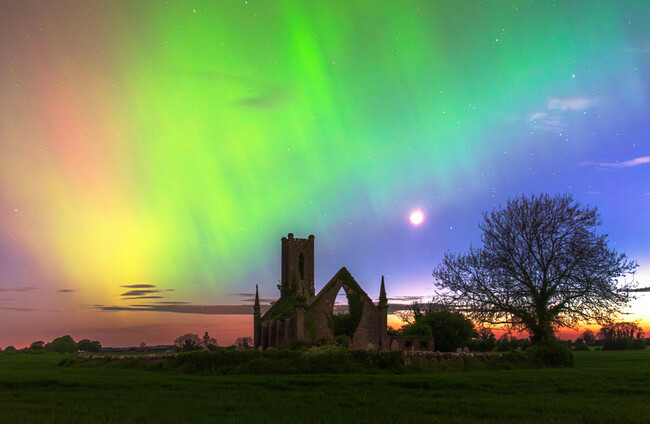
IRISH AURORA FORECASTERS have predicted that the Northern Lights will likely be visible across large parts of Ireland tomorrow night, meaning people will be able to mark the start of the new year with a natural light show.
The Magnetometer Network of Ireland, which measures the magnetic field strength of the earth, is currently tracking major solar flare activity, which may mean the Northern Lights will be visible as far south as Dublin tomorrow.
Professor Peter Gallagher of the Dublin Institute for Advanced Studies told The Journal that he thinks “there will be Aurora visible”, adding that several prediction models are showing that the Northern Lights will travel across at least half of the country.
The appearance of the Northern Lights is particularly rare in Ireland at this time of year, as auroras most commonly appear between May and August here.
Gallagher, who is also the principal investigator with the Magnetometer Network of Ireland, added that “it’s really hard to make a forecast” for the Aurora Borealis.
“A solar storm took off from the sun yesterday, which takes a couple of days to get to us, and it’s forecast this solar storm will arrive at the earth tomorrow evening,” Gallagher said.
“That means that from about 6pm tomorrow evening, until approximately 3am the next morning, the flare is expected to hit, which will produce the Aurora. It will then be quiet again by the following day”.
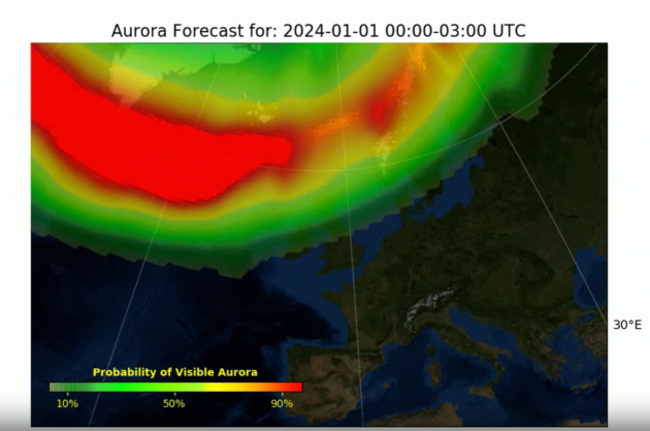
“I do think the Aurora is going to happen, but the question be cloudy or not?” Gallagher added.
The limited time frame for Aurora visibility overlaps with Met Éireann predictions of cloudy weather – but the national weather forecaster has said that clouds may break up during the early hours of New Year’s Day.
Gallagher said that the best thing people can do to increase their chances of spotting the Northern Lights is get away from city areas, which have high levels of light pollution.
“If you live in Cork or Dublin or Galway, just get north of them,” Gallagher explained, adding that the waiting process can be unpredictable and tedious.
“It’s like telling somebody to go out and watch a cloud to see if it’s going to rain – you just have to wait. So go out, wear something nice and warm, and just look north,” he added.
For people in Dublin hoping to spot the Aurora, Gallagher recommends heading for Balbriggan or other north coastal regions.
Donegal will likely have the best chance of spotting the Northern Lights, given that it is the northern-most county.
For those eager to see the Northern Lights in their full glory, a camera or your smartphone may be needed, as in some spots the lights may not be fully visible to the naked eye.
“They can look a little bit gray to start with from the naked eye, but then eventually, as your eyes get used to the darkness and it can turn it green,” Gallagher said.
“If you take your mobile phone out and just take a photograph, your mobile phone will take a great picture faster than your eyes will pick it up however”.
Those hoping to track the predicted movements of the Northern Lights can do so via the Magnetometer Network of Ireland website.

To embed this post, copy the code below on your site















have your say