Sign in. It’s quick, free and it’s up to you.
An account is an optional way to support the work we do. Find out more.
Sign in. It’s quick, free and it’s up to you.
An account is an optional way to support the work we do. Find out more.
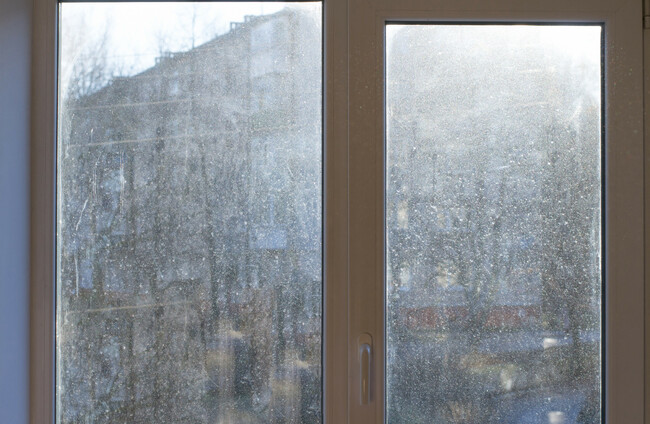
IF YOU’RE CURRENTLY admiring a new coating of grime on your windows, or questioning the powder substance covering your car and windowsills, fear not – it’s an expected occurrence after storms like Éowyn.
Several concerned Irish people took to social media this afternoon to question the powder deposits left on various surfaces outside following Storm Éowyn, which brought high-speed winds and destruction to many parts of the country.
Coastal areas were hit particularly hard, with gusts reaching speeds of up to 183km/h.
These high-speed winds deposited a off-coloured powder, which has covered a number of outdoor surfaces.
Aideen took this photo in Dunmore East with trees looking white which is likely from salt blown in by storm too. After the night of the big wind in 1839 salty vegetation was mentioned. #StormÉowyn pic.twitter.com/MYp1aiHevC
— Carlow Weather (@CarlowWeather) January 24, 2025
The ‘powder’ is nothing to worry about – it’s a a simple concoction of salt, dust and dirt, experts say.
Peter Thorne, a professor of Physical Geography (Climate Science) at Maynooth University, said there’s no need for alarm regarding the ‘dusting’, explaining that a major storm (such as Éowyn) will usually cause this to happen.
“The dust and salt were picked up from the sea and local area by the strong winds, and were deposited by the winds onto a range of vertical surfaces, including windows,” Prof. Thorne said.
“The reason it is so visible on windows is simply down to the fact that windows are clear,” he added.
Thorne added that the record waves along the west coast caused by the stormy conditions meant that the wind “was able to pick up large amounts of fine matter and carry it as far as the midlands”.
Met Éireann explained that while it may not be the most common occurrence in Ireland, the public has had previous experience with the weather phenomenon before, following deposits of dust carried by strong winds from the Sahara Desert.

The national forecaster reiterated that the “dusting” was “nothing to panic about”.
“We would be more familiar with Saharan dust,” Met Éireann meteorologist Rebecca Cantwell explained.
“People might recognise the red coating that appears on our cars that we sometimes wake up to in the mornings, and that’s brought in by strong southerly wind from the Sahara, after dust and sand is brought up.
“In this case, westerly winds from Storm Éowyn picked up salt and dust deposits from coastal areas with tall waves, and pushed it all inland”.
For those still in doubt, take a page out of Carlow Weather’s book and give it a taste:
Can confirm it is salt! It’s a long way from sea to Carlow pic.twitter.com/2bixrjNRI1
— Carlow Weather (@CarlowWeather) January 24, 2025

To embed this post, copy the code below on your site











have your say