Take part in our latest brand partnership survey

We need your help now

Support from readers like you keeps The Journal open.

You are visiting us because we have something you value. Independent, unbiased news that tells the truth. Advertising revenue goes some way to support our mission, but this year it has not been enough.

If you've seen value in our reporting, please contribute what you can, so we can continue to produce accurate and meaningful journalism. For everyone who needs it.

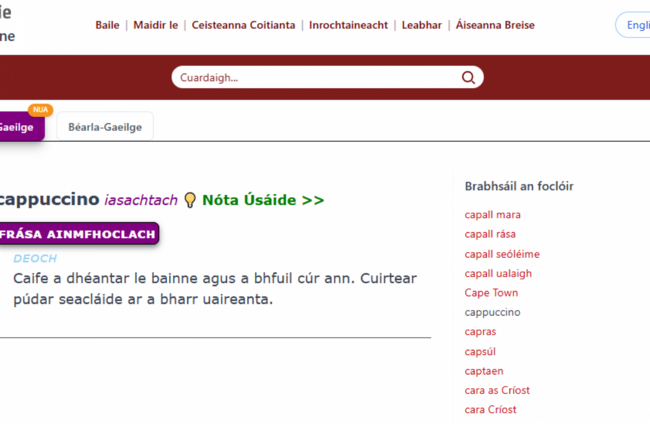
A number of words from languages other than English are defined in Irish in the new dictionary. An Fhoclóir

New Irish language dictionary described as 'vital tool' for community by President Connolly

Athru ó bhonn é seo do phobal úsáidte na Gaeilge – ní gá focail as Gaeilge a shainmhíniú trí theanga eile níos mó.

(Seo alt ónár bhfoireann nua Gaeltachta.  Is féidir an bunleagan as Gaeilge a léamh anseo.)

THE PRESIDENT Of Ireland, Catherine Connolly, has described the new monolingual Irish dictionary, which was made available live online at lunchtime today, as “an essential tool”.

Speaking ahead of the launch of the new dictionary at an event in central Dublin tonight, the President stressed the importance of the monolingual dictionary in allowing the Irish language and its heritage to be “defined in its own words and by its own people, rather than constantly being defined through the medium of another language”.

The new dictionary, which will contain 20,000 words and 40,000 meanings, is planned to be available online only, and will be available from lunchtime today at www.focloir.ie.

Today’s publication is only the first part of this major work that began three years ago and it is intended that the rest will be published between now and 2027. When the project is completed in 2027, people will be able to access be 30,000 words and approximately 80,000 meanings.

According to Seán Ó Coinn, chief executive of Foras na Gaeilge, the dictionary fundamentally changes the discourse about the Irish language.

“For generations, Irish speakers who encountered unfamiliar Irish words were forced to translate them into English and then search for definitions in English dictionaries,’ he said.

This tedious process not only created unnecessary barriers to learning but also shaped how Irish speakers understood the world – through the lens of English.

 “The new monolingual Irish dictionary changes this paradigm. Instead of asking “What’s the English for X?”, speakers will now be empowered to ask “What does X mean?” in their own language.

“This shift has the potential to transform the teaching and learning of Irish at all levels ─ from young children discovering new vocabulary for the first time, to advanced speakers seeking deeper linguistic insight.”

Previously, Irish-English and English-Irish dictionaries have been published and a new Irish-English dictionary will also be published in 2027.

According to the President, speaking ahead of the official launch, “the lexical resources of the Irish language are now a model of good practice for other minority languages ​​around the world”.

This new dictionary places the Irish language and its community on an equal footing with other languages ​​and language communities of our time.

This monolingual Irish dictionary has a number of pioneering features, for example:

  • It reflects Irish as a living language by including real-world, every-day, contemporary usage, aiming to re-affirm current good practice in the standard language as well as recognising common dialectal forms.
  • It includes definitions of foreign words that are in common use in the Irish language, such as ad hocal frescobaguettecappuccino and aide-de-camp.
  • Many phrases, idioms and proverbs have dedicated entries and definitions.
  • It not only meets the needs of advanced Irish speakers but also gives helpful grammar and pronunciation guidance for those less sure about how to use and pronounce words and phrases.
  • The dictionary aims to provide guidance where needed as to the intricacies of Irish grammar, more than would ordinarily have been provided in previous dictionaries. This is done through various means such as usage notes, grammar information within entries, or widespread use of examples that illustrate different points of grammar.

The dictionary is edited by Irish language scholar Dr Pádraig Ó Mianáin and he called the publication of this monolingual Irish dictionary a ‘significant step in the ongoing development of the lexical resources being provided by Foras na Gaeilge’.

“The demand for a major monolingual dictionary by the Irish language community in Ireland and around the world has been increasing for years, and we are very pleased that this need is finally being met,” he said.

“We look forward to continuing to add to and develop the dictionary in the remaining two years of the project.”

This project is under the auspices of Foras na Gaeilge, the cross-border language institute established as a result of the Good Friday Agreement, and the Department of Rural and Community and Gaeltacht Development in Dublin and the Department of Communities in Belfast are the main funders of the project, with additional support from the Department of Education in Dublin.

The Journal’s Gaeltacht initiative is supported by the Local Democracy Reporting Scheme

Readers like you are keeping these stories free for everyone...
A mix of advertising and supporting contributions helps keep paywalls away from valuable information like this article. Over 5,000 readers like you have already stepped up and support us with a monthly payment or a once-off donation.

Close
Comments
This is YOUR comments community. Stay civil, stay constructive, stay on topic. Please familiarise yourself with our comments policy here before taking part.
Leave a Comment
    Submit a report
    Please help us understand how this comment violates our community guidelines.
    Thank you for the feedback
    Your feedback has been sent to our team for review.

    Leave a commentcancel

     
    JournalTv
    News in 60 seconds