Sign in. It’s quick, free and it’s up to you.
An account is an optional way to support the work we do. Find out more.
Sign in. It’s quick, free and it’s up to you.
An account is an optional way to support the work we do. Find out more.
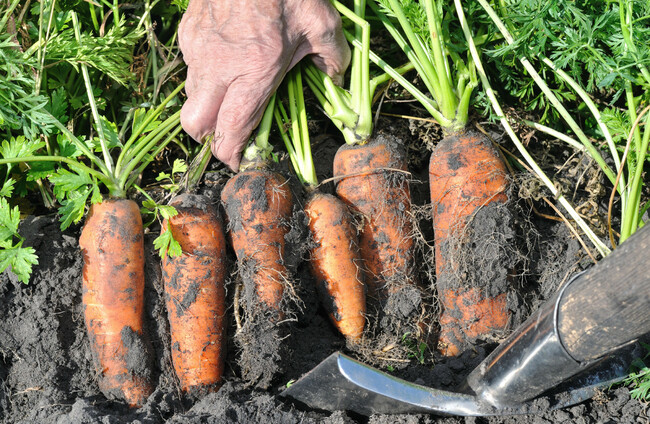
IRELAND HAS ONE of the lowest rates of organic farming of EU member states and one of the weakest targets for its expansion in the coming years, a new report has identified.
The European Court of Auditors has released analysis today of organic farming across the European Union, finding that Europe’s farmers have received around €12 billion in support under the Common Agricultural Policy to convert to organic farming or maintain organic farming practices.
However, the uptake of organic farming has varied significantly between countries, the report outlines, with Ireland among the weakest performers.
The report also outlines that the EU’s approach to support for organic farming is flawed.
Some farmers can receive money ringfenced for organic farming despite not complying with its basic principles, among other issues highlighted in the critical report.
In Austria, around one-quarter of agricultural land is used for organic farming, closely followed by Estonia (23.4%) and Portugal (19.3%).
The figures are based on data from 2022 (and in Austria’s case, 2020).
At the time, Ireland was using only 2.2% of its utilised agricultural area for organic farming. Bulgaria was also using 2.2% of agricultural land for organic methods, putting it and Ireland tied for second-last, while the worst performer was Malta, where organic farming makes up only 0.6% of the share of the utilised agricultural area.
Since then, Ireland has increased the share of farmed land used for organic farming to 5%, according a sectoral review by the Climate Change Advisory Council.
That means Ireland’s performance has increased since the 2022 statistics were counted – but it still lags behind the vast majority of European countries, even when comparing Ireland’s current, improved share of organic farming to the share reached by other countries two years prior.
Denmark, which has a similar population to Ireland but is half the size, was using 11.4% of its agricultural area for organic farming in 2022.
The Irish government’s target for increasing organic farming by 2030 is also one of the weakest in the bloc. It intends for the share of organic farming by the end of the decade to be 10% – a proportion that many countries have already surpassed.
Of the countries that have set 2030 targets, the only country with a lower target than Ireland is Malta (5%).
Austria has set the highest target of 35%, while Sweden, Germany and Belgium’s Wallonia region are aiming for 30%. Denmark’s target is for organic farming to make up more than 20% of the land use share by 2030.
The EU’s collective target is 25%.
There are currently around 5,000 farmers engaged in Ireland’s Organic Farming Scheme.
The Climate Change Advisory Council said in its recent sectoral review of Irish agriculture that the Organic Farming Scheme has seen growth in the area but that further support is still needed to support necessary changes in farming practices and land use.
Organic farming is an approach to agriculture that is supposed to use methods that help instead of harm the environment, like rotating crops and not using chemical fertilisers or pesticides.
Agriculture is a major source of greenhouse gas emissions that trap heat inside the atmosphere and push average global temperatures upwards, which is leading to climate change.
Increasing the share of agriculture that is done through organic farming is seen as a way helping to reduce harm caused by practices that are harmful to the climate or environment, such as the extensive use of chemical pesticides.
Overall, the European Court of Auditors found that the EU is spending billions on extending the area of land that is organically farmed but has not paid enough attention to the sector’s needs.
It said the EU’s strategy does not have adequate or sufficiently quantifiable goals or concrete ways to measure progress, nor does it show any strategic vision beyond 2030, which the ECA says would provide the “stability and long-term perspective” that the sector needs to succeed.
Additionally, the auditors found that environmental and market objectives can be overlooked by Common Agricultural Policy support.
“For instance, farmers can receive EU money even if they do not apply the crop rotation or animal-welfare standards that are basic principles of organic farming,” an ECA statement to media notes.
“The auditors also found that it was common legal practice to obtain authorisation for using non-organic seeds when planting organic crops and they note that there is currently no way to measure how the supposed environmental benefits of organic farming have materialised,” it says.
“CAP support was meant to compensate farmers for the additional costs of and income lost by switching from conventional to organic farming. As organic farmers were not required to produce any organic products in order to receive EU money, this contributes to a situation where organic production remains a very small market, accounting for no more than 4% of the total EU food market.”
ECA member Keit Pentus-Rosimannus, who was responsible for the audit, said that the EU must do more to support the organic farming sector.
“European agriculture is becoming greener, and organic farming plays a key role in that. But for lasting success, it is not enough to focus on increasing just the area of land that is organically farmed. More needs to be done to support the sector as a whole – developing the market and boosting production,” she said.
“Otherwise, we risk creating a lopsided system that is entirely dependent on EU funds, rather than a thriving industry spurred on by informed consumers.”

To embed this post, copy the code below on your site










have your say