We need your help now

Support from readers like you keeps The Journal open.

You are visiting us because we have something you value. Independent, unbiased news that tells the truth. Advertising revenue goes some way to support our mission, but this year it has not been enough.

If you've seen value in our reporting, please contribute what you can, so we can continue to produce accurate and meaningful journalism. For everyone who needs it.

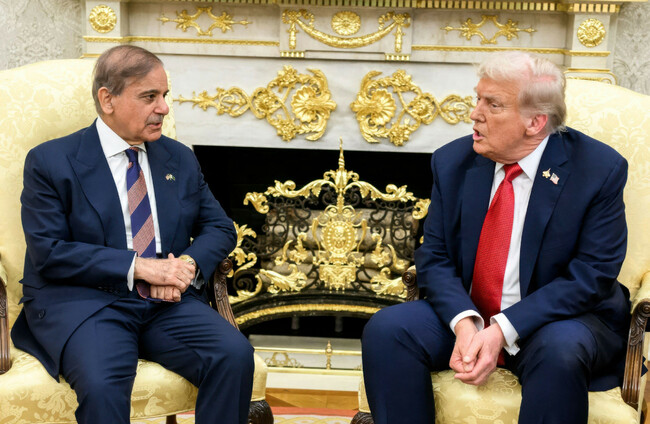
US president Donald Trump meeting Pakistan's prime minister Shehbaz Sharif n the Oval Office last September. Alamy Stock Photo

Pakistan 'stands ready' to host talks to end US-Israeli war in Iran, prime minister says

US president Donald Trump reshared the statement from Shehbaz Sharif on his Truth Social platform.

LAST UPDATE | 3 hrs ago

PAKISTAN’S PRIME MINISTER Shehbaz Sharif has said Islamabad is prepared to host negotiations to stop the US-Israeli war with Iran, after mounting speculation it could act as a mediator.

In a post on social media, Sharif wrote: “Pakistan welcomes and fully supports ongoing efforts to pursue dialogue to end the WAR in Middle East, in the interest of peace and stability in (the) region and beyond.

“Subject to concurrence by the US and Iran, Pakistan stands ready and honoured to be the host to facilitate meaningful and conclusive talks for a comprehensive settlement of the ongoing conflict.”

US president Donald Trump reshared the post from Sharif on his Truth Social platform. 

When asked about potential talks in Pakistan, White House press secretary Karoline Leavitt said it was a “fluid situation”, adding that “speculation about meetings should not be deemed as final until they are formally announced by the White House”.

The US State Department announced that secretary of state Marco Rubio would meet G7 counterparts in France on Friday to discuss Iran, his first foreign trip since the war began.

Tehran’s foreign ministry suggested yesterday that messages had been received from “some friendly countries indicating a US request for negotiations at ending the war”, according to the official IRNA news agency.

Sharif also said he had spoken with Iran’s president Masoud Pezeshkian, promising his government’s help in bringing peace to the region.

Pakistan’s foreign minister and deputy prime minister Ishaq Dar also said he had been in touch with his Iranian counterpart, Abbas Araghchi.

Araghchi’s office said he has been talking about the war this week with his counterparts in several countries.

Iran ‘will continue until complete victory’

But Iranian parliament speaker Mohammad Bagher Qalibaf called the idea of negotiations “fake news”, and the spokesman of Iran’s top military command issued a newly defiant statement.

“Iran’s powerful armed forces are proud, victorious and steadfast in defending Iran’s integrity, and this path will continue until complete victory,” Iranian state television quoted Major General Ali Abdollahi Aliabadi as saying today.

Aliabadi did not say what “complete victory” would look like, but it appeared likely Iran’s military was trying to warn against offering concessions in any possible negotiations.

Pakistan’s foreign ministry spokesman Tahir Hussain Andrabi meanwhile told AFP that his country was “always willing to host talks” and had “consistently advocated for dialogue and diplomacy to promote peace and stability in the region”.

The country’s former ambassador to Oman, Imran Ali Chaudhry, told 92 News late yesterday that Pakistan’s army chief recently held talks with US negotiators in the Gulf.

“Around two to two-and-a-half weeks ago, Field Marshal Asim Munir went to Oman on a trip that was not disclosed and he held a four-hour meeting with (Steve) Witkoff and (Jared) Kushner,” he said.

Iran is a long-standing ally of Pakistan and Islamabad has condemned the killing of supreme leader Ayatollah Ali Khamenei. It also sent congratulations to his son and successor, Mojtaba.

Shia Muslims make up about 10-15% of Pakistan’s population and Ali Khamenei’s death sparked deadly riots at US diplomatic missions across the country.

Any talks between the US and Iran would face monumental challenges.

Many of Washington’s shifting list of objectives, particularly over Iran’s ballistic missile and nuclear programmes, remain difficult to achieve.

Meanwhile, it is not clear who in Iran’s government would have the authority to negotiate – or be willing to, particularly as Israel has vowed to continue taking out leaders after killing several.

Iran also remains highly suspicious of the US, which twice under the Trump administration has attacked during high-level diplomatic talks, including with the 28 February strikes that started the current war.

Irish consular assistance

Foreign Affairs Minister Helen McEntee this evening noted at a Cabinet meeting that over 19,000 Irish citizens have registered their presence in Gulf countries since the war started and described this as “the most significant consular crisis since the COVID pandemic”.

Direct consular assistance has been provided to more than 2,500 citizens since 27 February, which represents a typical year’s normal consular caseload. 

She also noted that the resumption of commercial flight options in recent days has “enabled many more Irish people to travel home, providing relief to them and their families”.

Contact has also been made by the Department to citizens stranded in other areas – mainly in South East Asia – not immediately affected by the conflict.

So far, this team has made contact with over 350 of these citizens, providing direct assistance to almost 100. 

It is understood that most citizens temporarily in the Gulf region on holiday or transiting have been able to return to Ireland. 

It’s estimated that around14,000 Irish citizens, mainly long-term residents, remain in the region. 

Consular teams and embassies in the region will continue to provide support and assistance and are said to be “preparing for all scenarios”. 

Strikes continue

Today, Israel’s army said it had conducted a “large wave” of airstrikes across several areas of Iran, which had earlier launched a “direct hit” on a building in an upscale area of Tel Aviv.

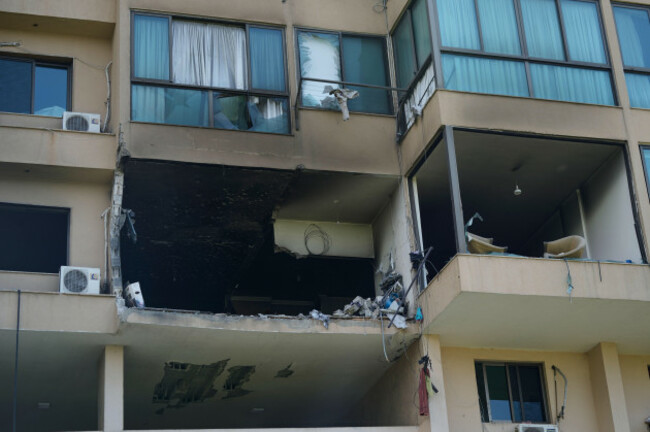
a-residential-apartment-damaged-in-an-israeli-airstrike-is-seen-in-bchamoun-about-10-kilometers-6-miles-southeast-of-beirut-lebanon-tuesday-march-24-2026-ap-photobilal-hussein A residential apartment damaged in an Israeli airstrike is seen in Bchamoun, about 10 kilometers southeast of Beirut. Alamy Live News. Alamy Live News.

AFP images showed rubble-strewn streets and the side of a three-storey building in Israel’s commercial hub in ruins, as first responders scrambled to assist at least four people lightly injured at four different locations.

Earlier, Iranian media reported US-Israeli warplanes had struck two gas facilities and a pipeline, hours after Trump stepped back from his threat to attack energy sites, citing negotiations to end the war.

Gulf nations Bahrain, Kuwait, the United Arab Emirates and Saudi Arabia said they intercepted renewed drone and missile attacks today. 

Israel meanwhile said its military would take control of south Lebanon up to the Litani river, around 30 kilometres from the border.

Israeli pounded Beirut’s southern suburbs throughout the night while a strike on Bshamoun, south of the capital, killed two people today, according to Lebanon’s health ministry.

“There’s nothing left. It’s all burned or destroyed… No walls, the windows are gone, the facade is gone, all my hard work has been lost,” said Abbas Qassem, 55 from Bshamoun, weeping at the damage to his flat.

In Beirut, AFP images showed smoke billowing from gutted buildings, as rescuers picked through the rubble and twisted metal.

Lebanon was pulled into the Middle East war when Hezbollah began firing rockets into Israel on 2 March to avenge the killing of Iran’s supreme leader Ayatollah Ali Khamenei.

Israel’s attacks in Lebanon have killed more than 1,000 people, according to Lebanon’s health ministry, and displaced more than a million people.

At least 3,268 people have been killed in Iran since the war began, according to US-based Human Rights Activists News Agency (HRANA).

This includes 1,443 civilians – among them at least 217 children – as well as 1,167 military personnel and 658 people whose status had not been classified.

Due to reporting restrictions, AFP is not able to access the sites of strikes nor to independently verify tolls in Iran.

Israeli emergency services and authorities say attacks have killed 16 civilians on the Israeli side since the start of the war.

© AFP 2026 

Close
JournalTv
News in 60 seconds