We need your help now

Support from readers like you keeps The Journal open.

You are visiting us because we have something you value. Independent, unbiased news that tells the truth. Advertising revenue goes some way to support our mission, but this year it has not been enough.

If you've seen value in our reporting, please contribute what you can, so we can continue to produce accurate and meaningful journalism. For everyone who needs it.

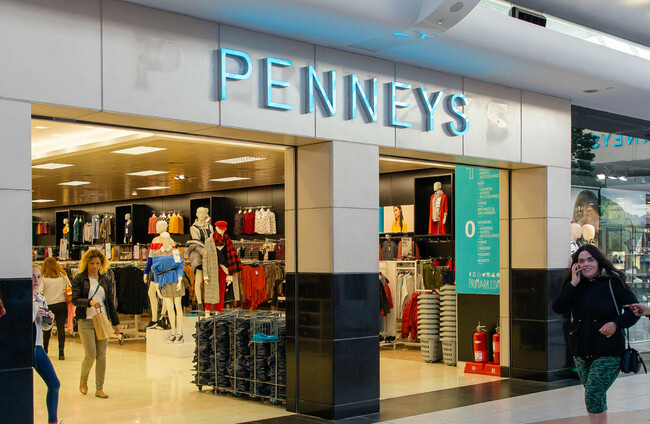
A Penneys store in Balnchardstown Shopping Centre. Alamy Stock Photo

With Penneys struggling to grow, why is its parent company thinking of separating it?

Despite delivering most of the group’s profits, the fast-fashion giant no longer fits neatly inside its food-focused parent.

PENNEYS IS ONE of Ireland’s biggest-ever business success stories.

Starting as a single shop in Dublin in 1969, in just a few short decades the company would go on to become a global juggernaut, with hundreds of stores across Europe, North America…

Stop me if you’ve heard this one before. Most people are well aware of how successful Penneys is. And it has achieved all of this while operating as part of Associated British Foods (ABF).

Penneys was built in Ireland, and has its headquarters in Dublin. But it has been owned by ABF from the start – the company financed the first Penneys store on Mary Street.

Penneys now pulls in well over €1 billion in operating profits per year, and is ABF’s single largest division.

Given all that – why is ABF considering separating it from the core group?

The London-based company recently told investors it is looking at ‘spinning out’ Penneys – known internationally as ‘Primark’ (sorry, we’ll be using ‘Primark’ from now on for simplicity. As it’s what ABF and everyone outside Ireland calls the firm).

“The Board of ABF has been conducting a review of the group structure. The outcome may lead to the Board deciding to undertake a separation of the Primark and Food businesses,” it said.

For those unfamiliar with the corporate lingo – ‘spinning out’ is when a large business creates a new, separate company from one of its existing divisions.

So ‘spinning out’ Primark would mean it would become its own company.

ABF’s owners would still be the ultimate owners of both what’s left of ABF, and a new, standalone Primark.

Obvious question then – why?

Primark takes in plenty of money. In ABF’s 2025 financial year, total group sales came in at £19.5 billion (€22.5 billion).

Primark accounted for £9.5 billion of this – so about half of total revenue.

It is also the most profitable part of the company. ABF made operating profits of £1.7 billion in 2025. Primark was responsible for £1.1 billion of that – so about two-thirds of total operating profits.

Why would ABF want to spin off its most profitable division?

Short answer – which is almost always the answer to a business-related question – is they think they could make more money.

Primark’s odd position

For years, Primark has always sat slightly awkwardly within ABF. The clue is in the name – Associated British Foods.

Besides Primark, the company is almost entirely focused on food. And not even retail – most of the group’s operations centre around production.

Primark is the only part of the company which does not overlap with this in some way.

Many analysts suspect that this slightly odd structure has led to investors undervaluing both Primark and ABF’s food business.

One said that the group “was valued at a 11% conglomerate discount to peers”.

That means they think the two businesses separated would be worth at least 11% more than ABF’s current valuation.

And it’s worth noting – all this is happening at a time when Primark is showing some vulnerability.

Covid aside, the last decade or so was a period of strong growth for the business. It roughly doubled revenue, and also doubled its number of stores to almost 500.

But Primark has finally hit a blip. It is struggling to grow.

The warning signs were there in its 2025 results. While it recorded £9.5 billion in revenue, this was only a 1% increase compared to the year before.

Then last week, ABF warned that its 2026 profits would likely come in below 2025. A contributor to this was that sales at Primark dropped by 2.7% in the 16 weeks to January.

Its US operations are performing well, with sales up by 4%. But revenue dropped by almost 6% across continental Europe. Irish sales also fell slightly, although by how much is unclear, as the figures are lumped in with the UK.

ABF didn’t detail why exactly there has been a fall off, although plenty of analysts have speculated.

One of the most common guesses is that consumers are feeling the pinch. With Primark specialising in affordability, it is more at risk of falling off if people have to cut back on non-essential spending.

The other is that competition in the market has heated up. Primark used to be the go-to for getting decent clothes at extremely low prices.

But in the last few years, online retailers specialising in fast fashion – such as Shein and Temu – have muscled in on its turf.

Primark is still on course to make another £1 billion or so in operating profits in 2026. So, still plenty of money. But the worry now is that, much like Alexander the Great, it has no more worlds to conquer.

Davy Stockbrokers puts it in a more straightforward manner: “[Primark’s] growth model continues to generate limited traction.”

It also thinks that, rather than a temporary blip, this could be a long term issue.

“We see limited near-term catalysts for recovery, with earnings momentum likely to remain challenged as growth pressures appear increasingly structural.”

ABF outlook

This is all pretty gloomy for ABF, which is struggling as a whole. Its share price dropped by about 12% in the wake of the profit warning. Which is part of a longer trend – its stock currently trades at around half its peak of £36 per share in 2015.

Anyone who has bought (and held) shares since then is down – a long time to be in the red. Which means it’s unsurprising that the owners are anxious to boost valuations.

The stock price trend also does show some of the logic for why ABF is considering spinning out Primark. The business has performed excellently during the last 10 years, but that hasn’t boosted ABF’s stock.

It’s then understandable that its owners might think that Primark could shine more on its own.

But all of the concerns over growth makes the timing of the spin out considerations a bit suspect.

If the point of the move is to get more investors interested, why do it right as they’re being spooked by profit warnings and growth concerns?

From an Irish point of view, all of these corporate shenanigans are unlikely to make a major difference in how Penneys stores run on a day-to-day basis. At least, not right away.

But with close scrutiny on Primark’s growth, and with a possible overhaul in its group structure in sight, there could be increased pressure to change things up. Watch this space.

Readers like you are keeping these stories free for everyone...
A mix of advertising and supporting contributions helps keep paywalls away from valuable information like this article. Over 5,000 readers like you have already stepped up and support us with a monthly payment or a once-off donation.

Close
29 Comments
This is YOUR comments community. Stay civil, stay constructive, stay on topic. Please familiarise yourself with our comments policy here before taking part.
Leave a Comment
    Submit a report
    Please help us understand how this comment violates our community guidelines.
    Thank you for the feedback
    Your feedback has been sent to our team for review.

    Leave a commentcancel

     
    JournalTv
    News in 60 seconds