Sign in. It’s quick, free and it’s up to you.
An account is an optional way to support the work we do. Find out more.
Sign in. It’s quick, free and it’s up to you.
An account is an optional way to support the work we do. Find out more.

A LEADING PROVIDER of data centres in Ireland has successfully challenged the decision of South Dublin County Council to refuse it planning permission for two new centres at its campus in west Dublin.
An Coimisiún Pleanála has upheld the appeal taken by EdgeConneX Ireland against the council’s ruling in July 2023 to reject its planning application to construct two adjoining single storey data centres covering an area of over 15,000 metres squared on a site at Ballymakaily, Lucan, Co Dublin.
The plans also provided for 24 standby diesel generators with associated 25-metre-high flues in a yard to the west of the data centres as well as a new internal access road and security gates.
However, the Commission imposed a planning condition that the standby generators have to be powered by a renewable fuel source.
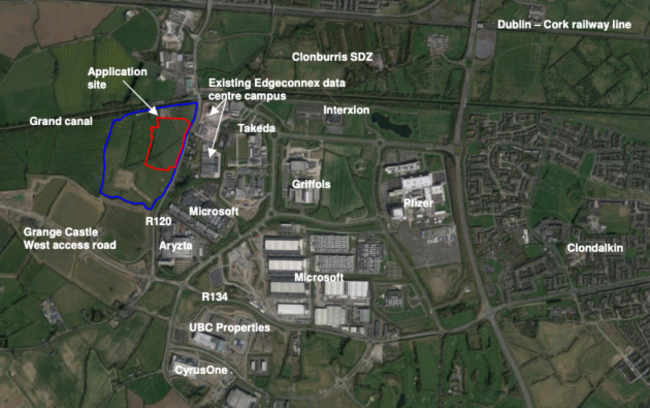
South Dublin County Council had refused planning permission for the development on the basis that it had failed to demonstrate that the proposed use was acceptable for lands zoned to provide for enterprise and employment given the lack of a fixed connection agreement to the grid and a lack of significant on-site renewable energy.
In reaching its decision, the council said it also had regard to the existing insufficient capacity in the national grid as well as the applicant’s reliance on gas powered plant to provide energy for the data centres and an absence of power purchase agreements (PPAs).
It also rejected EdgeConneX Ireland’s application on a separate ground in relation to the retention and protection of existing green infrastructure.
Council planners said the county development plan placed a key emphasis on the requirement for data centres within its administrative area to be sustainable and for applicants to show there was sufficient capacity within the electricity network to accommodate them.
Elected representatives of South Dublin County Council had imposed a total ban on the development of new data centres but a ministerial directive issued in August 2022 reversed the controversial measure.
In its appeal, EdgeConneX Ireland accused the local authority of adopting “an unduly rigid approach” to its county development plan.
The company claimed the council’s decision on its planning application was “inherently flawed” and its concerns were “unfounded.”
EdgeConneX Ireland said that it was not within the remit of South Dublin County Council to determine whether there was sufficient capacity on the national grid.
Nevertheless, it confirmed that it had obtained a connection agreement with EirGrid who had developed policy criteria which applicants had to satisfy and which were largely designed to take into account capacity constraints on the grid.
EdgeConneX Ireland argued that the council should be satisfied that EirGrid, as the appropriate authority on the national grid, had determined that its data centre campus can connect to the grid.

It pointed out that the overall on-site dispatchable energy generation capacity on the campus was already established under a previous planning application and should not have to be reconsidered.
The company said it had sought to maximise the use of renewables through the design and future proofing of the power plant on the campus so that it had capacity to accept biogas and hydrogen when they become available.
It also argued that having gas as the primary fuel of the power plants played its part in decarbonising the national grid – which it claimed had been acknowledged in the Government’s Climate Action Plan.
EdgeConneX Ireland said it had also provided “robust evidence” of engagement with PPAs in Ireland.
The company said having an onsite generation plant that was predominantly powered by natural gas should not be a ground for refusal of itself.
In addition, it stressed that its power plant would reinforce the national grid once the EirGrid connection was realised.
The company accepted that some 760 metres of hedgerow would be removed as part of the project but stressed that over 1,300 metres of hedgerow would be retained and a further 1,052 metres of new hedgerow was being proposed which would result in “a net biodiversity and ecological gain”.
Subject to compliance with a number of planning conditions, An Coimisiún Pleanála said it was satisfied that EdgeConneX Ireland had a fixed connection agreement to connect to the grid and that the data centres were not an “islanded” development which was dependent solely on onsite energy generation.
The Commission said it was also satisfied that the company had incorporated strong energy efficiency measures to reduce its carbon footprint and had demonstrated engagement with PPAs as well as that there was sufficient capacity with the relevant water, wastewater and electricity network to accommodate the proposed use.
It accepted that EdgeConneX Ireland had sought to protect and enhance the biodiversity and ecological value of the existing green infrastructure network where possible.
The Commission also ruled that it would not seriously injure the residential or visual amenities of the area and would be acceptable in terms of the safety and convenience of pedestrians and other road users as well as not being prejudicial to public health.
The planning appeals authority said it was also satisfied that various mitigation measures proposed by the company would ensure that the development would not have any unacceptable direct, indirect or cumulative effects on the environment.
The Commission noted that data centres had been identified as core infrastructure and enablers of a technology-rich innovative economy and of significant importance from a national and international perspective in the Government Statement on the Role of Data Centres in Ireland’s Enterprise Strategy published in July 2022.
It accepted that EdgeConneX Ireland had demonstrated that the proposed data centres would be in accordance with the twin transitions of “digitisation and decarbonisation” as well as the principles outlined in the Government Statement.
One of the planning conditions is that the company enters into a corporate PPA with a renewable energy provider for the proposed data centres before they become operational.
EdgeConnex Ireland is also required to provide a draft agreement that it would be willing to connect to a future district heating network if one becomes available.
To embed this post, copy the code below on your site















have your say