We need your help now

Support from readers like you keeps The Journal open.

You are visiting us because we have something you value. Independent, unbiased news that tells the truth. Advertising revenue goes some way to support our mission, but this year it has not been enough.

If you've seen value in our reporting, please contribute what you can, so we can continue to produce accurate and meaningful journalism. For everyone who needs it.

Shutterstock

'Potentially challenging situation' in meeting Ireland's electricity demand

Since 2016, EirGrid has warned of an increasing tightness between supply and demand.

THE OPERATOR OF the national grid has warned of “a potentially challenging situation” in meeting electricity demand between 2026 and 2028.

Since 2016, EirGrid has warned of an increasing tightness between supply and demand.

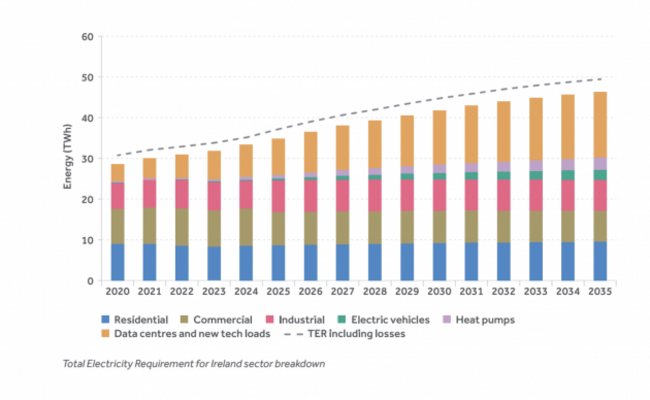
In it’s latest analysis of electricity demand and supply in Ireland over 10 years, the grid operator found that additional capacity is required to meet Ireland’s electricity demands between 2026 and 2028.

The state body said the connection of data centres and other new technology loads is a “key driver” for electricity demand over the next few years.

It predicts that from 2030 electricity demand will continue to increase, followed by a “slower but sustained growth” until 2035.

Screenshot 2026-02-26 at 07.36.15 Total Electricity Requirement for Ireland sector breakdown EirGrid EirGrid

EirGrid said Ireland will have to find new ways to meet the need for energy without relying on burning fossil fuels. 

Marc Senouci, Head of Power System Insights and Research Design Authority at EirGrid, said: “The electricity industry will need to identify new ways to meet growing demand for energy.”

“As the landscape of demand and generation supply changes, and as electricity demand increases, government policy will help guide the transition, but a coordinated effort to manage both the volume and type of new capacity will be needed.”

“In addition, it’s crucial that the capacity market delivers new capacity efficiently, and the type and volume of capacity needed to underpin the energy transition.”

Readers like you are keeping these stories free for everyone...
A mix of advertising and supporting contributions helps keep paywalls away from valuable information like this article. Over 5,000 readers like you have already stepped up and support us with a monthly payment or a once-off donation.

View 17 comments
Close
17 Comments
This is YOUR comments community. Stay civil, stay constructive, stay on topic. Please familiarise yourself with our comments policy here before taking part.
Leave a Comment
    Submit a report
    Please help us understand how this comment violates our community guidelines.
    Thank you for the feedback
    Your feedback has been sent to our team for review.

    Leave a commentcancel

     
    JournalTv
    News in 60 seconds