Sign in. It’s quick, free and it’s up to you.
An account is an optional way to support the work we do. Find out more.
Sign in. It’s quick, free and it’s up to you.
An account is an optional way to support the work we do. Find out more.

THE STATE THINK tank has found that short absences in teenagers aged 13 can have an effect on Leaving Certificate performance.
The Economic and Social Research Institute (ESRI) said that absences between one to three days impacts performance, while those with chronic absence levels (over 20 days) score 124 points lower than students with absences.
In its latest report, which analysed the long-term impacts of school absences, the ESRI found that school absenteeism can impact educational outcomes, health, wellbeing and social connectedness.
It found that as absences are an important driver of later inequality, absences must be addressed with “urgency”, especially given the higher levels since the pandemic.
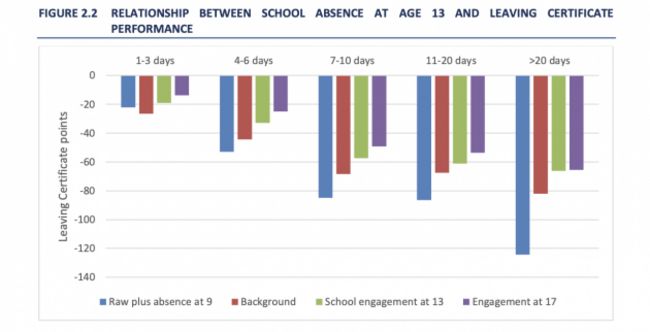
The report said that the gap in educational outcomes associated with absenteeism is present across all social groups, with no evidence that more advantaged families can buffer the impacts for their children.
The researchers also found that young people who attend a school with higher levels of chronic absence achieve lower Leaving Certificate points, even if they have good attendance themselves.
This risk was found to be greater for students from migrant backgrounds, which the ESRI suggested may be because they are more reliant on school-based resources given that their parents may be less familiar with the Irish education system.
School absence was also associated with greater disengagement from school and poorer-quality relationships with teachers.
The think tank noted that although educational attainment and employment outcomes are “strongly linked” in Ireland, the relationship between school absence and labour market outcomes is modest.
There are no differences in labour market status at age 25 related to absence level, but young adults with longer absences are more likely to have spent time unemployed or on home duties.
Prolonged absence is found to impact wellbeing and social connectedness.
Chronic absence at ages nine and 13 can cause depressive symptoms and higher stress levels at 20 and 25 years, while life satisfaction at 20 and 25 years of age is much lower among those who were persistently absent at age 13.
Even those with moderate levels of absence, between four to six days, were found to have much lower levels of general trust in others.
The ESRI recommends establishing clear messaging to parents about the value of attendance.
It said there should be tiered supports available to address specific drivers of absence, school supports to address learning loss and foster social integration among students who have been absent, and broader support for families and communities.

To embed this post, copy the code below on your site













have your say