Sign in. It’s quick, free and it’s up to you.
An account is an optional way to support the work we do. Find out more.
Sign in. It’s quick, free and it’s up to you.
An account is an optional way to support the work we do. Find out more.
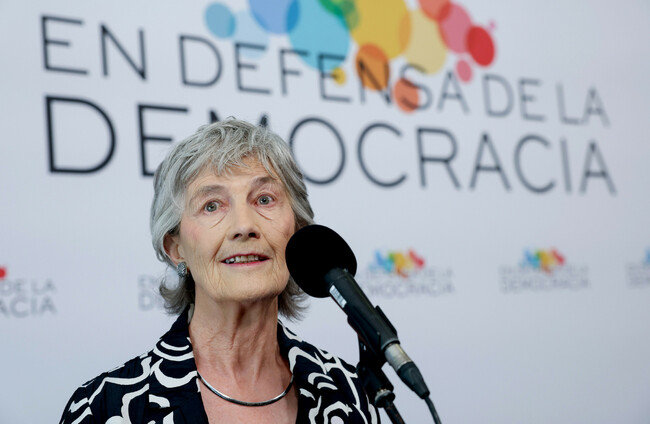
PRESIDENT CATHERINE CONNOLLY has said “all voices have to be heard” in a in relation to the recent fuel protests which shut down the country.
Speaking to reporters in Barcelona ahead of a summit of several left-leaning world leaders, Connolly said the issue was ultimately one for political leaders to address.
“I think that’s a matter for the politicians in Ireland to look at,” Connolly said.
Following five days of fuel protests last week which saw thousands gathering across the the country, protests across a number of major roads and the temporary blockade of Whitegate oil refinery in Cork, the government survived a vote of no confidence earlier this week but lost the support of two independent TDs.
Asked if she had any sympathy for the protesters and their reasons for protesting, Connolly added: “It’s always very important to listen to people”.
“Obviously, in a democratic state, wherever that state is, all voices have to be heard.”
“That’s why we’re here in Barcelona today, we’re talking about democracy, the title of the summit is in Defence of Democracy, and that title tells you where we’re at.”
She added that she believes democracy is “at risk”.
“We have to ask ourselves, how could we get to this point that we need a conference in defence of democracy?”
Connolly also addressed her decision to convene a meeting of the Council of State for the first time in her tenure to consider the International Protection Bill 2026, adding that “there are issues in relation” to the bill.
“As you know, I called the Council of State, and that’s my prerogative to do that,” Connolly told reporters.
The Bill, which was passed by the Oireachtas this week, aims to reform the country’s asylum system in line with the EU Migration and Asylum Pact, but has been criticised by the Irish Human Rights and Equality Commission over a number of provisions.
Among the points of concern are new powers to detain applicants in order to establish elements of their claims, the absence of legal advice and representation at first instance, and amendments to family reunification.
Speaking earlier this week, Justice Minister Jim O’Callaghan described the legislation as “the most significant reform of Irish asylum laws in the history of the State”.
Connolly announced on Thursday that she would be convening the Council of State to discuss the bill.
The Council is an advisory body that helps the President decide whether to exercise their constitutional power to refer a bill to the Supreme Court to test its constitutionality.
“I look forward to getting the advice of all members of the Council of State. We’re talking about a bill that’s very, very significant,” Connolly said.
“I will gladly listen to their advice and listen to their opinions,” Connolly added.
Connolly said the move reflected the seriousness of the legislation, which is due to be discussed at a meeting on Monday.
“I think when the President calls the Council of State, it’s because there are issues in relation to it, and that’s why we have a Council of State, to look at that, and we do that on Monday.”

To embed this post, copy the code below on your site














have your say