We need your help now

Support from readers like you keeps The Journal open.

You are visiting us because we have something you value. Independent, unbiased news that tells the truth. Advertising revenue goes some way to support our mission, but this year it has not been enough.

If you've seen value in our reporting, please contribute what you can, so we can continue to produce accurate and meaningful journalism. For everyone who needs it.

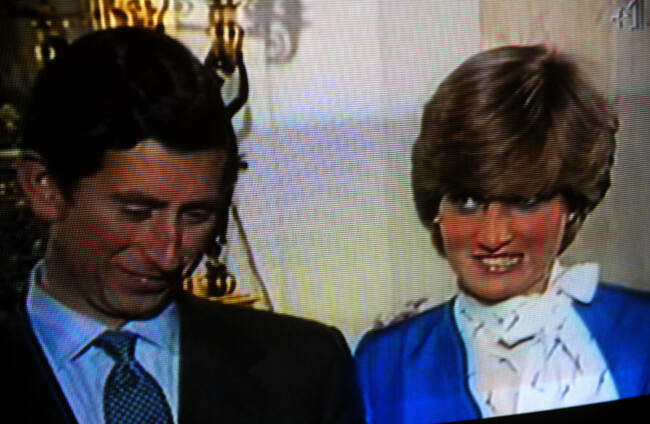
Princess Diana and Prince Charles together on a News Broadcast shortly after their marriage in 1981. Alamy Stock Photo

Prince Charles's team told Irish officials that Diana might fancy 'upstaging' him by visiting Ireland

State Papers from 30 years ago detailed the behind-the-scenes chat about Charles’ visit here.

THIRTY YEARS AGO, Irish officials were musing about a possible visit to Ireland by Diana, Princess of Wales after a close advisor to Prince Charles suggested that Diana’s team may wish to “upstage” a similar trip by her estranged husband. 

The May 1995 visit by Charles was the first official visit to the Republic of Ireland by a member of the British royal family since independence and was seen as a success, even if it was critiqued by elements of the British media as “all rather worthy but boring”. 

Behind-the-scenes reflections on the two-day visit are contained in confidential documents circulated at the time by officials from the Department of Foreign Affairs. 

Secret government documents are released annually under the 30-year rule and sent to the National Archives, providing journalists and historians with a fresh glimpse into historical events.

The files for 1995 contain a range of revelations from a turbulent time in Irish history, which includes the negotiations post the Provisional IRA ceasefire and the Divorce Referendum of that year. 

It also coincides with a period in which the British monarchy was in turmoil following the separation of Charles, the current monarch, and his former wife, the late Diana Spencer. 

The pair had separated in 1992 but the period before their divorce in 1996 was characterised by much public debate and press briefings about their relationship, culminating in Diana’s infamous Panorama interview with Martin Bashir in November 1995, and what it meant for the monarchy. 

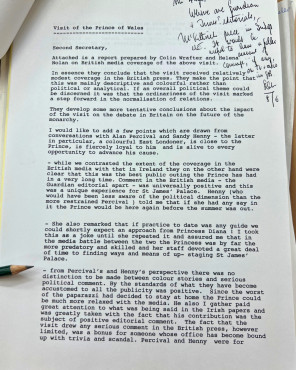
Indeed, in one document written by DFA officials Colin Wrafter and Helena Nolan which analyses the British press coverage of the event, the authors note that there is “an ongoing debate, at least in some establishment circles in Britain, on the future of the Monarchy”. 


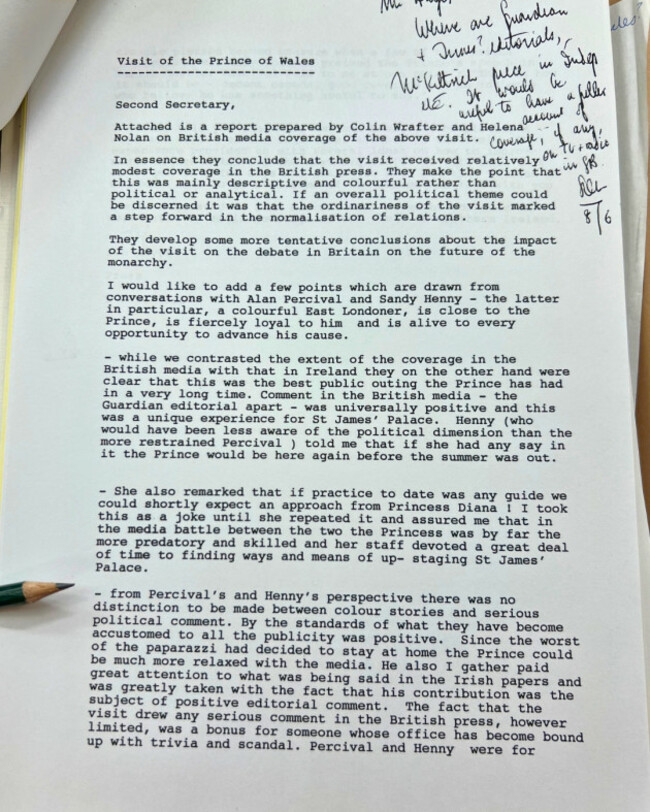
Document titled 'Visit of the Prince of Wales' Document titled 'Visit of the Prince of Wales' National Archives National Archives


(Click here to view a larger version of this image)

The document is based on observations by Irish diplomatic officials but also on conversations with Prince Charles’s team based in St. James’s Palace following the visit to Ireland. 

The documents report that Charles’s camp saw coverage of the visit to Ireland “as part of a long-term public relations strategy to rehabilitate the Prince in the eyes of the British public.”

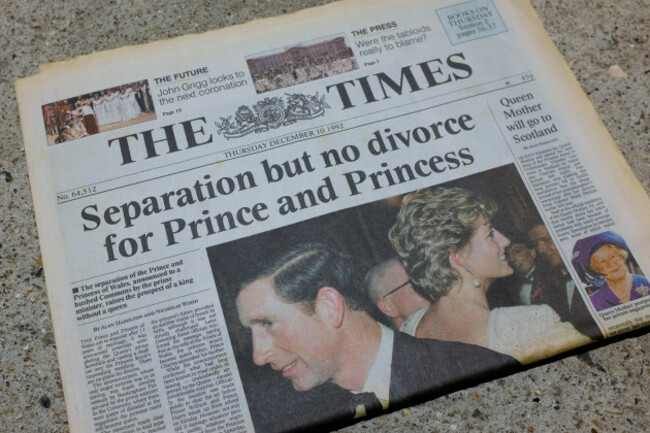
a-report-by-the-times-on-10th-december-1992-on-the-separation-of-prince-charles-and-princess-diana A report by The Times on 10th December, 1992. Alamy Stock Photo Alamy Stock Photo

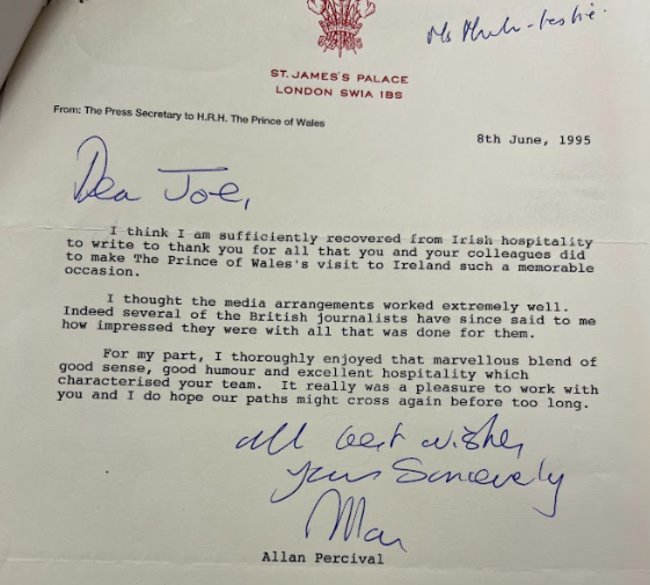
Charles’s press team, led by press secretary Alan Percival and his successor Sandy Henney, had reported to Irish officials that they felt the visit to Ireland was “the best public outing the Prince has had in a very long time”. 

In another document, signed by the DFA’s Joe Hayes, Henney is described as being “a colourful East Londoner” who is “close to the Prince, fiercely loyal to him and alive to every opportunity to advance his cause.” 

It is in the context in which Henney reportedly suggested that Diana might like to pay Ireland a visit in response to the one undertaken by her former husband.   

“Henney (who would have been less aware of the political dimension than the more restrained Percival) told me that if she had any say in it the Prince would be here again before the summer was out,” according to the document. 

“She also remarked that if practice to date was any guide we could shortly expect an approach from Princess Diana!”

Hayes added: “I took this as a joke until she repeated it and assured me that in the media battle between the two, the Princess was by far the more predatory and skilled and her staff devoted a great deal of time to finding ways and means of upstaging St James’ Palace.”

It was noted by officials on both sides of the Irish Sea that, in contrast with the blanket coverage in Ireland, the coverage of the visit in the UK was “though positive, relatively light” in tone.

Percival, Charles’s press secretary, had “expressed surprise at the paucity of interest in the British media”.

Part of this was due to “a technical problem at the BBC on the evening of the Prince’s arrival” but it was also due to the wider context of how the monarchy was perceived at the time. 

PastedImage-63110 National Archives National Archives

While in Ireland there was an important political context to Charles’s being hosted at Dublin Castle, the documents show that this was less important British media, who viewed it as lighter news.

“From Percival’s and Henney’s perspective, there was no distinction to be made between colour stories and serious political comment,” Irish officials reported, adding that Charles’s team saw light press coverage as preferable to bad press. 

By the standards of what they have become accustomed to, all the publicity was positive. Since the worst of the paparazzi had decided to stay at home the Prince could be much more relaxed with the media.

Despite the visit being viewed in the UK as being relatively non-political, the “ordinariness” of the trip is described as being “a step forward in the process of normalisation of relations between Ireland and Britain.” 

John Taylor / YouTube

Elsewhere in the documents, there is significant detail about the planning for a banquet held in Dublin Castle for Prince Charles hosted by Taoiseach John Bruton and his wife Finola Bruton. 

During the banquet, Bruton raised a toast to: “Her Majesty Queen Elizabeth and the friendship between our two peoples and countries.”

Bruton is often mis-quoted as saying during the banquet that Charles’s visit was the “best day of my life”, instead he had spoken about the significance of the visit, saying: 

“Your courage, your innovation and your initiative in coming here has done more in symbolic and psychological terms to sweep away the legacy of fear and suspicion that has lain between our two peoples than any other event in my lifetime.”

[National Archives document reference number: 2025/124/160]

Readers like you are keeping these stories free for everyone...
A mix of advertising and supporting contributions helps keep paywalls away from valuable information like this article. Over 5,000 readers like you have already stepped up and support us with a monthly payment or a once-off donation.

Close
12 Comments
This is YOUR comments community. Stay civil, stay constructive, stay on topic. Please familiarise yourself with our comments policy here before taking part.
Leave a Comment
    Submit a report
    Please help us understand how this comment violates our community guidelines.
    Thank you for the feedback
    Your feedback has been sent to our team for review.

    Leave a commentcancel

     
    JournalTv
    News in 60 seconds