We need your help now

Support from readers like you keeps The Journal open.

You are visiting us because we have something you value. Independent, unbiased news that tells the truth. Advertising revenue goes some way to support our mission, but this year it has not been enough.

If you've seen value in our reporting, please contribute what you can, so we can continue to produce accurate and meaningful journalism. For everyone who needs it.

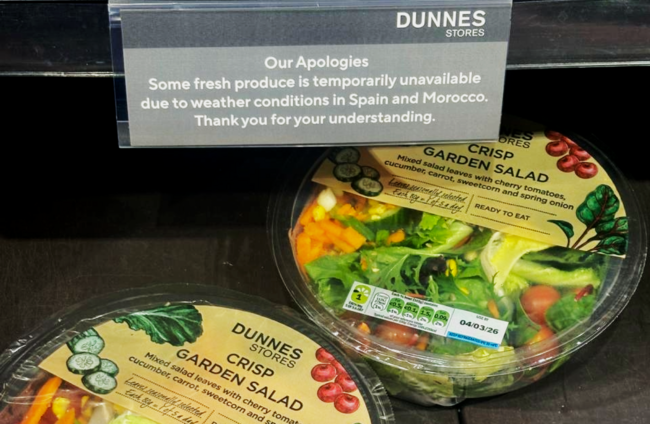
Sign in Dunnes Stores earlier this week apologising for a lack of fresh produce The Journal

Fresh produce shortages after torrential rain in Spain and Morocco could soon push up prices

While overall inflation might not increase by much, the price of much of the food we import could.

FRESH PRODUCE SHORTAGES following torrential downpours across Spain, Portugal and Morocco could push up the cost of food we import from these regions in the coming weeks.

Nine storms unleashed torrential rain and hurricane-force winds across the three countries from 16 January to 17 February, killing more than 50 people and forcing over 200,000 to flee their homes, mostly in Morocco.

Grazalema, one of the hardest-hit municipalities in southern Spain, saw more than a full year’s expected rainfall in just a few days.

This week, some branches of Dunnes Stores had signs apologising to customers that “some fresh produce is temporarily unavailable due to weather conditions in Spain and Morocco”.

Damian O’Reilly is a senior lecturer in the School of Business Technology, Retail and Supply Chain at Technological University Dublin.

He noted that the torrential rain has damaged a lot of crops across Europe and north Africa and added that it’s “going to put prices at risk for the coming months”.

For example, Andalucia in Spain produces a lot of citrus fruits and avocados, but O’Reilly said this region “lost 20-30% of their production” as a result of the heavy rains.

“Down the line, you could see prices of these items we import coming under pressure because of the rainfall and the extra cost associated with maintaining and trying to produce the crops.”

O’Reilly added that consumers could see an “impact on quality, quantity and price”.

“There’s less quantity, the quality is not as good because the products may be saturated and it doesn’t grow properly, and then it doesn’t travel or store as well,” said O’Reilly.

“That will cause extra cost and waste and push up the price of these items we import in the future.”

O’Reily also noted that any changes to the supply chain have a “magnitude effect”.

“Something small that happens within the supply chain becomes a big deal because tomatoes, cucumbers, avocados, peppers, these are things we can’t produce here without an extra cost or artificially.

“The wet weather on the continent means those supply chains become more fragile and that’s going to push prices up.”

While O’Reilly noted that he doesn’t foresee this having a significant impact on overall price inflation, he said it could “certainly” result in a “significant increase” in certain fresh produce that is imported.

“Some items are going to be affected more than others,” he added, “such as tomatoes, cucumbers, avocados, apples, citrus fruits because of the damage to crops.”

He said such price hikes however “won’t kick in for several months until the impacts of supply and demand kick in”.

“The price is going to go up if demand stays the same while supply comes down.”

Meanwhile, O’Reilly called on consumers to shop local as much as possible but acknowledged that many people are struggling financially.

The CSO for example found that in 2025, 45% of households said they had at least “some difficulty in making ends meet”.

“Food is a precious commodity that we treat like an everyday commodity,” said O’Reilly, “and we’re worried more about price than the quality and the provenance of the product.

“I think we should be more concerned with the provenance of the product.

“We haven’t put money into the horticulture sector in 30 years and we can’t grow it ourselves unless we’re willing to pay the extra money.

“You should buy as much Irish produce as you can so you can keep the local producers in business.

“But many people are under tight constraints financially and because of that, they’re going to buy the cheaper product, and the cheaper product is usually not local.”

Readers like you are keeping these stories free for everyone...
A mix of advertising and supporting contributions helps keep paywalls away from valuable information like this article. Over 5,000 readers like you have already stepped up and support us with a monthly payment or a once-off donation.

Close
22 Comments
This is YOUR comments community. Stay civil, stay constructive, stay on topic. Please familiarise yourself with our comments policy here before taking part.
Leave a Comment
    Submit a report
    Please help us understand how this comment violates our community guidelines.
    Thank you for the feedback
    Your feedback has been sent to our team for review.

    Leave a commentcancel

     
    JournalTv
    News in 60 seconds