We need your help now

Support from readers like you keeps The Journal open.

You are visiting us because we have something you value. Independent, unbiased news that tells the truth. Advertising revenue goes some way to support our mission, but this year it has not been enough.

If you've seen value in our reporting, please contribute what you can, so we can continue to produce accurate and meaningful journalism. For everyone who needs it.

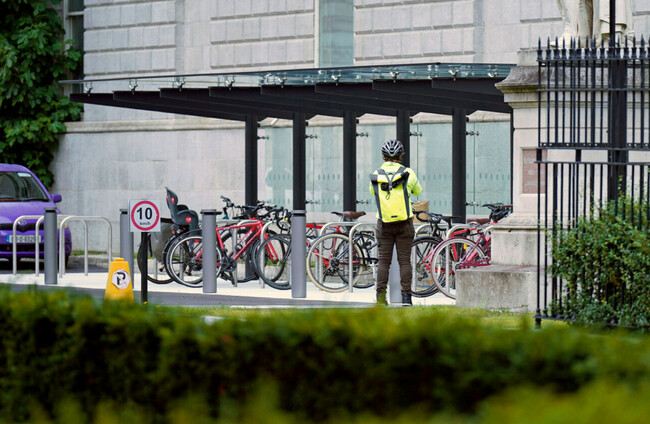
The OPW spent €335,000 on a bike shed at Leinster House last year. Alamy Stock Photo

Opinion Those outraged by a €100k bike shed should look at the annual cost of renting out car park spaces

We have completely normalised investment in congestion, pollution and the continuation of car-first planning, writes Ciarán Cannon.

WHEN IS €100,000 a national scandal? Apparently, when it’s spent on a bike shed.

This week in the Dáil, Sinn Féin leader Mary Lou McDonald accused the Government of “bike shed groundhog day” because €100,000 may be spent on secure bike parking at the National Maternity Hospital. Her outrage was echoed by others. A hundred grand for somewhere to lock a bicycle? Unthinkable.

Except, it isn’t. The real scandal is that a €100,000 investment in cycling is being painted as reckless, while far larger subsidies for cars pass without a whisper. The Office of Public Works spends around €1.2 million every year leasing car parking spaces for civil servants. In central Dublin, dozens of spaces for the Revenue Commissioners cost over €100,000 annually. Parking for Leinster House itself runs to a similar figure each year. These are recurring bills, quietly signed off without any outrage. Yet a once-off €100,000 for secure bike storage for hospital staff and patients is treated as if it were a national disgrace.

That’s the hypocrisy: €100k once-off for secure, dry storage for nurses, doctors, and patients’ families is a scandal. But €1.2 million every single year to prop up car dependency is just “the way things are.” We have completely normalised investment in congestion, pollution and the continuation of car-first planning.

Basic infrastructure

As soon as the word “bicycle” is mentioned in Irish politics, too many hear not the voices of staff or patients, but the imagined cheering of keyboard warriors. That’s pathetic populism. Waving the price tag of bike storage as if it were an outrageous indulgence is short-sighted and disrespectful to the thousands who already face hostile roads, poor infrastructure and real risks just to get to and from work.

The people who actually cycle to work are not abstract figures in a culture war. They are teachers, carers, retail workers and hospital staff. They cycle for reasons of convenience, cost, health, necessity or simple enjoyment. In Dublin and its suburbs alone, more than 61,000 people cycle to work or education every day. You’d never know they exist from the way politics treats cycling, as if secure storage were some grotesque luxury. For those tens of thousands of commuters, it is simply basic infrastructure that makes daily life easier and safer. Reducing this to a punchline in the Dáil does a disservice to their reality.

There is also an enormous economic cost to ignoring cycling. In 2023, the Department of Transport estimated that congestion in Dublin City costs us €336 million annually, and that figure is projected to rise to €1.5 billion by 2040, without decisive intervention. Every bike on the road is part of the solution to this problem.

The health outcomes of cycling are equally powerful. Regular active travel reduces the risk of cardiovascular disease, cancer, obesity, diabetes and depression. Public health studies consistently show that cycling brings net health benefits, even in cities with poor infrastructure. In a health system already under immense pressure, it is truly astonishing that politicians would belittle small, sensible investments that reduce demand on hospitals in the long-term.

Sustainability

Transport is Ireland’s second-largest source of emissions, responsible for over 21% of national greenhouse gases and almost 30% of public-sector emissions. And emissions aren’t falling. The EPA has warned bluntly: “Incremental efficiency is not sufficient, we need a sustainable mobility transformation.” These aren’t abstract words. Ireland has a legally binding duty to halve emissions by 2030 and reach net zero by 2050. Every hospital and government department must play its part in this endeavour. Mocking bike sheds isn’t just cheap politics: it’s undermining the State’s own climate obligations.

The HSE recognises this clearly. Its Sustainable Transport Framework is explicit: “The health sector has a part to play in advocating for sustainable transport – public transport, walking and cycling.” It also recommends a “shift from car transport to active travel, such as walking and cycling.” Hospitals and healthcare campuses are supposed to become sustainable transport hubs, supporting patients, staff, and visitors in moving away from cars. Secure cycle storage is not a luxury add-on. It’s a core part of health, equity, and climate resilience.

The National Maternity Hospital is one of the busiest healthcare facilities in the country. Staff work long and demanding shifts. Patients and their families face stress and expense every day. Cycling offers many of them a simple, affordable way to get to and from the hospital while reducing congestion, easing parking demand and improving health. Secure, weather-protected storage means staff can finish their shift without worrying that their bike will be gone, stripped for parts or drenched by rain. That matters to people’s lives in ways most politicians don’t really understand.

The real scandal here is not “bike shed groundhog day.” It’s the groundhog day of car dependency, subsidised at vast public expense, locking us into congestion, pollution, poor health and missed climate targets.

The next time our politicians stand up in the Dáil to debate investment in national infrastructure, they might resist the easy temptation of populism, and speak as if they truly understand the realities and challenges of 2025.

Ciaran Cannon is President of Cycling Ireland and a former minister of state.

Readers like you are keeping these stories free for everyone...
A mix of advertising and supporting contributions helps keep paywalls away from valuable information like this article. Over 5,000 readers like you have already stepped up and support us with a monthly payment or a once-off donation.

Close
83 Comments
This is YOUR comments community. Stay civil, stay constructive, stay on topic. Please familiarise yourself with our comments policy here before taking part.
Leave a Comment
    Submit a report
    Please help us understand how this comment violates our community guidelines.
    Thank you for the feedback
    Your feedback has been sent to our team for review.

    Leave a commentcancel

     
    JournalTv
    News in 60 seconds