Sign in. It’s quick, free and it’s up to you.
An account is an optional way to support the work we do. Find out more.
Sign in. It’s quick, free and it’s up to you.
An account is an optional way to support the work we do. Find out more.
LAST UPDATE | 17 Jan
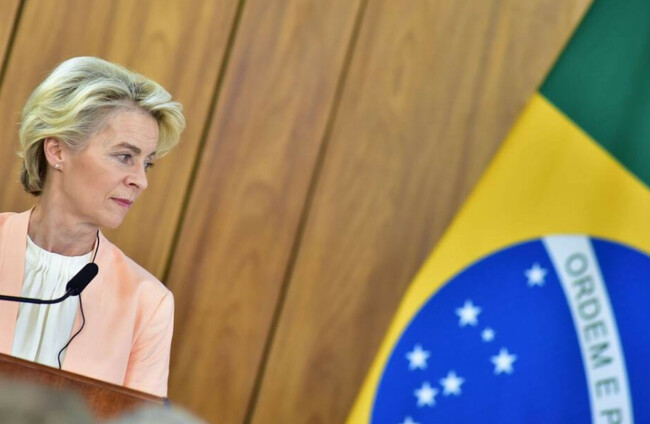
EUROPEAN COMMISSION PRESIDENT Ursula von der Leyen has signed the controversial Mercosur deal in Paraguay.
Von der Leyen hailed “fair trade over tariffs” as the European bloc prepared to sign the major trade deal with South America’s Mercosur nations that has been 25 years in the making.
“We choose fair trade over tariffs, we chose a productive long-term partnership over isolation,” von der Leyen said at the ceremony in Asuncion, Paraguay.
Paraguay’s President Santiago Pena also praised the treaty as “a clear signal in favour of international trade” in “a global scenario marked by tensions.”
The EU is to carry out onsite audits of the South American food supply chain before they are exported to countries including Ireland, as part of efforts to sway doubters over its colossal Mercosur trade deal.
At least two out of six of these inspections will be carried out in Brazil, senior EU officials said yesterday.
Speaking in Brazil ahead of the signing of the agreement, von der Leyen hailed it as “the achievement of a generation” after “25 years in the making”.
Welcome to the world’s biggest market. pic.twitter.com/n4QKd4B5G6
— Ursula von der Leyen (@vonderleyen) January 17, 2026
The deal removes tariffs on more than 90% of trade and now moves to the European Parliament, where opposition and legal challenges are expected.
The agreement has been met with a sustained protests across Europe by farmers and environmental groups.
Farmers have claimed that they will be undercut from the flow of cheaper beef from South America, while EU officials have argued their fears are overblown and ignore the benefits for the likes of pharma.
There remain two pressing consumer welfare issues for critics of the deal, both of which impact on the food that may well appear in supermarkets here further down the line.
One of the consistent concerns raised by the farming lobby has been whether Brazilian beef imported into EU markets will be as safe to eat for consumers here.
The EU has moved to reassure this by pointing to new safeguards for meat exported under Mersosur.
A spokesperson for the European Commission insisted that they have “built in every necessary protection for our farmers” as part of getting the deal done.
Speaking with media yesterday, EU officials insisted that there is a strong system of controls to check products.
This includes customs agents in each EU country as a final check.
However, they noted that if there is a serious concern with respect to animal or human health, it is “always possible to delist” the operator, according to the trade deal’s terms.
“This is still which is very much on the table,” a senior EU official said.
A Commission spokesperson told The Journal that the Mercosur agreement is essential for the EU, not just for its economic prospects, but also for trade diversification and as a “geopolitical signal” during wider global turmoil.
“The Commission’s focus in the coming weeks will be to engage with MEPs to win their support, ahead of their final consent vote on the agreement,” the spokesperson said.
“The EU-Mercosur agreement creates the largest free trade zone in the world. It will bring great opportunities for our companies and our citizens – in every EU Member State.
Concerns have been raised about the use of pesticides and chemicals on beef by South American farmers, which is not allowed in the EU.
EU officials said this week that the maximum residue limit – the amount that is allowed on or in food and animal feed – for pesticides would not be looked at as part of Mercosur – and would instead take place separately at a later date.
This was blasted by Irish Green Party leader Roderic O’Gorman who has come out strongly against the deal in its current form, along with other members of European green and left groupings.
“The issue about how beef in Mercosur countries is being reared with pesticides or hormones that are banned in the EU is absolutely central to the consumer welfare issues that the Green Party and others have raised throughout this debate,” O’Gorman told The Journal.
The Dublin West TD that to keep the checks on residue limits separate to the trade negotiations was an example of “kicking this issue down the road”.
He added: “Not having it absolutely clarified before the deal is signed is a further reason that the European Parliament should vote against this deal.”
Von der Leyen has now formally signed the deal – but there are still some hurdles to clear.
Aside from Europe, the deal also needs South American nations to ratify the deal. Aside from Brazil, the other Mercosur countries include Argentina, Uruguay, Paraguay and Bolivia.
However, it can still move ahead even if one Mercosur country opts out of the agreement.
MEPs in Europe need to approve the deal before it can be enacted.
Next week will see some opposition MEPs group attempt to refer the agreement to the courts
EU sources believe that it will come before the European Parliament for a final vote in April or May.

To embed this post, copy the code below on your site













have your say