Sign in. It’s quick, free and it’s up to you.
An account is an optional way to support the work we do. Find out more.
Sign in. It’s quick, free and it’s up to you.
An account is an optional way to support the work we do. Find out more.
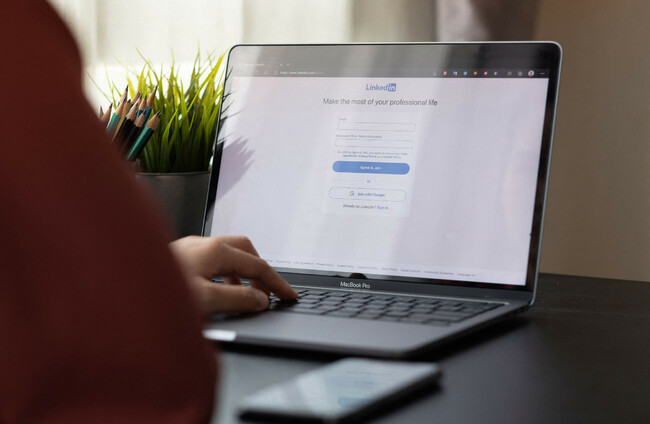
DANNI TAFFE RECEIVED an email last year out of the blue. The person claimed to be a headhunter and told her he had looked at her LinkedIn and was impressed with her experience.
The person said he was looking to recruit for four communications roles in NGOs – Taffe’s field of work – and asked her if she was interested in learning more.
“He said he’d found me through LinkedIn, so I thought he must be legit,” Taffe said. “So I just replied to him and said, ‘Yeah I’m interested. Can you tell me more?’”
They exchanged a few emails before the recruiter asked Taffe to share her CV.
“That’s when he replied quite quickly and said, ‘Oh, I don’t think your CV would get through the initial recruitment round with the way AI is’.”
The recruiter then suggested that she get an expert to look over her CV.
Taffe said that AI is generally not used in the NGO world to vet CVs, as they’re “not that adept with tech”, so she thought his comment was “a bit weird”. He was also using more corporate speak than she was used to – saying ‘corporation’ rather than ‘organisation’ – so she started to become a bit suspicious.
She clicked on the signature in his email, which referenced legitimate, real companies, but the links didn’t lead anywhere. He was also emailing from a personal email address.
She called up the companies that he’d said were advertising – and was told that the jobs did not exist.
What Taffe experienced was a type of scam that is becoming more prevalent: recruitment scams. The scams are insidious: they sound realistic and are much more targeted than previous scams, meaning they are very believable to the person at the receiving end.
For Taffe, flattery had played a certain part.
“I was like, Oh my god! Like wow! Which is quite embarrassing,” she said. “I was in there like, ‘Oh, I’m so great! And then I was like, Oh, I was nearly scammed.’”
The scam generally goes as follows: a sham recruiter contacts you, flatters you, and entices you with the prospect of a job. You can be contacted via cloned recruiter profiles on LinkedIn, via email, or through another form of social media.
The scammer will often pose as a legitimate employer or recruiter. After a while, when your interest is piqued, communication is taken to WhatsApp or email.
The scammer will then try to extort information or money from you by asking for identity documents, saying you must pay for a service or equipment, or saying you need to make a bank transfer on behalf of the company.
In some cases, the scammer will go as far as to conduct an interview with you, and even hire you, before finding some excuse for you to hand over money.
These scams capitalise on the state of the job market and the difficulty of finding work, according to Stephen Treacy, cybersecurity professor at University College Cork.
“They’re lulling the respondent into this setting where they’re increasing the levels of trust that the respondent has, for the company logo that’s on offer, for the role. They’re buying in,” he told The Journal.
“There’s that belief that they’re a part of this process, and there’s something valuable and tangible at the end of the tunnel.”
Treacy said that AI may be used by the scammers ahead of time to help prepare them conduct a realistic interview, and also to “socially engineer” who the person is to make the scam more personal. Ultimately, he said, the process is geared towards “harvesting data”.
The level of trust that has been built means that when the demands are made at the end of the hiring process, the scam victim is more likely to say yes.
“They’ve almost reverse-engineered something that we take so naturally into something that is more dubious and sinister,” he said.
Key to avoiding these types of scams, Treacy said, is to independently verify the person who has contacted you, and the role they are advertising, through a different channel.
Treacy also said to be clear on the warning signs of a scam. You should never pay to obtain a job. You should never transfer money to a bank account, nor should you be personally purchasing equipment for a supplier as a condition of employment.
A 2025 report by the Global Anti-Scam Alliance (GASA) surveyed people in 42 countries (with 15 countries in Europe) and found that of these, Ireland is the European country with the highest number of scams.
The Garda National Economic Crime Bureau has also recently warned of the rise in recruitment scams, saying that fake recruitment campaigns and fake interviews are conducted, with the goal of obtaining people’s personal data for fraudulent uses afterwards.
In Ireland, 79% of people surveyed (out of 500) by GASA had experienced a scam – which was remarkably higher than the 53% in Europe and 57% globally. It was also higher than the UK, where 67% of people surveyed had been victims of a scam.
Of those, 33% were subject to recruitment scams, with the vast majority (69%) comprising Gen Z and millennials under the age of 44.
Worryingly, the scams are successful some of the time, with 27% of people in Ireland losing money in scams last year (compared with 20% in Europe and 23% globally).
Jorij Abraham, managing director at GASA, said that one hypothesis about why scams are more frequent in Ireland is that Ireland is an English-speaking country, and scams often target English-speaking countries because the language is spoken widely, especially in wealthy nations.
Scammers are becoming increasingly sophisticated, Treacy said, and “if there is an opening, it will be exploited”.
Scammers only need to be successful in five to 10% of attempts, in what he described as a “machine-gun approach where you put everything out and hope something sticks”.
Abraham said that recruitment scams can also work in reverse. He told The Journal how he was nearly subject to one of these attempts.
“I was approached by an IT developer via LinkedIn and we did an interview. And only because I had a weird feeling in my stomach, I asked, Would you mind removing your glasses? And then the connection broke,” he said.
Jorij said that he realised that he was talking to a deepfake, and the call had hung up once Jorij had asked to get a better look at the ‘person’ he was talking to.
The scam works in reverse in these cases, whereby the scammer cons you into hiring them, but then demands an advance before they start the job, and often asks for money, saying they need it ahead of time because they were treated badly by a former employer.
Jorij said that the use of AI is also creating more sophisticated scams, allowing scammers to create deepfakes that can scam you. It also allows for scams to be automated.
He gave the example of a person’s car being transposed onto a picture in front of an adult club, and the scammer threatening to send the picture to family and friends unless the person sends them money.
“The process is completely automated,” he said. “Identifying new cars, creating a picture with the right model and the right colour with the right licence plates. [The car] is placed in front of an adult club, and a picture automatically sent to the mobile phone number of that owner demanding money.”
Other scams, such as ‘task scams’ also exist, where people will be asked to do a simple online task.
The task could involve reviewing a product or rating an app, Treacy said. “As you’re doing these tasks, you can start to see the earnings accumulate.
“It’s almost like this carrot at the end of the stick, but you must actually make a deposit first of your own money to withdraw the money.”
While these types of scams can take place on any social media platform, people tend to have the expectation that LinkedIn is legitimate, according to Treacy, which can make the scam all the more effective.
Jorij said that LinkedIn is being “abused” by scammers, just like any other social media platform, but he emphasised that LinkedIn has guardrails in place.
LinkedIn’s Oscar Rodriguez said that jobseekers are navigating a “challenging labour market”, which scammers are “unfortunately exploiting”.
He said that LinkedIn has brought in a number of safety features to make it easier for users to verify who they’re interacting with, including verification badges for recruiters, company pages and job postings.
LinkedIn also recently published a guide on how to search for jobs safely.
For Taffe, her experience with the first scam meant that she was more alert when another email came her way.
“The person was a recruiter, but for construction companies,” she said. “And that’s when I was like, that’s completely not my field, so this is obviously a fake.”
To embed this post, copy the code below on your site














have your say