Sign in. It’s quick, free and it’s up to you.
An account is an optional way to support the work we do. Find out more.
Sign in. It’s quick, free and it’s up to you.
An account is an optional way to support the work we do. Find out more.

DONALD TRUMP’S BRIEF visit to Ireland was always likely to generate some headline-grabbing claims.
In remarks at the US ambassador’s residence in Dublin and questions from reporters at his Doonbeg golf resort, Trump spoke about Ireland’s pharmaceutical industry, global oil supplies and domestic US politics.
We examined four of his more substantial claims over the two-day trip to see how well they stand up.
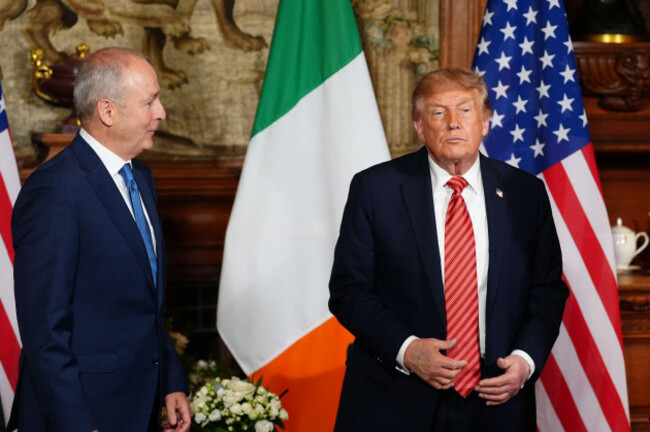
In a speech to guests at the US ambassador’s Phoenix Park residence in Dublin, Trump hit out at a supposed trade imbalance between Ireland and America, claiming that our economic relationship benefits Ireland at the expense of the US.
He said:
You took all of our medical companies. We gotta get a couple of ‘em back. You people did very well. You fleeced us, but that’s okay.
But did Ireland really take US pharmaceutical companies away from America?
We are definitely a significant pharmaceutical manufacturing centre, and a huge amount of our exports go to the US.
Figures from the Central Statistics Office show that exports of medical and pharmaceutical products reached €138.6 billion in 2025, accounting for more than half (53.2%) of all Irish goods exports.
The CSO notes that foreign-owned corporations dominate pharmaceutical manufacturing here, and that much of the income from their production flows out of Ireland.
An industry report produced by Goodbody for the Irish Pharmaceutical Healthcare Association earlier this year estimated that the US imported 62% of Irish pharmaceutical exports in 2025.
But there’s an important caveat to that report as well.
The report says the surge last year was partly driven by companies bringing shipments forward ahead of potential US tariffs, flagged by Trump himself, alongside rapidly growing American demand for GLP-1 weight-loss and diabetes medicines.
The broader context there actually tells a bigger story which Trump alluded to at the weekend, when he claimed Ireland “fleeced” the US.
The threat of tariffs last year formed part of a wider series of claims by Trump that the US was disadvantaged by its trade relationships with other countries.
The same CSO release cited above shows that the US was Ireland’s top exporting partner last year, accounting for €111.7 billion worth of goods in 2025, or 42.9% of our total exports.
Ireland also imported the most goods in 2025 from the US, but this represented just €22.7 billion (15.7%) of our imports.
That imbalance is visible in American data as well.
The US Bureau of Economic Analysis recorded a $114.2 billion goods deficit with Ireland in 2025, the fifth-largest bilateral US goods deficit that year and higher than any other European country.
It appears sixth in the BEA list because the EU is included separately as an economic area, which has a deficit bigger than Ireland’s.
But does this amount to the US getting “fleeced”?
In plain English, a $114.2 billion goods deficit means that the US bought $114.2 billion more in goods from Ireland than it sold here.
It is not a bill that Ireland owes the US, and the figure alone does not show that either country was cheated out of money.
What’s more, the figure also covers goods only.
Data derived from the BEA also shows that, once services are included, the overall US deficit with Ireland in 2025 was considerably smaller, at $48.2 billion.
Services accounted for 83.9% of US exports to Ireland, including $44.4 billion in charges for the use of intellectual property.
This is important context when assessing Trump’s suggestion that the economic relationship between Ireland and the US is one-way.
Imagine you work for an IT company with a coffee machine in the office.
And let’s say your company buys €1,000 worth of beans for its machine from a local supplier, and the supplier buys €700 worth of IT services from your company.
The IT company has a €300 trade deficit with the supplier, but it has not been ripped off: it received the beans it paid for.
The same principle applies between countries, and looking only at goods leaves out services sold in the other direction.
Nor can Ireland be accused of “taking” pharma companies from the US.
Many of the pharma plants based in Ireland are owned by US-headquartered multinationals, including Pfizer, Eli Lilly, AbbVie, Johnson & Johnson and MSD, known as Merck in the US.
Those factories remain parts of US-headquartered multinational groups.
The companies chose to set up factories in Ireland for a mix of reasons, including access to the EU, an English-speaking workforce, an established life-sciences cluster, tax policy and a long-running State strategy to attract foreign investment.
There may be a legitimate debate about where pharmaceuticals that are consumed in the US should be manufactured, how corporate profits are taxed in Ireland and whether the US exchequer is theoretically losing out.
Ultimately, decisions to set up here were made by the companies themselves, many of which still have a presence on the other side of the Atlantic.
There is a very small degree of truth to Trump’s claim.
Some US-founded healthcare companies have moved their legal parent to Ireland through so-called tax inversions, or mergers that make a group legally based abroad without removing its US operations.
Medtronic did this through its acquisition of Covidien, while Perrigo created an Irish parent when it acquired Elan.
But those examples are far removed from Ireland taking “all” of America’s medical companies as Trump suggested.
We therefore rate this claim: MISLEADING.
As per our verdict guide, this means the claim either intentionally or unintentionally misleads.
Later in the same speech, Trump turned to investment flowing in the opposite direction – from Irish-linked owners into US businesses – and credited its supposed growth to the performance of the American market.
“Ireland is now the sixth-largest source of foreign direct investment in the United States with nearly $392 billion invested in 2025,” he said.
He also connected that figure to the performance of the US market, saying the investment was “up probably 60 or 70%” and that “over the last year and a half” the numbers had “practically doubled”.
Trump’s claim about FDI is close to the official figure.
The US Bureau of Economic Analysis (BEA) put Ireland’s FDI position at $391.745 billion at the end of 2025. Rounded to the nearest billion, Trump’s “nearly $392 billion” claim is correct.
But the key word is “position”.
The $392 billion was not new money sent to the US during 2025.
It was the total value at the end of the year of stakes and company loans that were ultimately linked to owners based in Ireland.
That can include multinationals legally headquartered here, so the money did not necessarily come from Irish people or pension funds.
The figure placed Ireland sixth, behind Japan, Canada, Germany, the United Kingdom and France.
But the same dataset shows that the available figures do not support the “60 or 70%” growth claim.
Irish investment was at $364.004 billion in 2024 and $391.745 billion in 2025, an increase of 7.6%.
Even compared to 2020, when the level of investment was $302.396 billion, the increase to 2025 was about 30% and did not “practically double” over that five-year period.
It is also incorrect to treat an FDI position as if it was a stock-market portfolio or pension fund.
The US BEA’s figures on direct investment measure ownership and financing of businesses.
Those figures can change because of acquisitions, new capital, reinvested earnings, debt movements, exchange rates and revisions: they do not rise and fall in line with share prices.
Trump’s claim about Irish investment therefore combines a correct 2025 figure and Ireland’s ranking on the US FDI list with growth figures that are not supported by the available data.
We therefore rate this claim: MIXTURE.
As per our verdict guide, this means there are elements of truth in the claim, but also elements of falsehood. Or, the best available evidence is evenly weighted in support of, and against, the claim.
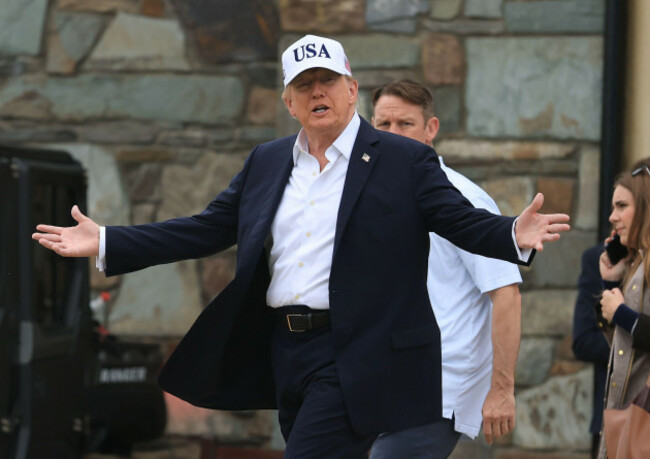
The day after his Phoenix Park speech, Trump told reporters in Doonbeg that Ukrainian President Volodymyr Zelenskyy should stop striking Russian diesel infrastructure.
He claimed that attacks on Russian refineries were “hurting the world” and leading to global fuel shortages – rather than the US-Israeli war on Iran.
“Mr Zelenskyy has to do one thing: he has to stop knocking out diesel fuel in Russia,” Trump said.
He added that the global oil shortage “isn’t done by the Middle East, this is done by what’s happening with Russia and Ukraine“.
There is clear evidence of a tight global distillate market for diesel, and Ukrainian attacks on Russian refineries are one of its causes.
Ukraine has carried out repeated long-range drone attacks on Russian refining infrastructure. Those attacks have reduced Russian fuel production and contributed to domestic shortages in Russia.
Ukraine says Russian refineries are legitimate military targets. The strikes come amid Russia’s full-scale invasion and repeated Russian attacks on Ukraine’s energy system, which have been documented by UN human-rights monitors.
The US Energy Information Administration’s latest short-term energy outlook, which was published days before Trump’s comments, explicitly said that the loss of Russian refinery activity is adding pressure to global distillate prices.
Distillates are a family of products made in refineries and include diesel and heating oil.
Crude oil is the raw material from which those products are made, so disruption to refineries and disruption to crude-oil supplies can both affect diesel prices and availability.
But the EIA report does not identify Ukraine’s attacks on Russia as the sole cause, or even describe Russia as the only major source of lost supply.
The agency said that US distillate inventories fell below their five-year range after the loss of large amounts of supply from the Middle East, Russia and China.
It also says its forecast for falling diesel prices depends on the return of normal tanker traffic through the Strait of Hormuz, which would allow refineries in Saudi Arabia and Kuwait to export more fuel.
The strait, a narrow 21-mile-wide sea passage through which around 20% of the world’s oil supply passed before the US and Israel’s war in Iran, has been unpredictably opened then shut several times this year.
The EIA reported that disruptions to crude oil and refined-product flows through the strait were a defining feature of the market beset by shortages in the second quarter of this year.
In other words, it is true that attacks on Russian refineries have tightened supply.
Trump’s claim that the shortage “isn’t done by the Middle East” very much ignores a major cause of shortages as a result of his administration’s war, which has been identified by the US government’s own energy agency.
The claim that Ukrainian attacks on Russian refineries are causing the global diesel shortage does contain an element of truth.
But Trump’s overlooking of ongoing disruption in the Middle East contradicts the EIA’s assessment of the main causes of the global oil shortage.
We therefore rate this claim: MOSTLY FALSE.
As per our verdict guide, this means there is an element of truth in the claim, but it is missing critical details or context. Or, the best available evidence weighs against the claim.
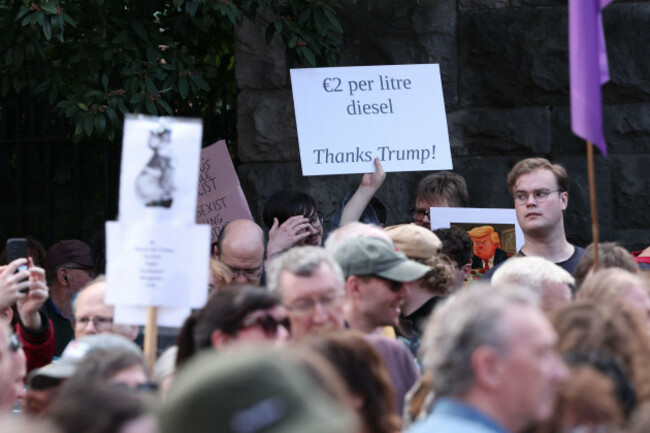
Meanwhile, Trump also told reporters in Doonbeg that his administration could easily afford to pay $5,000 to every adult in the US if Republicans retained control of Congress during this November’s mid-term elections.
“It’s easy if the Republicans win. $5,000 to all adults in the country and we can easily handle that because we’re taking in so much money,” he said.
According to a Census-based estimate cited by Reuters, there are about 240 million adults in the United States.
Paying them $5,000 each would put the total cost of Trump’s plan at $1.2 trillion.
The federal government could make the payments if Congress enacted and funded them, though Trump could not authorise the spending unilaterally.
But would it be easy?
Neither Trump nor his administration has published a plan showing how the payments would be funded.
US Vice President JD Vance has suggested that tariff income could be used to make the payments.
The Congressional Budget Office estimates that customs duties had raised $167 billion so far in the fiscal year, which is about a seventh of the cost of Trump’s pledge.
The same office also estimated that the federal government had already run a $1.8 trillion deficit in the first 10 months of the 2026 fiscal year, and that it would finish the year with a $2.1 trillion shortfall – before accounting for the additional $1.2 trillion.
Trump justified the pledge yesterday by saying that “trillions of dollars” were coming into the US, but this appears to blur different kinds of money.
Private investment entering the US economy is not a form of revenue that’s available to the US Treasury, and it can’t be spent by Trump as though it were tax income.
There is a further constitutional obstacle to the plan as well.
Under the US Constitution, Congress controls federal spending and Republican House Speaker Mike Johnson said on Sunday that congressional approval would be required for the $5,000 plan.
If Congress approves, and that is not a given, the US could in theory finance a $1.2 trillion programme by raising taxes, cutting other spending or borrowing more.
But Trump’s claim that the payments would be “easy” because of money already coming into the US is not supported by available figures.
The cost of the idea is far more than current tariff receipts, while the federal government is already running a large deficit.
We therefore rate this claim: MOSTLY FALSE.
As per our verdict guide, this means there is an element of truth in the claim, but it is missing critical details or context. Or, the best available evidence weighs against the claim.
The Journal’s FactCheck is a signatory to the International Fact-Checking Network’s Code of Principles. You can read it here. For information on how FactCheck works, what the verdicts mean, and how you can take part, check out our Reader’s Guide here. You can read about the team of editors and reporters who work on the factchecks here.

To embed this post, copy the code below on your site
















have your say