Sign in. It’s quick, free and it’s up to you.
An account is an optional way to support the work we do. Find out more.
Sign in. It’s quick, free and it’s up to you.
An account is an optional way to support the work we do. Find out more.

LET’S BE HONEST, nobody likes paying taxes, yet like them or not, they are the price we pay to live in a civilised society. Some products, like cigarettes, attract high taxes. Three-quarters of the cost of a packet of fags in Ireland is tax.
The main purpose of high cigarette taxes isn’t to raise revenue, but rather, to dampen demand, and it has been hugely successful. In the last two decades, some 800,000 people have quit the habit, with Ireland’s smoking rate dropping from 27% to 18%.
Carbon emissions are orders of magnitude more dangerous than tobacco, threatening civilisation as a whole and presenting an existential risk to billions of people worldwide.
If that sounds hyperbolic, here’s how UN Secretary General Antonio Guterres framed it: “Our addiction to fossil fuels is pushing humanity to the brink. We face a stark choice: either we stop it, or it stops us”.
This, in a nutshell, is why putting a price on the damage inflicted by carbon is not just a very good idea; it’s essential if we are to have even a shot at decarbonising in time to avert a civilisation-ending global calamity.
Some 35 years ago, Sweden led the world in introducing a carbon tax, initially levied at €23 a tonne, rising steadily over time to €138 per tonne today. As the Swedish government explains: “By increasing the tax gradually and in a stepwise manner, households and businesses have been given time to adapt, which has improved the political feasibility of tax increases”.
Had it worked? In short, yes. Over the last half-century, Sweden’s per capita emissions have halved, to around 4.5 tonnes, despite national income more than doubling in the same period. And bear in mind that Sweden is a lot colder than Ireland, where our per capita emissions today are around 10 tonnes.
Ireland first introduced a carbon tax in 2010, initially at €15 per tonne. It increased to €20 in 2012, and remained at that level until 2020, when the Finance Act set out in law a trajectory of annual increases. By raising it at a steady €7.50 each year, the aim is to have a €100 per tonne carbon tax by 2030.
Last October, the carbon tax reached €71 a tonne for motor fuels, with other fuels due to reach this level on May 1st next. Ireland’s carbon tax brings in just over €1 billion a year, and, unusually, this funding is fully ring-fenced for environmental spending.
The bulk, around €550 million, helps fund the SEAI’s retrofitting and community energy projects, including free retrofits for lower-income households – a surefire way to lift families permanently out of energy poverty. Another third of a billion euros in carbon tax revenue goes to the Department of Social Protection and funds the Fuel Allowance, and payments for children, people living alone and working families.
Despite the torrent of anti-carbon tax rhetoric from the agriculture lobby, the sector is in fact also a major beneficiary, with €170 million in ACRES agri-environmental funding for farmers.
And according to the Environmental Protection Agency, in 2023, Ireland’s emissions were at their lowest level in over three decades, due at least in part to “climate action and decarbonisation measures”, including the carbon tax.
Between 2020 and 2025, the carbon tax has raised a total of €4.2 billion, with half of the households in Ireland now better off as a result, with the main benefits flowing to the lowest income households, according to an ESRI analysis.
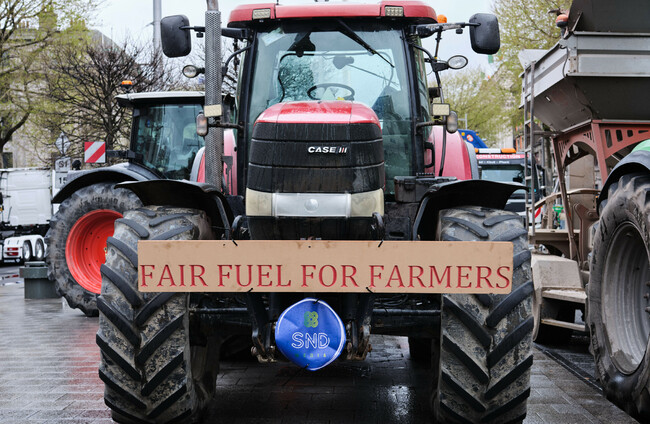
Carbon tax is a lightning rod for protestors, yet the current €71 per tonne translates into only around 16 cents per litre of petrol and 19 cents for diesel. For an average Irish motorist driving 17,000 kilometres a year, the carbon tax adds around €3.50 a week, or the price of one takeaway coffee.
It is, in other words, hardly draconian. Carbon taxes are based on the polluter-pays principle. Assuming the tax continues to ratchet up as intended, the €100 per tonne in 2030 translates into around 19 cents a litre for petrol and 26.8 cents a litre for diesel, which works out at around €5 a week extra for the average driver. Again, hardly enough to be manning the barricades over.
Once upon a time, the refrain was that it was unfair to put carbon taxes on liquid fuels, as there were simply no alternatives. That is manifestly no longer the case. Electric vehicles have now achieved price parity with their internal combustion counterparts, and the key weakness of EVs – their limited range – has been largely eliminated as newer models are now achieving similar ranges as petrol or diesel cars.
While road hauliers bemoan the price of diesel, electric heavy goods vehicles are now a reality, as are electric tractors. More than half the trucks sold in China at the end of 2025 were either full or hybrid electrics. The vital attribute for a HGV – pulling power or torque – is available in spades from powerful electric motors. After all, electricity already propels massive high-speed trains weighing hundreds of tonnes, as well as the DART and Luas here in Ireland.
In early March of this year, just days after the chaos in Iran kicked off, the government rolled out an updated Zero Emission Heavy Duty Vehicle (ZEHDV) grant scheme, offering up to €500,000 a year in support for companies to transition to electric HGVs, with an additional funding of up to €300,000 to install high-speed depot charging facilities.
However, as long as the government responds to every oil shock by capitulating to protestors and throwing hundreds of millions of euros at stop-gap measures, all we are really doing is delaying the clean energy transition while prolonging our disastrous dependence on fossil fuels, and storing up far worse trouble for the near future.
The world’s most powerful country will continue to be ruled by a vengeful and mentally unstable individual until at least January 2029, so the prospect of further and potentially even more crippling economic, political and energy shocks in the months and years ahead is a near-certainty.
It is odd indeed that the most visceral loathing of carbon taxes emanates from the farming community. Apart from the huge funding it receives directly from this tax, agricultural ‘green’ diesel has a further carbon tax exemption, as farmers are allowed to claim a tax deduction, which means they effectively pay carbon tax at the much lower 2012 rate.
An environmental review of Ireland in 2021 by the OECD recommended removing VAT exemptions on agri-diesel, arguing that removing this taxpayer subsidy would ‘contribute to a more efficient use of resources and reduce greenhouse gases’. The Irish government, you won’t be surprised to hear, ignored this expert advice.
The real reason for the vitriolic opposition to carbon taxes in rural Ireland is, I suspect, due to the systematic demonisation of Green politicians by populist rural TDs in particular, who routinely use them as handy scapegoats for their own failings. This anti-green narrative has been amplified in the farm press as well as in right-wing media outlets.
It may be deeply dishonest, but it has been effective. Ireland’s livestock-dominated agriculture sector, while accounting for only one in 25 jobs, produces around 40% of national carbon emissions, making it a key target for emissions reductions. Opposing the carbon tax has become a proxy war for resisting all measures to reduce the livestock industry’s huge emissions and pollution footprint. Denmark, meanwhile, has extended the carbon tax to include livestock emissions from 2030.
While governments across Europe and the world have reacted to the oil crisis by reducing speed limits and restricting car usage to save fuel and so ease pressure on supplies, the Irish government baulked at introducing any such moderate, sensible measures, presumably fearful of backlash from a public conditioned to believe that any sacrifice, no matter how small, is intolerable.
This, regrettably, is the state of politics in Ireland today. I shudder to think how we as a society will cope when things get really bad, and there is no state piggy bank to magic away future energy or food crises.
The chaos flowing from the Strait of Hormuz is both a threat and an opportunity. Across Europe, people are scrambling to install rooftop solar and heat pumps and buy EVs in response to the deepening Iran crisis.
This may represent our best, last chance to break the stranglehold of fossil fuels and finally kick-start the electrification of Ireland, powered by clean, domestically produced energy. But this will only happen if our politicians stop capitulating to bullies and special interests and act instead in line with the overwhelming scientific evidence.
John Gibbons is an environmental journalist and author of ‘The Lie of the Land – A game plan for Ireland in the climate crisis’.
To embed this post, copy the code below on your site












have your say