Sign in. It’s quick, free and it’s up to you.
An account is an optional way to support the work we do. Find out more.
Sign in. It’s quick, free and it’s up to you.
An account is an optional way to support the work we do. Find out more.

Politics by Numbers is a new series for The Journal where broadcaster, author and spreadsheet stan Gavan Reilly takes a data deep dive into a political point of the week.
OK, YES, THE budget is still months away. Eighty-nine days, in fact, if you’re desperate for a rolling countdown. But the budget is no longer a one-day event; it’s a rolling cascade of governance and paradigms and exchequer returns and fiscal envelopes and seasonal statements and and and and.
This makes for tedious media coverage but governance-wise it’s a good thing. It’s only 23 years since the Budget Day announcements were so last gasp and short notice that they included a surprise plan to move entire government departments out of Dublin, relocating 10,000 civil service jobs with them. Arguable in principle; almost impossible in practice.
These days, the sums aren’t done on the spot, and imaginary billions are not suddenly found down the back of a couch on Merrion Street.
The amount available for new measures is almost pre-ordained years in advance. We know already, for example, that Ireland intends to spend €147.3 billion in the year 2030 – it was on page six of the Annual Performance Review published in April.
The same document told us that (“voted”) spending in 2027 will be €7.7 billion higher than it is this year. On the face of it that sounds like a huge amount: imagine what you could buy for €7.7 billion! Imagine the services you could create, the investment you could make, the increases you could afford… As a raw total, it’s an impressive figure.
But the Business Post did us all some service at the weekend, with details of an unpublished analysis by the Fiscal Advisory Council, and it turns out that much of the €7.7 billion is, effectively, already spent.
€2.5 billion will be taken up by inflation, and the adjustment to pensions and welfare costs to keep up with it. Another €2 billion will be needed for what’s called ‘existing levels of service’: when the population is growing and ageing, it costs more simply to stand still. Under the National Development Plan, €1.2 billion is already earmarked for ‘capital spending’ (one-off spending on things like infrastructure and construction).
That’s €5.7 billion occupied already, leaving only €2 billion for ‘new’ measures… But even all of that isn’t available.
Given how some Departments are likely to exceed their original budgets for 2026, the starting point for spending in 2027 is €1.2 billion higher than it would otherwise be. The €7.7 billion suddenly becomes €0.8 billion… And that’s without the impact of a possible deal on public sector pay.
It’s hardly any wonder, in that light, that some in government are putting so much focus on ‘the income tax package’ that will form part of October’s announcements. When there’s seemingly so little to spend on new measures, ministers will hope people are happy to have more money in their own pockets.
It also explains why the Department of Public Expenditure is so gung-ho about trying to enforce more efficiency in public sector spending.
This week, officials from that Department told TDs that there are now escalated spending controls at three other Departments: Health, where an intense flu in January and February immediately saw spending rush ahead of plan; Education, which was granted an extra €646 million to support children with additional educational needs; and Children, which is also responsible for the provision of disability services.
Some of those departments are not like the others. The Department of Health has overshot its budget every year this century, simply because healthcare turns out to be more expensive than expected, even in non-pandemic years.
Politicians wring hands and tut, but continually provide more funding, because the alternative is for the health service to run out of cash in November or December and for the lights to be turned off.
The other two departments have slightly different tales to tell. The Department of Children now has official responsibility for the provision of disability services, including the beleaguered and overstretched CDNT system. The Department of Education, meanwhile, is facing into its annual scramble for appropriate school places and supports for children with additional needs, and has already received €646 million in extra cash this year to rectify the historical underprovision in those areas.
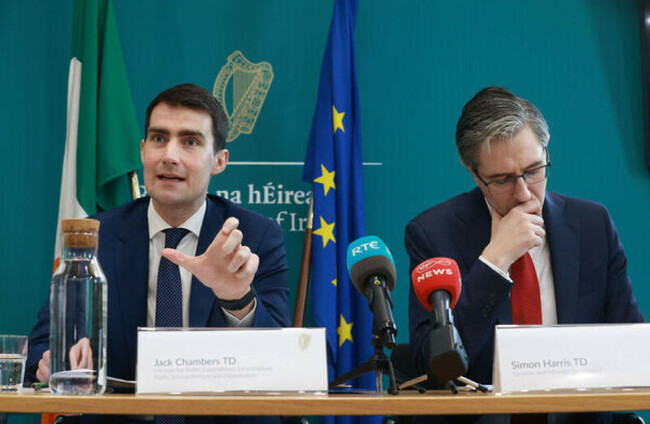
Only Education, however, has been made subject to an ‘Expenditure Levy’ – where much of 2026’s extra funding, will be docked from the budgets of others in 2027. It’s a novel initiative, and a public attempt to illustrate that Ireland might spend big, but it isn’t flathiúlach. At least, that’s the version Jack Chambers presented, when he came onto my Monday night programme last week (when in a Freudian turn, he called it an “efficiency levy”):
The reason why there was no such levy introduced when the HSE spends more than its budget, he said, is because Health has taken “corrective action” to manage its spending.
The unspoken implication is that Education has not done the same.
Quite how it would do so is hard to tell: is it supposed to simply not create the special classes that children need? Would the CDNTs be told not to hire the physiotherapists, and speech and language therapists, that are so desperately required?
When the three departments being scrutinised are the ones which are (and used to be) responsible for providing children’s disability services, and for educating children with additional needs, you’d be forgiven for developing an inferiority complex.
Nonetheless, you can understand why the bean counters are suddenly so fretful about where all their money is going.
The public sector unions are openly touting the prospect of industrial action, insisting on pay increases that match or exceed the rate of inflation. Childcare subsidies, a linchpin of the election and of the Programme for Government, demand an increase. Likewise, student fees. Likewise any number of priorities for which the cash might be hard to find.
And that’s the ultimate challenge: no matter how much cash might be available, there’s always an area in society that could really use more money. Meeting all those demands, when there’s deceptively little money available, is a massive challenge for those in power.
Gavan Reilly is the Political Correspondent for Virgin Media News and the host of Monday with Gavan Reilly, which airs every Monday at 10pm on Virgin Media Play and Virgin Media One.
To embed this post, copy the code below on your site













have your say