We need your help now

Support from readers like you keeps The Journal open.

You are visiting us because we have something you value. Independent, unbiased news that tells the truth. Advertising revenue goes some way to support our mission, but this year it has not been enough.

If you've seen value in our reporting, please contribute what you can, so we can continue to produce accurate and meaningful journalism. For everyone who needs it.

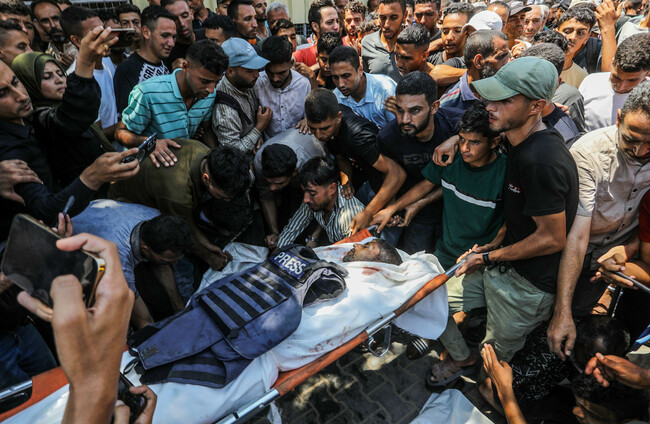
Khan Younis, Palestinian Territories. 26 Aug, 2025. Palestinians carry the body of a journalist who was killed in an Israeli strike on Nasser Hospital in Khan Younis. Alamy Stock Photo

Humanitarian worker in Gaza 'Please do not look away, we need your help now'

Hani Alaskari, working with the Palestinian Centre for Human Rights in Gaza, says history will remember not only the crimes committed, but also those who remained silent.

For nearly two years, staff at Christian Aid’s local partners have worked tirelessly to provide vital food, water, shelter and medical treatment to people in Gaza. This is despite the great personal risk they take by working in the most dangerous place to be an aid worker — with over 500 aid workers killed in Gaza since the start of the war.

As well as providing life-saving aid, Christian Aid’s partners are also monitoring and documenting evidence of atrocities, human rights abuses and possible war crimes in the hope to seek accountability and justice for the victims.

Hani Alaskari works for the Palestinian Centre for Human Rights (PCHR). Before the war, the 35-year-old analysed data for PCHR, but his role has expanded to include emergency coordination and responding to urgent humanitarian needs of the people in Gaza.

Hani spoke to Christian Aid Ireland about the importance of his work and the great personal toll that the war has exacted on him and his colleagues. He also explained the crucial lifeline provided by humanitarians, aid workers and human rights organisations in Gaza…

OUR WORK IS vital in an environment overwhelmed by human rights violations. We exist to promote and protect human rights, the rule of law, and the dignity of every person. In a context where justice is often absent, our work documents the truth, supports victims and advocates for accountability.

No one in Gaza has been left untouched. The loss is universal, but the damage varies — though everyone has suffered. The ‘lucky’ ones are those who have ‘only’ endured the constant fear of being killed, displaced, or starved, without losing loved ones.

During the first week of the war, I was forced to flee my home in northern Gaza. I have been displaced three times — though far fewer than many of my colleagues, who have moved seven or eight times.

Homes to rubble

My family’s three-story building was destroyed by a missile strike. It was destroyed without reason. There is nothing that can justify turning homes into rubble. You cannot imagine what it means to be made homeless, to live without water, or to face illness without medical treatment.

I have lost 10 other relatives during this war. My brother and my four-year-old niece were killed while they were out trying to get food. Many friends and family members have also been detained. The grief is constant and heavy. I was due to leave Gaza in October 2023 to pursue my PhD — I lost that opportunity too.

There is no safe place in Gaza — every area is at risk. In the last two months, my neighbourhood in Deir al Balah has been hit by over 20 airstrikes. Israeli forces have issued wide evacuation orders, making renewed displacement a constant threat.

Rampant hunger

Every person in Gaza has lost a lot of weight; at least 10–15 kg on average. The markets have no meat or chicken. Locally grown vegetables are scarce and outrageously priced — a kilo of tomatoes can cost $35 USD, potatoes $60 and onions $100. Drinking water costs around $70 per cubic metre. Adults look pale, tired and drained. Personally, I feel dizzy almost every day. We have been forced to live on one meal a day for months.

Breakfast is often a mix of ground lentils and pasta. Wheat is no longer available after the destruction of so much farmland. Friends ration bread for their children, locking it away to make it last.

Adults can endure hunger, but it is unbearable to see children go to sleep without eating. After the March ceasefire collapsed, Israel completely stopped allowing food and other basic goods into Gaza, making life even harder.

The courage of aid workers in Gaza moves me deeply — they are true warriors, selfless heroes who embody the highest ideals of humanity. Many of them are personally affected by the hardship and loss, yet they put others ahead of themselves, walking into danger day after day to offer hope and healing.

The words I hear from colleagues — “We will not abandon our role; we will help until our last breath” — reveal an unwavering commitment that defies description. Their dedication is a light in the darkest times.

‘Every life matters’

In the midst of destruction, loss, and profound grief, I find strength in knowing that our work offers a lifeline to those who suffer. Every legal case we document, every victim we support, every voice we help to amplify — these acts are reminders that no one is invisible, that every life and every right matters.

The memory of loved ones lost, the courage of my colleagues, and the resilience of my people inspire me every day to keep going. It is my way of honouring them, and of holding on to hope.

I say to people around the world, please do not look away. Gaza is not only a headline — it is home to two million people whose lives, dreams and dignity are being erased before our eyes. I urge you to use your voices, your platforms and your influence to demand an end to this war, to lift the siege and to ensure justice for those who have suffered.

For those who have stayed silent, I want to say: Your silence is felt here, and it is a form of complicity. History will remember not only the crimes committed here, but also those who stayed silent.

Please stand with us and show the world that compassion and accountability still matter. Stand with Gaza now — not when it is too late.

Hani Alaskari works for the Palestinian Centre for Human Rights (PCHR) in Gaza. Throughout the war in Gaza, Christian Aid Ireland’s local partner, PCHR, has continued its vital work of monitoring and reporting human rights abuses and possible war crimes thanks to funding from Irish Aid. To donate to Christian Aid Ireland’s appeal as they continue to support local partners in Gaza and across the region, visit: www.caid.ie/GazaAppeal.

Readers like you are keeping these stories free for everyone...
A mix of advertising and supporting contributions helps keep paywalls away from valuable information like this article. Over 5,000 readers like you have already stepped up and support us with a monthly payment or a once-off donation.

Close
JournalTv
News in 60 seconds