Sign in. It’s quick, free and it’s up to you.
An account is an optional way to support the work we do. Find out more.
Sign in. It’s quick, free and it’s up to you.
An account is an optional way to support the work we do. Find out more.

LAST UPDATE | 13 Jan
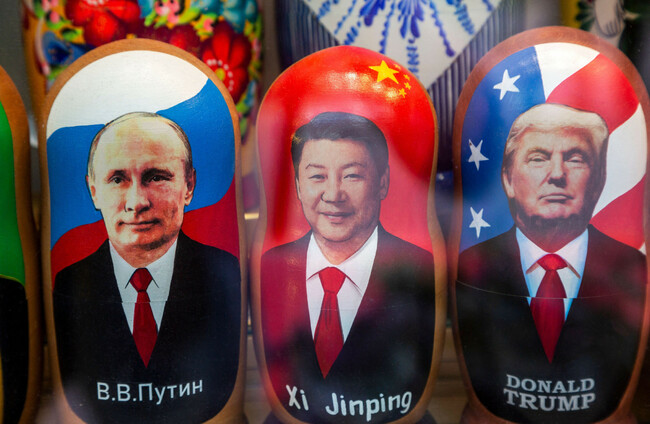
DONALD TRUMP AND his political twin in Moscow, Vladimir Putin, continue to threaten and challenge the world in 2026 with their malign and specious doctrine that “might is right”.
It is not just Venezuela and wider Latin America, it is not just Ukraine and wider Europe that are in their respective sights. It is the very nature and practice of diplomacy.
In the conduct of international relations, diplomacy is ultimately the only alternative to war. It is about respectful relations between countries, compromises between their competing interests, respect for international law and support for international institutions.
It means respecting the borders, sovereignty and dignity of others. Two of the world’s military superpowers have chosen, for the moment, to set themselves against those principles. This disturbing era is not the time for other countries around the world to give up on diplomacy. Far from it. It is rather precisely the time for decent democracies, including the European Union, to double down on it.
However depressing the current global outlook, for those who want to work towards eventually replacing aggression with agreement, there is no alternative to diplomacy. It’s true that the practice of diplomacy is going through an exceptionally rough patch, but we have a straightforward moral obligation to try to make it work as effectively as we can.
As someone famously pointed out, “jaw-jaw” is self-evidently better than “war-war”.
Moreover, despite the growing constraints that diplomacy faces from those who have decided to prioritise brute force or the threat of it, diplomacy can still have some impact. Determined and complex European diplomacy has kept Trump involved, for the moment at least, in resisting Russian aggression in Europe and in resisting his otherwise likely personal inclination to support Putin’s ambitions.
Diplomacy is staying his hand on his preposterous claim to Greenland. Diplomacy has also played a part in bringing about, for now, a belated, imperfect and uncertain calm for the tormented people of Gaza. States still face the embarrassment of being brought before the UN Security Council to account for their actions, even if some of the worst culprits can brazenly veto any formal condemnation or concrete action by the United Nations.
It is essential, at the same time, to be realistic about what diplomacy alone can achieve and about how it can be deployed. It faces perhaps three principal constraints.
First, and most importantly, diplomacy alone will not have the slightest effect, for example, on Putin’s relentless aggression. It is of immense and ultimately existential importance, including for Ireland, that our European partners have been stepping up their defence expenditure and preparedness.
The only hope of a lasting negotiated outcome in Ukraine, and the peace that we all want, is if Russia is made to realise that it cannot achieve the total victory that it craves to meet its imperial objectives. Those, including in this country, who speak naively about pursuing diplomacy and peace while condemning the build-up of European military resistance to Russia are, in effect, even if inadvertently, supporting war by arguing for it to be rewarded.
Likewise, fine words alone will not halt Trump’s gallop. If he continues on his present course, he will have to learn eventually, from China, Russia, Latin America or Europe — each in different ways — that actions have consequences.
Second, diplomacy often involves biting your tongue rather than speaking your mind. There is no doubt, for example, that the recent seizure by the United States of Venezuela’s President Nicolás Maduro was a breach of international law and that its primary motivation was to gain control over that country’s oil reserves.
Despite the distasteful nature of Maduro’s regime, many would have liked to see the EU condemn the attack for what it was. There was a case for a forceful and outspoken response, not least because of obvious parallels with Trump’s threatened invasion of Greenland.
However, in the particular circumstances, it was probably right, from a diplomatic point of view, that Europeans were muted and elliptical in their criticism of the US assault. At a time when Europe is in discussions with the Trump administration about support for Ukraine, the low-key diplomatic response may have been the right one.
Third, diplomacy is not the same as being a public commentator free to fulminate about the issue of the day. It is about weighing up competing objectives, complex constraints and imperfect alternatives. It is often about calculation, nuance and timing.
Throughout 2025, the most important choice for European diplomacy, as for much of the world, has been whether to advance Europe’s interest by placating Trump or by confronting him. So far, the balance of advantage has been judged to lie with a broadly conciliatory stance. However, Trump’s amorality and impulsiveness may force a rethink in 2026.
Trump has claimed that he was saved by God to Make America Great Again. With equal blasphemy, Putin has recently described Russia’s invasion of Ukraine as a “holy mission”. Diplomacy does not deal in such divine certainty. It accepts that other countries have their own legitimacy and that other people are entitled to their own point of view. That is the EU’s philosophy in an increasingly dangerous world, and what makes it such a vital player.
Ireland’s EU Presidency in the second half of this year will be both a challenge and an opportunity for us to deploy our diplomatic skills.
Bobby McDonagh is a former Irish Ambassador to the EU, UK and Italy. He is an executive coach and commentator on subjects around the EU and Brexit.
To embed this post, copy the code below on your site













have your say