Sign in. It’s quick, free and it’s up to you.
An account is an optional way to support the work we do. Find out more.
Sign in. It’s quick, free and it’s up to you.
An account is an optional way to support the work we do. Find out more.
I REMEMBER THE first time I realised that survival, for many queer people, is a form of activism in itself.
I was 22, living in Dublin’s north inner city. I had spent a summer in New York, where I had been cracked open and stitched back together by an unruly chorus of young queer people – drag queens, club kids, mostly young people of colour – who embraced me with radiant defiance.
We laughed, danced, and held each other in the afterglow of a generation marked by grief and loss. I carried that sense of possibility home, but Dublin felt smaller now. Too small, really. Yet there was a new energy in the air. I had changed; something was awake in me, and it wasn’t going back to sleep.
That awakening set me on the path that became both my life’s work and my writing, which comes not from polished campaigns or tidy progress, but from the messy, lived reality of queer survival and shared hope. From the audacity it took to imagine something better for LGBTQ+ young people in Ireland, when barely anyone could say those letters aloud. From the people who stayed, who fought, loved, despaired, organised, and kept moving even when the ground gave way.
Working first with refugee and homeless teenagers, I saw up close how young people on the sharpest edges of Irish society – young Travellers, young migrants, young people of colour, young homeless people – were being failed, contained, and ignored.
Those failures multiplied when queerness entered the frame. These early experiences grounded my politics in class, race, and justice. They still do.
For too long, I believed I had to leave my own story out of the work. Professionalism was framed as a matter of distance, neutrality, and control. We spoke about bullying without bruises, asylum policy without loneliness, and campaigns without the tremble in our voices.
Sometimes, even without admitting we were exhausted. I wore the suit. I learned the lingo. I minimised myself so others could feel comfortable in the presence of my queerness.
Eventually, something broke, and then healed. I came to see that the personal is not just relevant to our politics: it is the politics.
Queer youth work, policy change, and movement-building cannot be understood without the interior lives of those who lived it.
We were not only creating policy. We were building culture, refuge, and possibility. We laughed in boardrooms. We cried at Pride. We accompanied young people as they came out, and then escorted them into meetings with government ministers.
At BeLonG To, we tackled the most challenging issues head-on: education, mental health, religion, and violence. It was a rough ride. We rarely spoke about how rough it was, but it stands to us. We stood with young people harmed in silence and forced the system to look. We pushed. We kept showing up.
Something extraordinary happened in Ireland between 1993 and 2015. In just over two decades, LGBTQ+ young people went from being publicly unmentionable to being written into almost every national youth strategy.
Yet that arc has too often been flattened, reduced to referendums or headlines. What gets lost is the how – the long nights in community centres, years on buses travelling the country, the bust-ups, the humour, the relentlessness. The countless quiet acts that turned mismatched campaigns into a movement with muscle, soul, and strategy.
What also gets lost is the role of queer optimism. Not the Hallmark-card kind of rainbow inclusion, but the radical, stubborn hope that survives repression, that laughs in the margins, that believes in better even when the evidence says otherwise.
Queer optimism is not a mood. It’s a method. It lets us imagine policy change not just as an institutional process but as a rewilding of the public imagination, reclaiming it from shame and silence.
As academic José Esteban Muñoz wrote in his book Cruising Utopia in 2009: “Queerness is not yet here. Queerness is an ideality.” I’ve come to believe queer youth work was always a futurist project. We weren’t just meeting needs; we were creating futures, building architectures of belonging for people whose existence was still politically inconvenient.
We were not only responding to suffering. We were cultivating joy as resistance. Artefacts of the movement include prom posters and parade floats as much as strategy documents and frameworks. These moments mattered because they sustained us with love, humour, and collective creativity.
I owe much to the mentors who first shaped me in Irish youth and community work, and to the Black queer organisers I later learned from in South Africa, who deepened my understanding of liberation. It was also there that I married my husband, Jaime Nanci – artist, activist, companion, and co-conspirator in all of this.
Over the years, I’ve worked with thousands of LGBTQ+ young people – courageous, brilliant, hilarious, tender. Some of them didn’t make it. I will always cry for them, for the perfection others couldn’t or wouldn’t see. For others who I have reconnected with, I cry with pride. To remember is to feel it all over again. But embedded within that grief is something precious: proof that it all mattered.
We’re in a time of a worldwide assault on rights. Across the world, and increasingly in Ireland, scapegoating and bigotry are on the rise. We have lived through a pandemic in which over 15 million people died worldwide, and we are witnessing a genocide in Palestine that leaves so many people of conscience unable to sleep at night or breathe in the day.
To watch a people being ethnically cleansed, while governments look away, is to feel both rage and a profound responsibility to act. In Gaza alone, The Lancet has estimated that more than 10% of the population has been killed. These realities remind us of how quickly dignity and safety can be stripped away.
Narratives we fought to change are being revived in new and dangerous ways.
The arc does not always bend. Sometimes it snaps. Sometimes it must be rebuilt.
This is why remembering matters. Not nostalgia, but honest movement memory. A new generation of activists is rising to face new intersections, new oppressions, new violences, and to create new strategies.
They deserve a history that includes them. They deserve to know movements are messy, coalitions fray, and wins are complicated. But they also deserve to know it is possible. We know because we’ve done it. We know because we are still here.
So, this is my offering. A love letter and a map. A messy archive of what happens when queer people take enough room to organise — and what we do with that room when we believe change is inevitable and we have enough power to shape it.
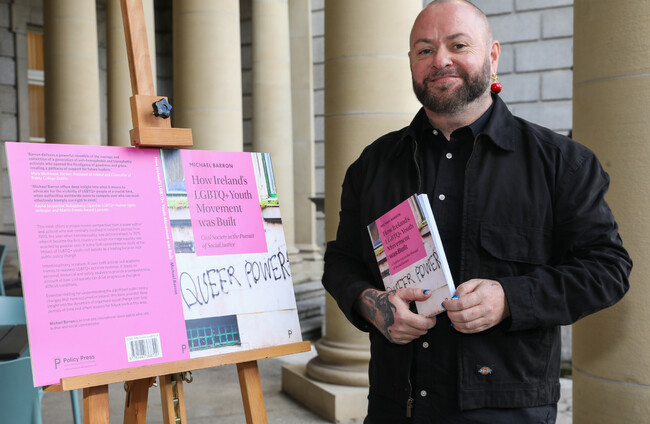
Dr. Michael Barron is an Irish social justice advocate, writer, and strategist. He was the founding director of BeLonG To, EQUATE, and The Rowan Trust, and has worked internationally with UNESCO, the Council of Europe, and the OSCE. His writing combines queer memory, political strategy, and movement building. He lives in Valencia with his husband, Jaime Nanci.
His new book, How Ireland’s LGBTQ+ Youth Movement Was Built: Civil Society in the Pursuit of Social Justice (Policy Press, 2025), is available now.
To embed this post, copy the code below on your site












have your say