We need your help now

Support from readers like you keeps The Journal open.

You are visiting us because we have something you value. Independent, unbiased news that tells the truth. Advertising revenue goes some way to support our mission, but this year it has not been enough.

If you've seen value in our reporting, please contribute what you can, so we can continue to produce accurate and meaningful journalism. For everyone who needs it.

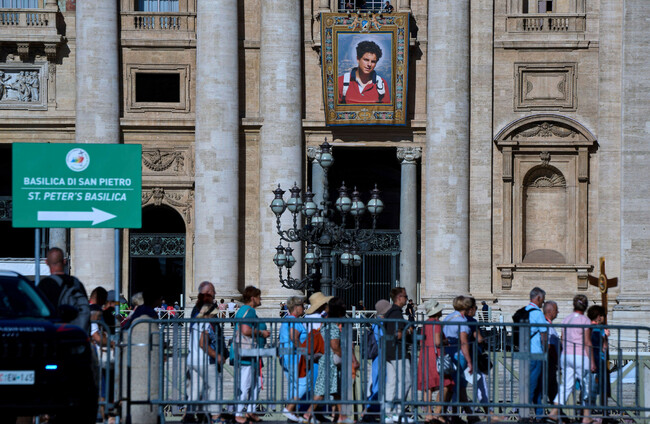
A portrait of Saint Carlo Acutis in the Vatican pictured earlier this month ahead of his canonisation on 7 September. Alamy Stock Photo

Opinion Cynics suggest the Church may use Carlo to boost attendance - there may be merit to that claim

Dublin priest Father Michael Collins charts Saint Carlo Acutis’s canonisation and the high-profile treatment it’s been given.

GO INTO ANY church in Ireland and you will probably see two saints lurking in the back corners nearest the door.

Well, perhaps not real saints, but statues of people who died a long time ago and are among Irish Catholics’ favourite spiritual beings.

Marie Françoise-Thérèse Martin, who became Saint Thérèse of Lisieux, was born in northern France in 1873. At the age of 15, the teen entered the Carmelite Order at Lisieux, where she lived a relatively obscure life until her death of tuberculosis at the age of 24. 

Today, no convent in the world would dream of admitting a child of 15, but times were different then.

Towards the end of her life, the normally cheerful girl revealed that she sometimes doubted whether God existed. 

Reflecting on her life after death, many claimed she was a person of outstanding holiness. A process was opened to examine her life, which led to her canonisation in 1925.

St. Anthony of Padua (although born in Portugal) is arguably even more popular. Who has not prayed, in desperation, to find keys and wallets?

One of the early followers of St. Francis of Assisi, Antony was an impressive preacher. As time went by he was venerated for his extraordinary care of the poor and the sick.

A year after his death in 1231, at the age of 35, Antony was one of the most quickly canonised saints in history.  The statue of St. Antony often showed the saint holding a book on which the infant Jesus appears. 

Since Sunday 7 September, the Catholic Church has two new saints: Pier Giorgio Frassati and Carlo Acutis.

Newly canonised

Frassati was an engineering student from Turin and a member of the St. Vincent de Paul Society in his local parish.

An opponent of Fascism, he agitated for social reform on behalf of the poor of his district.

Struck down with polio at the age of 24, the athletic young man whose passion was mountaineering, died in his mother’s arms.

Seven years after his death in 1925, many poor people whom he had helped called for his canonisation.

The process of collecting the testimony of witnesses and investigation into the claims of miracles was slow. The alleged cure of a young man in 1933 was not recognised for decades and Frasatti was only beatified in 1990.

A year following that ceremony in Rome, an infant was born in London to Italian parents who would go on to become our other newest saint.

Saint Carlo’s childhood 

In September 1991, Carlo Acutis’ family returned to Italy where his father Andrea worked in his father’s insurance firm.

A wealthy family, the parents doted on their child, and his shopaholic mother showered Carlo with largely unwanted gifts.

To their surprise, the young Carlo developed a precocious interest in his Catholic faith, unusual given that his parents rarely attended Mass or had much interest in their religion.

At the age of seven, Carlo received his First Holy Communion, three years earlier than the norm in Italy.

From that time, he recited the rosary and attended Mass almost every day. This already marked him out as unusual. 

When his mother insisted on buying several pairs of jeans and sneakers on her shopping trip, Carlo pointed out to her that he only had two feet.

He saved his pocket money and gifts from birthdays and Christmas and bought sleeping bags and blankets for the poor, many of which were Muslim migrants, who lived rough on nearby streets.

After the family dinner, he regularly brought food he had cooked for them.

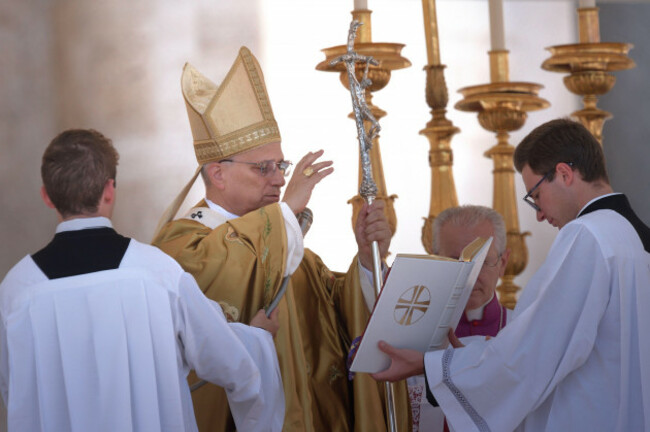
vatican-city-vatican-07th-sep-2025-vatican-city-vatican-september-07-pope-leo-xiv-holds-the-canonisation-ceremony-of-carlo-acutis-and-pier-giorgio-frassati-in-st-peters-square-at-the-vatican Alamy Stock Photo Alamy Stock Photo

So far, nothing particularly saintly, just a nice kid. An interest in miracles of the Eucharist led him to design a website documenting the phenomena.

He was born at the dawn of the internet. While older people thought he was quite brilliant at coding, by today’s standards, Carlo would be seen as a Luddite. 

Shortly after beginning school in September 2006, Carlo began to feel unwell and within a few days his symptoms worsened.

Admitted to hospital in Monza near Milan, he was diagnosed with a rapid form of leukaemia. His condition deteriorated and on 12 October, he died at the age of 15.

Becoming a saint

Five years later, at the request of many people who believed Carlo to be a saint, the diocese of Milan and the Vatican began the process of examining his life.

Just thirteen years later a miraculous healing of a young Brazilian boy was attributed to  his intercession and Carlo was beatified in Assisi where he had been buried. 

The mother of a girl almost fatally injured in a traffic accident travelled to Assisi and prayed at the young boy’s tomb for several hours. As she left Assisi, the hospital staff phoned to say that her daughter had suddenly regained consciousness.

The girl’s mother believed that her prayers had brought the healing, while the medics were confounded by the sudden and permanent cure. All the medical records were examined and the miracle was accepted as genuine.

Is there something mildly distasteful about wonder-working saints? Christians of the Reformed tradition look askance at the ‘exaggerated’ claims Catholics make about the saints. There should be no need to ask the intercession of saints – a direct prayer to God will be heard. 

There has been quite a fuss over Carlo Acutis in the period of his canonisation.

Cynics suggest that Church authorities may use life of the young boy to bolster falling participation in Catholic life in some parts of the world which have been rocked by clerical sexual abuse scandals. There may well be merit to that claim. 

We must acknowledge that there are many fine young people who love their faith.

Donal Walsh from Blennerville in County Kerry derived great comfort from his Catholic faith as he faced terminal cancer.

Even after his death in 2013 at the age of 16, Donal’s memory is alive not only in his family circle but is an inspiration for thousands of young people who admire his bravery and tenacity.

In an age of celebrities, maybe we all want to believe in holy heroes.

Fr. Michael Collins is the author of Carlo Acutis God’s Influencer – A Short Biography, published by Red Stripe Press.

Readers like you are keeping these stories free for everyone...
A mix of advertising and supporting contributions helps keep paywalls away from valuable information like this article. Over 5,000 readers like you have already stepped up and support us with a monthly payment or a once-off donation.

Close
JournalTv
News in 60 seconds