Take part in our latest brand partnership survey

We need your help now

Support from readers like you keeps The Journal open.

You are visiting us because we have something you value. Independent, unbiased news that tells the truth. Advertising revenue goes some way to support our mission, but this year it has not been enough.

If you've seen value in our reporting, please contribute what you can, so we can continue to produce accurate and meaningful journalism. For everyone who needs it.

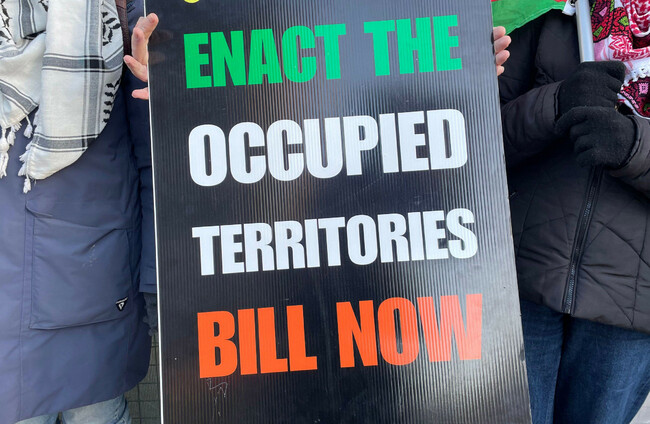
Irish Palestine Solidarity Campaign protest outside Leinster House calling for the Occupied Territories Bill to be enacted. Alamy Stock Photo

Law professor Diluting the Occupied Territories Bill would be a political choice more than a legal one

Conor Crummey examines the Taoiseach’s comments that the Attorney General has advised that the bill in its current form would not be implementable.

IF THE TAOISEACH’S comments in the Dáil last week are to be believed, the Occupied Territories Bill is to be significantly diluted before it is brought to the Oireachtas.

Micheál Martin indicated that the legislation, which would make it a criminal offence to engage in particular kinds of trade with illegal Israeli settlements in the Palestinian West Bank, would apply only to goods, not services.

Rather than make political arguments for watering down the legislation, the Government instead relies on vague allusions to legal or constitutional problems with the bill. It is not obvious what legal problems there could be with including services in the bill, and since Attorney General advice is not made public, most of us have no way of assessing this claim.

This tactic – pointing to confidential advice and undefined legal issues – is a helpful one for a government to employ if it wants to avoid having to defend an unpopular political choice on policy grounds.

‘Not implementable’

Speaking to the Dáil last week, the Taoiseach said: “The Attorney General is coming back to us on a number of fronts – one is implementability, by the way. The feedback I am getting is it is not just implementable, but, second, are you putting companies based here in a very difficult position through no fault of their own in respect of how that would be treated in the United States?”

What does it mean to say the bill is not ‘implementable’? Since the Taoiseach is invoking the Attorney General, presumably he means that there are legal reasons why the bill cannot be passed. What might these legal issues be? During a parliamentary debate last November, the Taoiseach stated that the Attorney General’s advice “remains that the Bill, in its present form, is incompatible with EU law and the Constitution”. Perhaps, in last week’s statement, the Taoiseach meant that either the Constitution or EU law stands in the way of including services in the bill.

Fortunately, this is a rare occasion on which we can check the Attorney General’s advice on the matter. Earlier this year, The Ditch published the Attorney General’s leaked advice. The Attorney General carried out a careful analysis of the potential issues under both EU and domestic constitutional law. He pointed to certain issues of constitutional and EU law, but made clear that these issues could be resolved with minor amendments prior to enactment. Notably, nowhere in his advice did the Attorney General say that the bill’s scope needed to be confined to exclude services.

If the constitutional issues were unrelated to the inclusion of services in the bill, the obvious conclusion is that the exclusion of services is a political choice. What might the Government’s political reasons be?

Avoiding US backlash?

Well, look again at the second half of the Taoiseach’s statements last week: “Are you putting companies based here in a very difficult position through no fault of their own in respect of how that would be treated in the United States?” Our economy is, at present, heavily reliant on the US tech sector. Against this backdrop, the Government may wish to avoid ‘provoking’ the US President. The difficulty, of course, is that the people that elected the Government overwhelmingly support solidarity with Palestine.

Watering down a law that is designed to curb trade with a genocidal state’s illegal settlements would not be a popular measure. Arguing that it needs to be done to appease the United States would be less popular still. So the Government finds itself between a rock and a hard place.

If you are in government and find yourself in this kind of position, there is an easy solution. If you don’t want to pass part of a law for political reasons, but you think that this might be difficult to defend to the public, just say there are constitutional or legal issues with the bill (but don’t be too specific). It’s not just you that says so; it’s the Attorney General. The Attorney’s advice is confidential, so the public (unless those meddling kids at The Ditch interfere again) will just have to take your word for it.

All of this is bad practice in a democracy. In order to ensure that the Government is accountable to the public, policy choices must be defended as just that: policy choices. Sometimes proposed legislation would be plainly unconstitutional, and it would be a waste of time to bring it forward.

Other times it isn’t clear whether legislation would be constitutional or not. The Constitution itself provides a mechanism to refer legislation to the Supreme Court in these circumstances. Other times, however, it is clear that vaguely defined constitutional issues (or even more vague allusions to ‘implementability’) being used as cover to avoid substantive political debate. This is one of those occasions.

If the Government wants to water down the Occupied Territories Bill, it should be upfront about its reasons and let the public judge those reasons.

Conor Crummey is Assistant Professor in Law at Maynooth University School of Law and Criminology. He lectures in constitutional law, administrative law and legal philosophy.

Readers like you are keeping these stories free for everyone...
A mix of advertising and supporting contributions helps keep paywalls away from valuable information like this article. Over 5,000 readers like you have already stepped up and support us with a monthly payment or a once-off donation.

Close
JournalTv
News in 60 seconds