Sign in. It’s quick, free and it’s up to you.
An account is an optional way to support the work we do. Find out more.
Sign in. It’s quick, free and it’s up to you.
An account is an optional way to support the work we do. Find out more.
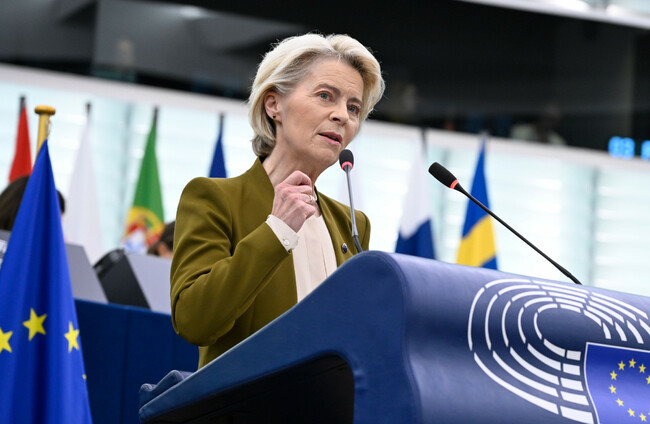

THE EUROPEAN COMMISSION President Ursula von der Leyen has belatedly proposed the suspension of trade aspects of the European Union’s Association Agreement with Israel. While the details of her proposal remain to be defined, it is clearly long overdue for the EU to take serious action against the behaviour of an Israeli government that is in such egregious breach of Europe’s most fundamental values.
Europe’s problem for some time has been that, while most of its member states – led by Ireland amongst others – have been urging it to act, it can only do so on trade matters by a qualified majority. A small group of countries, led by Germany and Italy, have thus far been able to block the will of the majority.
Now that the Commission has shifted its position to support serious trade measures, there is a renewed prospect of achieving a qualified majority for action against Israel. However, for that to happen, a change in the position of one or more of the recalcitrant member states will be required.
Germany has a particular responsibility in that regard, and a change in its position would carry most weight.
There are two striking facets to today’s Germany. On the one hand, it is an obviously admirable, decent and democratic country, a powerful advocate of the European Union and of its values. On the other hand, it still bears a deep and understandable guilt for the Holocaust, a guilt that it has admirably sought to come to terms with. These two realities, especially in the context of the Gaza conflict, are in growing tension with each other.
There are five reasons why Germany’s contemporary values, rather than its historical guilt, should predominate in determining its position on the Commission’s proposal to suspend aspects of the EU’s trade relationship with Israel. This does not mean for a moment that Germany should water down, in any way, its courageous acceptance of its own responsibility for genocide, or that its European partners should dismiss or downplay the sensitivities of Germany’s history.
The first reason for the German government to support the Commission’s proposal to suspend aspects of the EU’s Association Agreement with Israel is simply that the behaviour of Benjamin Netanyahu’s government towards the Palestinians in Gaza, as well as in the West Bank, is despicable by any standards of decency. Today’s Germany cannot be comfortable with the random killing of tens of thousands of innocent women and children or the blatant use of starvation as a weapon of war.
Second, while it will ultimately be for international courts to determine whether Israel’s behaviour has legally amounted to genocide, it certainly bears significant hallmarks of it. Germany’s important and laudable commitment to ensuring that genocide can never happen again can no longer be simply equated with unquestioning support for the current Israeli government.
Clearly, it is for the German people themselves to decide how best to come to terms with their tortured history, and I have immense respect and empathy for them in the difficult choices they must make. However, Hitler’s uniquely grotesque attempt to annihilate the Jewish people was founded on the belief that there was a superior race and an inferior race. It is hard not to conclude that the Netanyahu government, in contrast to many ordinary Israelis, regards the Palestinian people as inferior and their lives as entirely expendable. One thinks, for example, of the Israeli Minister who referred to Palestinians as “human animals”.
The third reason for Germany to reconsider its position is that a great many Israelis want Israel’s offensive to stop and for the hostages, seized by Hamas terrorists in the appalling 7 October attacks, to be returned. Most Israelis have indicated that they don’t trust the Netanyahu government and many fear that their Prime Minister is working to undermine Israeli democracy.
When the German government considers how best to maintain its long-term support for Israel, it should surely bear in mind the views of the Israeli people and the future of their democracy as well as the position of Netanyahu’s government. Many Jewish people around the world are also horrified by the behaviour of the Israeli Government.
Fourth, there has been a shift in opinion amongst many Germans themselves. While outsiders, like myself, may be regarded as impertinent in offering advice, the German government will surely take some account of shifting opinion amongst their compatriots. Ursula von der Leyen is herself, of course, German. Many would attribute her very regrettable lack of balance until now in her approach to the Gaza conflict as reflective of her nationality and her shared sense of German guilt. By proposing trade measures, she has significantly shifted her position and that of the European Commission. Moreover, many former German Ambassadors have signed a press release calling for much stronger action against Israel than that proposed by recently by the Commission President.
Finally, and perhaps most importantly, the failure thus far of the European Union to act on the Gaza conflict, due to the blocking minority in which Germany has played a central role, is doing deep damage to the European Union’s reputation amongst its own citizens and more widely. It also leaves it open to charges of hypocrisy, given Europe’s strong approach to Russian aggression in Ukraine, a conflict with obvious and strong echoes of Israel’s conduct: seizing land, the relentless targeting of civilians and the perpetration of other war crimes.
Germany is acutely aware that the EU must urgently step up to address the dangerous and growing challenges it faces. Assisting Europe to take a principled position on the Gaza conflict would represent a vital step in that regard.
Bobby McDonagh is a former Irish Ambassador to the EU, UK and Italy. He is an executive coach and commentator on subjects around EU and Brexit.
To embed this post, copy the code below on your site














have your say