Sign in. It’s quick, free and it’s up to you.
An account is an optional way to support the work we do. Find out more.
Sign in. It’s quick, free and it’s up to you.
An account is an optional way to support the work we do. Find out more.

OFFICE COMEDY IS having a cultural moment.
As a debut author of a workplace comedy, I would say that. But it’s not just me. The Paper, the new sitcom from the team that created The Office (and starring our own Domhnall Gleeson), has just been commissioned for a second season. Low-rent law-office comedy Fisk is back on Netflix for a third season. Here at home, The Lunch Punch Power Hour, a theatrical farce set in a Dublin office, just wrapped up a run at the Peacock Theatre.
But beyond the laughter, labour unions and collective action are proving to be bastions of hope and levers of power, at a time when our political leaders dither in a moral vacuum or backslide into conservatism. After decades of union decline, the rise of the gig economy and the subsequent erosion of employment rights, worker power seems to be on an upswing.
You might not see it in headline-grabbing instant results, however. Slow and steady pressure can open the door to change – not by bursting it open all at once, but by relentlessly worrying away at the hinges, using a variety of tools, until eventually there’s a shift, a splintering, and a new way appears.
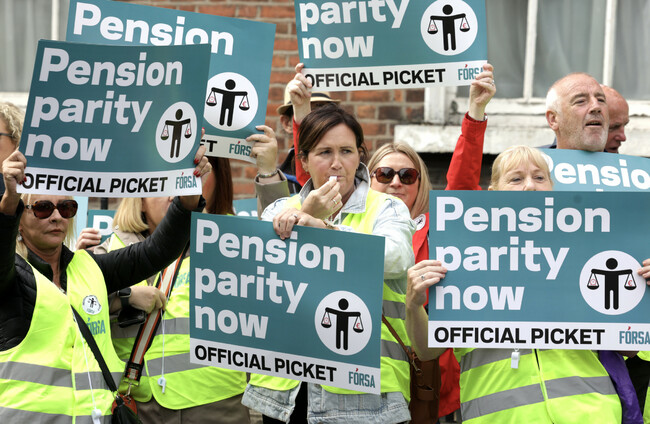
Here in Ireland, the government recently agreed to pension-parity talks with school secretaries and caretakers after two weeks of strike action organised by the Fórsa trade union.
Also this month, RTÉ announced that it would not take part in the Eurovision Song Contest next year if Israel is a participant. The announcement followed a letter sent by the National Union of Journalists to the Irish broadcaster in May, asking RTÉ to oppose Israel’s participation in the competition. The NUJ said it believes RTÉ’s decision reflects the views of its members.
And while the Irish government officially decries the ongoing genocide in Gaza, its failure to take any meaningful action to effect change is driving citizens – often represented by labour unions – to get organised.
In August, the ICTU, a national representative for trade unions around the country, called on the Central Bank not to rubberstamp the sale of Israeli war bonds, as protestors took to the streets with the same message. Right before the deadline, Israel withdrew its request (instead moving it to Luxembourg).
After the decision was announced, the Unite union – representing staff working in the Central Bank – issued a statement expressing “revulsion” at the position bank workers had been placed in.
Meanwhile, as non-governmental organisations and activists took to boats to try to bring aid directly in to Gaza, an Italian dockworkers’ union threatened to “shut down all of Europe” and block all shipments to Israel if communication with the aid flotilla was disrupted.
In a statement, the Unione Sindacale di Base (USB) said: “Where governments have failed, people can reach. Workers can play a decisive role in influencing the outcome of the situation.” Since then, union-backed workers have blocked several Italian ports and taken part in strikes around the country, disrupting public transport.
It’s worth remembering that in 1984, it was the Irish Distributive and Administrative Trade Union (IDATU) that instructed Dunnes Stores staff not to handle South African goods, as a protest against the apartheid regime – an action that led to a workers’ strike lasting nearly three years. Nelson Mandela later said the strike demonstrated that “ordinary people far away… cared for our freedom”.
Meanwhile, creative professionals are also resorting to old-school tactics to defend not just their livelihoods, but their very ownership of the things they create. Generative AI tools are marketed by Big Tech companies as improving our working lives and relieving us of mundane admin tasks.
But a series of lawsuits in the US are exposing the truth behind the hype: many of the Large Language Models (LLMs) used to create generative AI products have been built on the creative works of others, without consent or compensation.
What cutting-edge tools are creators using to push back? The means are refreshingly old-fashioned: collective bargaining, strike action, and the enforcement of long-standing copyright laws. It may not be glamorous, but it seems to be getting the job done.
In 2023, Hollywood screenwriters went on strike, soon followed by actors. Both groups were represented by large labour unions in negotiations with studio heads. While much of the writers’ strike centred around fundamentals like pension and healthcare benefits, the Writers Guild of America also won regulation around the use of artificial intelligence, to protect creatives from having their work exploited without permission or payment.
As a newly published author, I’ve just joined the Society of Authors, a labour union representing UK and Irish authors and currently chaired by Vanessa Fox O’Loughlin, AKA Sam Blake, a bestselling author and well-known figure in Irish publishing. (Sam Blake herself was recently in the news when fake AI-generated books appeared online, with her name on the cover.)
The Society of Authors are actively raising a collective voice against the use of AI in publishing. In April, they organised a ‘day of protest’ outside Meta’s offices in London, to protest alleged theft of copyrighted works; they are lobbying the UK government against the unlicensed use of books to train AI; and their policy team is advising members on the ongoing class action lawsuit against AI firm Anthropic in the US.
The Anthropic class action was brought by authors and publishers who say their copyright was infringed when the company, which built the AI chatbot ‘Claude’, admitted to using books from pirate websites to train their Large Language Model. The case is due back in court on 25 September, when the judge will make a ruling on a proposed settlement.
The world may be on fire, but there are reasons to be hopeful if we work together. The power brokers at the top of the ladder would do well to remember that the people down below are used to hard work, and they have access to tools.
Sylvia Leatham is an author from Dublin. Her debut novel, Chaos Theory, is out now.
To embed this post, copy the code below on your site















have your say