We need your help now

Support from readers like you keeps The Journal open.

You are visiting us because we have something you value. Independent, unbiased news that tells the truth. Advertising revenue goes some way to support our mission, but this year it has not been enough.

If you've seen value in our reporting, please contribute what you can, so we can continue to produce accurate and meaningful journalism. For everyone who needs it.

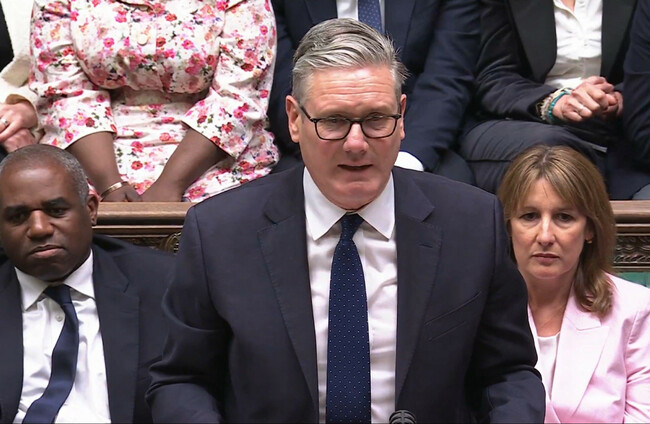
Keir Starmer during the debate on the King's Speech in the House of Commons, London, after the State Opening of Parliament. Wednesday. Alamy Stock Photo

Keir's woes Starmer may be weak, but his opponents are not strong

British PM Keir Starmer’s authority has steadily collapsed this week, but a change of leader may do little to stop Labour’s deeper electoral decline, writes Sydney Nash.

LAST UPDATE | 19 hrs ago

THE VOTES ARE in, and no one likes Keir Starmer. At least, that’s the conclusion being drawn from last week’s elections in England, Scotland and Wales.

At a purely technical level, Starmer was not on the ballot, but that did not stop Nigel Farage and his team from using the slogan “Vote Reform, Get Starmer Out”.

The events of the past week would suggest that that message was bang on the money.

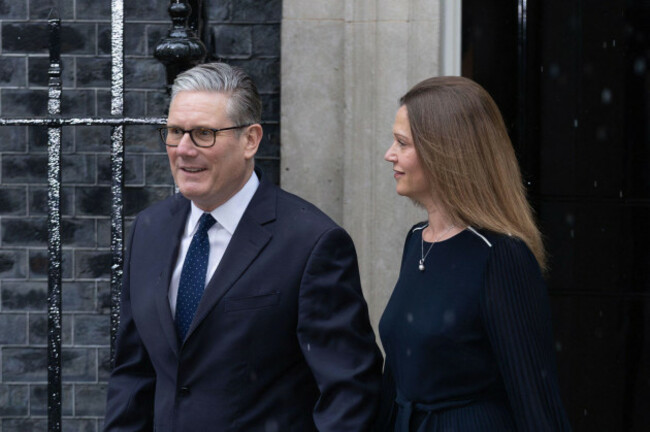
london-england-uk-13th-may-2026-uk-prime-minister-keir-starmer-l-and-his-wife-victoria-starmer-depart-10-downing-street-to-attend-the-state-opening-of-parliament-in-london-credit-image Starmer and his wife Victoria depart 10 Downing Street to attend the State Opening of Parliament in London on Wednesday. Alamy Stock Photo Alamy Stock Photo

Last Thursday, Reform hoovered up votes by the thousand. In England, they gained 1,452 council seats. Labour lost 1,498. In Wales, Reform won 34 seats, having previously had none.

Labour limped home with nine, having previously been the government. Reform even grew its vote share in Scotland, winning 17 seats, giving it the same representation in Edinburgh as Labour.

Labour’s electoral pain was not inflicted by Reform alone – the Greens, Plaid Cymru, Liberal Democrats, and Scottish National Party (SNP) all significantly contributed to Labour’s collapse.

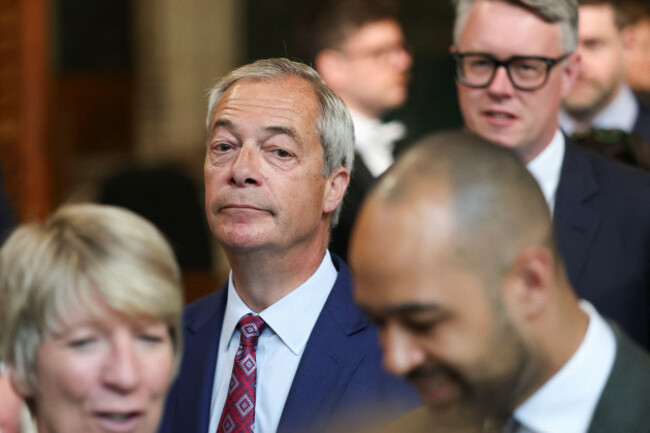
reform-uk-leader-nigel-farage-walks-through-the-members-lobby-of-the-houses-of-parliament-in-london-to-the-house-of-lords-to-hear-the-kings-speech-during-the-state-opening-of-parliament-picture-dat Nigel Farage's Reform Party has caused ripples in UK politics in recent weeks. Alamy Stock Photo Alamy Stock Photo

Despite this, a significant number of senior Labour figures seem to have read Reform’s slogan as a prophecy and are now focusing their time on trying to make it come true.

The calls for Starmer to resign began long before the elections. Anas Sarwar, Leader of the Labour Party in Scotland, sensing that Starmer was a drag on his own electoral prospects, called on him to step down in February. Back then, the Cabinet rallied behind Starmer. No longer.

Mutterings of a heave

On Monday, Home Secretary Shababa Mahmood told Starmer to resign. A day later, the stakes were raised. Four ministers – Miatta Fahnbulleh, Jess Philips, Alex Davies-Jones and Zubir Ahmed – joined calls for Starmer to resign and quit their jobs as well, for good measure.

Five Parliamentary Private Secretaries have also resigned, and at the time of writing, more than 80 Labour MPs had publicly called on Starmer to stand aside and make way for a new Labour leader and a new prime minister.

All of this has a strikingly familiar feel to it. It is less than four years since Boris Johnson faced a series of resignations, which ultimately led him to quit. In July 2022, Johnson suffered the indignity of more than 30 ministers and aides resigning in less than 24 hours.

file-this-photo-combination-shows-from-left-wes-streeting-in-liverpool-sept-30-2025-angela-rayner-in-shoreditch-london-june-5-2025-andy-burnham-in-liverpool-sept-29-2025-shabana-mahmoo Wes Streeting, Angela Rayner, Andy Burnham, Shabana Mahmood and Ed Miliband. Alamy Stock Photo Alamy Stock Photo

Starmer is not facing this level of disloyalty yet, but just like Johnson, he is deeply unpopular, mired in scandal (the appointment of Peter Mandelson as ambassador to the US for Starmer, the Owen Paterson, Chris Pincher and Partygate scandals for Johnson), and has taken a kicking at the local elections.

For Starmer, all of this is happening just 22 months after he won an enormous majority. For Johnson, the demise came only 19 months after he had won his own.

The similarities are so stark that it can feel as if the United Kingdom is living politics on repeat.

Could Starmer survive?

If that is the case, Labour politicians should reflect carefully on what happened to the Conservatives after Johnson was ousted. Some are doing this, and it is causing them to pause in fear of a leadership contest leading to chaos, not a reversal in electoral fortunes. 

Meanwhile, Starmer is digging in. Even though his appointment of Gordon Brown and Harriet Harman to newly created roles was met with bemusement, his reset speech on Monday was viewed as underwhelming, and the King’s Speech was overshadowed by leadership challengers coming to Downing Street, Starmer remains bullish and says he has no intention of resigning. This might come across as wishful thinking, but there is reason to believe that Starmer might be able to hang on, at least for now. 

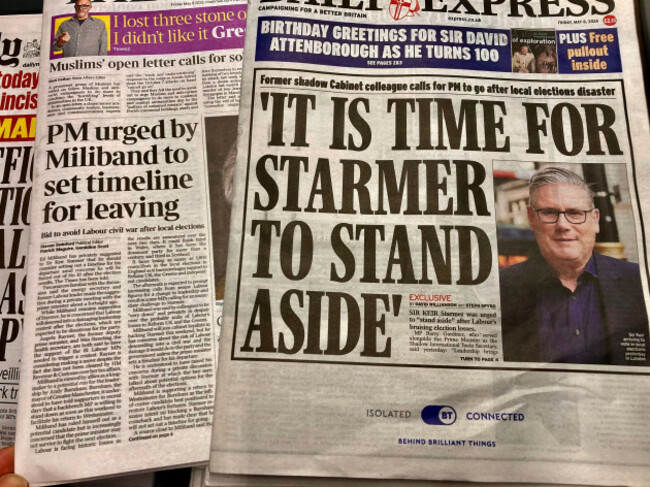
british-newspaper-widely-report-keir-starmer-was-urged-to-stand-aside-after-labour-lost-in-2026-may-local-election British newspaper widely report Keir Starmer was urged to stand aside after Labour lost in 2026 May local election Alamy Stock Photo Alamy Stock Photo

If Starmer’s opponents want to get rid of him, 81 MPs must back one specific challenger before a leadership election can be triggered. This would be a difficult hurdle to overcome under any circumstances, but the lack of consensus amongst Labour MPs regarding who they want to replace Starmer makes it even more challenging.

Furthermore, 111 MPs have now signed a statement opposing a leadership contest, while the bookmakers’ favourite to replace Starmer, Mayor of Manchester Andy Burnham, cannot be Labour leader, let alone PM since he is not even an MP. Starmer is undoubtedly weak, but his opponents are not overwhelmingly strong.

Given this, don’t be surprised if weeks and maybe even months pass with Starmer still occupying Number 10. If that does happen, we can expect further attempts at a government reset, most probably at the Labour Party conference in September.

Recent evidence suggests that such attempts will fail, in which case, the news will be dominated by the list of challengers who will continue to sit in the wings, waiting to topple Starmer. However, if they wait too long, they will quickly find themselves facing an electoral Groundhog Day when the UK next goes to the polls in May 2027.

Who wins?

If Starmer does go, the Labour Party will have solved the problem of having him as its leader. However, this may not be enough for them to solve the problem of how Labour survives in a new age of electoral politics.

For at least the last decade, British politics has been undergoing a grinding and often dramatic restructuring. The origins of this can be found in the aftermath of the 2008 financial crash, which led many to conclude that the system was fundamentally broken. However, it was not until the 2016 Brexit referendum that the new divide in British politics was revealed.

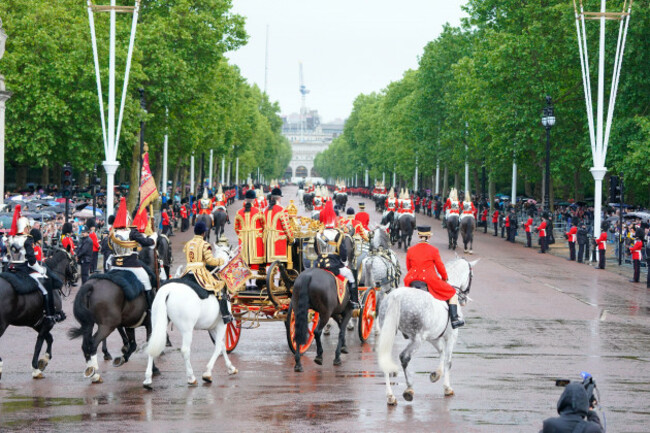
london-uk-13th-may-2026-king-charles-iii-and-queen-camilla-depart-buckingham-palace-in-the-irish-state-coach-en-route-to-the-palace-of-westminster-for-the-state-opening-of-parliament-where-the-ki Britain's King Charles and Queen Camilla depart Buckingham Palace for the Palace of Westminster for the State Opening of Parliament, where the King delivered his King’s Speech on Wednesday. Alamy Stock Photo Alamy Stock Photo

What was expressed as leave vs. remain then has since been variously described as open vs. closed, nativist vs. internationalist, somewheres vs. nowheres, and haves vs. have nots. However, it is imperfectly labelled; this is the divide that now runs through British politics, and it is forcing every political party to respond.

This is easier for some than it is for others. Reform, the Liberal Democrats, the Green Party, Plaid Cymru and the SNP all sit comfortably on one side or the other of this divide, and they are increasingly able to reap the rewards at the ballot box, just as they did last week. Labour, like the Conservatives, appears to be stuck, simultaneously on both sides of the divide and on neither.

The problem for Labour is not just that it has an unpopular leader (although this certainly doesn’t help) but that the structural changes in British politics risk making it appear irrelevant in the eyes of voters. Addressing this will require Labour to completely reinvent itself.

This is an enormous challenge, and the temptation will be to avoid the difficult questions, the arguments and the trade-offs, convince oneself that only Starmer was the problem, and hope that all that is needed to change Labour’s electoral fortunes is to get rid of him. It won’t be.

Changing leaders will only change Labour’s electoral fortunes if a new leader has the vision, capability, charisma and energy required to carry their party through this reinvention whilst simultaneously running the government.

Whether or not such a leader exists within Labour’s ranks remains to be seen.

Sydney Nash is a former civil servant, UK/EU negotiator, and advisor on Brexit and international trade. He writes in a personal capacity and can be found on Substack @nashsgc.

Readers like you are keeping these stories free for everyone...
A mix of advertising and supporting contributions helps keep paywalls away from valuable information like this article. Over 5,000 readers like you have already stepped up and support us with a monthly payment or a once-off donation.

View 15 comments
Close
15 Comments
This is YOUR comments community. Stay civil, stay constructive, stay on topic. Please familiarise yourself with our comments policy here before taking part.
Leave a Comment
    Submit a report
    Please help us understand how this comment violates our community guidelines.
    Thank you for the feedback
    Your feedback has been sent to our team for review.

    Leave a commentcancel

     
    JournalTv
    News in 60 seconds