We need your help now

Support from readers like you keeps The Journal open.

You are visiting us because we have something you value. Independent, unbiased news that tells the truth. Advertising revenue goes some way to support our mission, but this year it has not been enough.

If you've seen value in our reporting, please contribute what you can, so we can continue to produce accurate and meaningful journalism. For everyone who needs it.

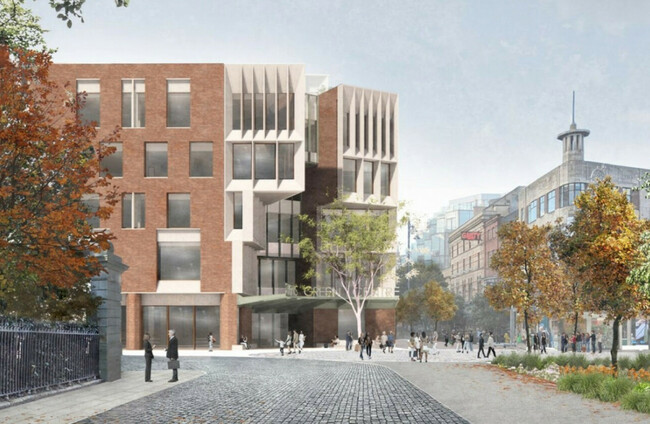
Digital visual of what the shopping centre could look like. Dublin City Council

Stephen's Green Shopping Centre Jaded Dubliners have had enough of bland, soulless buildings

As the battle over the Victorian-style landmark continues, Andrea Horan says it highlights a growing revolt in Dublin against monotonous, profit-driven architecture.

LAST WEEK, IT was announced that the owners of Stephen’s Green Shopping Centre had received permission from Dublin City Council to go ahead with their plans to redevelop the centre.

The public reaction to this decision was not good.

Between vox pops and instagram videos, articles and online commentary, the contentious decision provoked strong feelings of frustration amongst the people who Dublin belongs to – its population.

A poll in The Journal revealed a result of 81% of people who hated or didn’t like the planned redevelopment. 

What has been proposed for the redevelopment makes sense from a pragmatic perspective and based on market needs. It includes the reconfiguration of the retail spaces to create larger units to attract high(er)-quality retailers; 29,251 square metres of A-rated office space that appeals to multinationals; a two-screen cinema, and bringing the streetscape alive again on South King Street by opening up storefronts along the street that is currently dead street space.

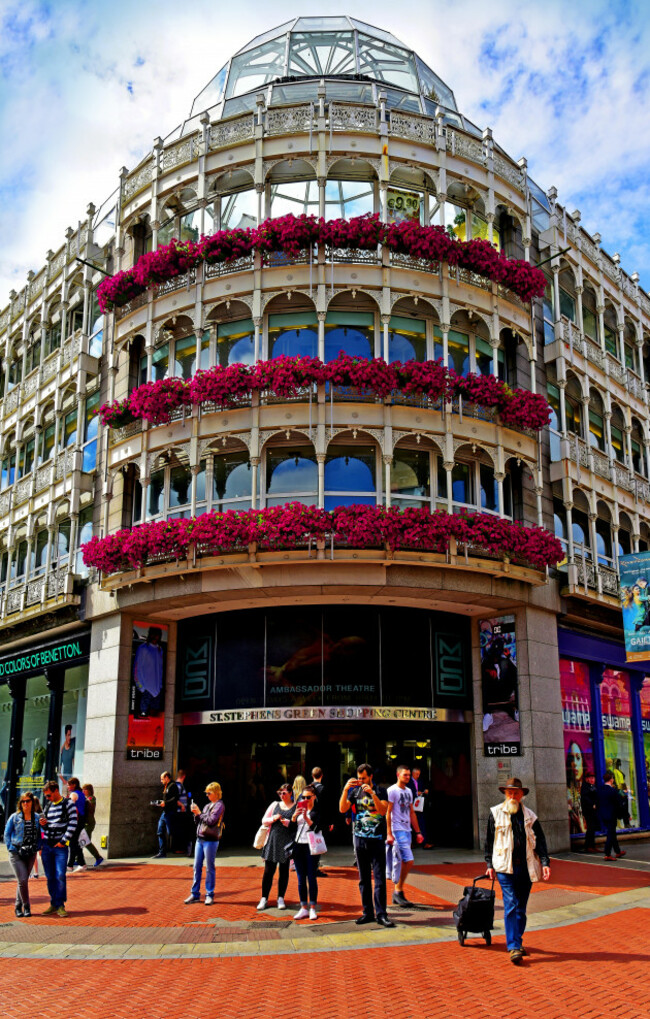
dublin-ireland-st-stephens-green-shopping-centre Alamy Stock Photo Alamy Stock Photo

Would it have felt progressive and within the interests of the city dwellers to turn the centre into something more civically minded, like a bustling food market with a botanical garden a la the Atocha station in Madrid, with retail, cultural space and residential units on the upper levels? Absolutely. But ‘commercial viability’ and the ‘market decides’ are the mantras for the world we live in, and international retailers and offices are where the money is at. Until we have a planning system that plans for the city we need rather than for who has the most money, this is the system we have to accept.

Notably, the planning permission was granted with an ask for the owners to pay a 4.2 million development contribution to the council and a 1.3 million contribution to the planning authority in respect of the Luas Cross City Scheme.

What’s interesting, though, is that the pushback from the majority of the public wasn’t about what was going into the building. It was what the proposed building looked like. Or didn’t, as the case may be.

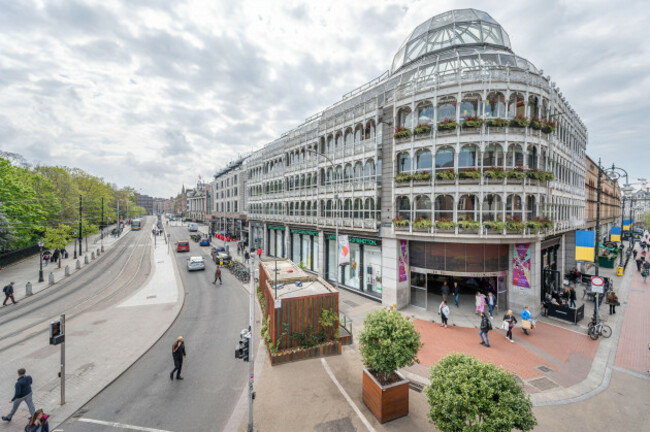
Stephen’s Green Shopping Centre has a facade that is found on many postcards of Dublin. It is a design that creates a sense of place and differentiation for the city. It is iconic. Granted, it is a faux Victorian design on the outside, but its distinctive curved facade has come to be beloved by visitors and residents alike. It may not have been universally loved, but it has become part of the fabric of Dublin City. And that counts for something.

exterior-of-st-stephens-green-shopping-centre-dublin-southern-ireland-eire The current Stephen's Green Shopping Centre. Alamy Stock Photo Alamy Stock Photo

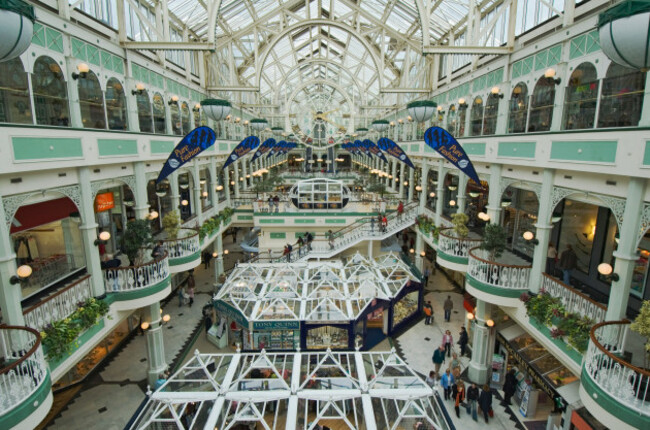
The building that has been there since the 80’s and its detailed ironwork and glass design create something charming and unique atop the main metropolitan street in Dublin. Inside, the dome and clock provide detailing that sparks interest, along with the curved balconies and greenhouse effect; you couldn’t be anywhere else but Dublin when you’re inside.

Jaded Dubliners

There has been such a huge negative reaction to the new design that it has felt puzzling to some. But whilst I don’t minimise the scale of discontent with the sharp and jagged new development, I do think that the frustration is cumulative and Dublin’s citizens are worn out from the assault of the lowest common design that has swept across the city.

Monotonous, uninspiring, soulless design has replaced buildings that had character, detailing and their own ecosystem of activity, culture and humanity within them. White-label hotels and student accommodation have taken over, built to be unassuming and unremarkable for the very reason that any brand could put their name over the door and instantly take ownership.

The Humanise Campaign, a global movement to push back against homogeneous and soulless modern design, has a slogan – ‘Human Beings Need Human Buildings’.  It is campaigning for buildings and cities which are interesting, joyful and human. The group has named the outbreak we’ve seen of these cheap, lowest common design buildings a ‘Blandemic (noun) – A damaging outbreak of bland, soulless architecture, that can cause physical, mental and social harm.’

The science is clear and can explain why the majority of people dislike these designs across the city, as well as the new proposal. Through neuroarchitecture – a growing interdisciplinary field merging neuroscience and architecture to study how built environments affect human behaviour, emotions and brain function – we can see the research results on why what we build matters. As humans, we thrive in certain environments. Aesthetics and good design have a positive physiological effect on us: reducing our stress, stabilising our heart rate, lowering our cortisol levels and helping us to relax.

Architect John Claflin & Lindsay Sturman, co-founder of the Livable Communities Initiative, co-authored ‘Why should we care about good urbanism’, and highlights that:

“When we look at a building with a blank facade made of materials like metal or glass, there is little for our eyes to rest on, but our brain is looking for a pattern — and this creates discomfort.While we process square and rectilinear buildings neutrally, jagged, angular shapes and details trigger a threat response in the brain. We associate sharp edges with danger, putting us on low-grade alert.Curved and rounded edges (arches, rounded doorways, organic shapes) are consistently preferred, as we process them as safer and more inviting.”

The sharp edge, the aggressive entrance, the jutting jagged angles and the dramatic pointedness all feel too harsh for this moment. It also mimics the lowest common design that is around the city: The rectangular, plain windows, red brick and glass. The materials and elements are stark and similar to the bland buildings that are impossible to escape in the city.

Design for a changing world

What’s at the Stephen’s Green site currently may not be an actual Victorian building, but it has heritage with the length of time it’s been there.

It has detailing and points of interest and softness provided with the planting, and it offers comfort in these very unsettling times.

ireland-dublin-st-stephens-green-shopping-centre-interior Alamy Stock Photo Alamy Stock Photo

When an architect slid into my DM’s this week saying they found ‘the backlash from non-architects fascinating’, it made me feel like this design was for other architects rather than the general public.

The Save Stephen’s Green campaign, comprised of architects, amongst others, posted “Architecture should never require the user to have any sort of academic knowledge to enjoy the experience of the space, and saying otherwise means completely missing the point of our profession and presenting ourselves as elitist, all of which lead to soulless, out-of-touch and overall, bad architecture.”

The whole point of architecture is to find the feeling, mood and surroundings and reflect that. The psychology of the user.

And for a population that has seen the city have the heart torn out of it for bland commercial development, this feels like a further attack.

A protest is now planned for this week outside the Stephen’s Green Shopping Centre, perhaps time for Dubliners to ensure they are heard.

Andrea Horan is the founder of Dublin nail bar Tropical Popical, The Hunreal Issues, co-founder of No More Hotels, and co-presenter of podcasts Don’t Stop Repealin‘ and United Ireland. 

Readers like you are keeping these stories free for everyone...
A mix of advertising and supporting contributions helps keep paywalls away from valuable information like this article. Over 5,000 readers like you have already stepped up and support us with a monthly payment or a once-off donation.

View 3 comments
Close
3 Comments
This is YOUR comments community. Stay civil, stay constructive, stay on topic. Please familiarise yourself with our comments policy here before taking part.
Leave a Comment
    Submit a report
    Please help us understand how this comment violates our community guidelines.
    Thank you for the feedback
    Your feedback has been sent to our team for review.

    Leave a commentcancel

     
    JournalTv
    News in 60 seconds