We need your help now

Support from readers like you keeps The Journal open.

You are visiting us because we have something you value. Independent, unbiased news that tells the truth. Advertising revenue goes some way to support our mission, but this year it has not been enough.

If you've seen value in our reporting, please contribute what you can, so we can continue to produce accurate and meaningful journalism. For everyone who needs it.

Alamy Live News.

Current scheme to house Ukrainians 'not fair' and 'too expensive', says Harris

He admitted that the initial approach taken by government to house those fleeing war in Ukraine is not something he would replicate in future.

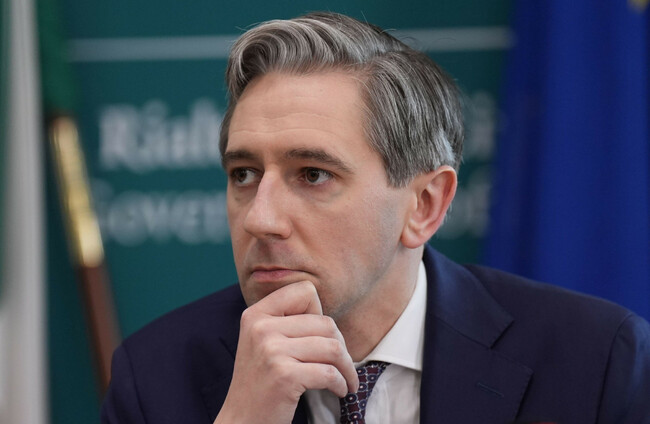
THE CURRENT SCHEME to house Ukrainian refugees is “not fair” and is in need of reform, Tánaiste Simon Harris said.

Ireland began taking in refugees from Ukraine in 2022. They were housed in various forms of accommodation contracted by the State, mainly hotels.

He admitted that the initial approach taken by government to house those fleeing war in Ukraine is not something he would replicate in future.

“I don’t think it was a mistake, but I think you learn from every crisis,” he said, continuing that he was proud of Ireland’s response.

“But you also do learn, and I think one of the learnings is the reliance. I can think of communities right across the country, I can think of communities that I represent in Dáil Eireann, where hotels were taken out of use.

“Now, interestingly, when [State] contracts have been not renewed, most of those hotels have become hotels again. So, we do need to look at the amount of money that was spent on this,” he said, adding that the amount “is very large”.

“I still think on balance it’s the right thing to do, it was the decent thing to do, but it’s not sustainable.”

The decision to begin withdrawing State-provided commercial accommodation has been the “position” of government for “quite some time”, the Taoiseach said yesterday.

Justice Minister Jim O’Callaghan secured the agreement on Monday afternoon at the Cabinet Committee on Justice, Migration and Social Affairs. 

Ukrainian people who arrived in Ireland before March 2024 will no longer be entitled to State-contracted commercial accommodation, with the exception of “highly vulnerable” people or those with barriers to independence. 

Currently 16,000 Ukrainian refugees are housed in State-provided accommodation.

Ukrainians have described feeling “lost” and “desperate” amidst the announcement of plans to withdraw the accommodation. Several have pointed towards the difficult rental market in Ireland and are unsure about how they will secure alternative accommodation. 

One woman told RTÉ News there is “huge uncertainty” for herself and her daughter. 

Green Party leader Roderic O’Gorman this morning said the move amounted to a cliff edge for families.

“The government says that this is a phased withdrawal but along with the removal of the Accommodation Recognition Payment, this is actually a very rapid removal of supports. Civilians are still dying every day in Ukraine.

“Now is not the time to take away all remaining supports for Ukrainians who were welcomed into communities across our country in 2022,” he said.

Stressing that people from Ukraine are welcome in Ireland, Harris said things have to be “regularised”.

“We can’t continue to spend billions of euros on accommodation, and we can’t continue to have a situation, and I say this really respectfully, but where people who are working in our country aren’t paying any rent.

“We can’t. There’s a social cohesion point here too,” he said.

A change in policy in 2024 means that Ukrainian refugees arriving into the country are only entitled to 30 days of State-provided accommodation, while those who arrived in Ireland beforehand have free reign to stay in their accommodation.

“So you now have some Ukrainians who are having to kind of go off into the rental market themselves, and you’ve other Ukrainians that since 2024 and before are living in rent-free state accommodation,” Harris said.

“It’s not fair. It’s too expensive, and it’s damaging to social cohesion.”

The move to change policy will be done carefully and in a transitionary way, he said, where vulnerable people will be protected. However, the move has garnered significant criticism.

Readers like you are keeping these stories free for everyone...
A mix of advertising and supporting contributions helps keep paywalls away from valuable information like this article. Over 5,000 readers like you have already stepped up and support us with a monthly payment or a once-off donation.

View 64 comments
Close
64 Comments
This is YOUR comments community. Stay civil, stay constructive, stay on topic. Please familiarise yourself with our comments policy here before taking part.
Leave a Comment
    Submit a report
    Please help us understand how this comment violates our community guidelines.
    Thank you for the feedback
    Your feedback has been sent to our team for review.

    Leave a commentcancel

     
    JournalTv
    News in 60 seconds