We need your help now

Support from readers like you keeps The Journal open.

You are visiting us because we have something you value. Independent, unbiased news that tells the truth. Advertising revenue goes some way to support our mission, but this year it has not been enough.

If you've seen value in our reporting, please contribute what you can, so we can continue to produce accurate and meaningful journalism. For everyone who needs it.

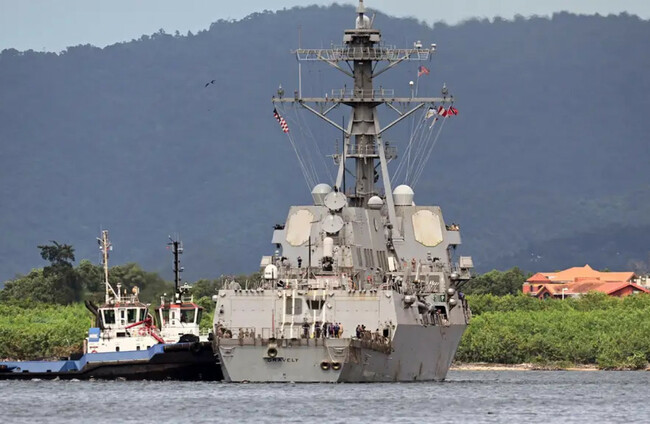
The USS Gravely destroyer preparing to dock for military exercises in Trinidad and Tobago, putting pressure on Venezuela. Robert Taylor/AP via PA

Opinion US strikes in the Caribbean show how far Washington has drifted from the rule of law

Hannah McCarthy details the fatal attacks by the US on ships in the Caribbean and what they tell us about America’s use of force.

FOR A FEW seconds, a small boat speeds along the blue waters of the Caribbean Sea.

In the next moments, a plume of smoke and flames engulfs the vessel.

The video of the lethal US air strike was shared by US Secretary of Defence Pete Hegseth on social media and was one of at least eleven such US attacks that have taken place in swathes of the Caribbean Sea which belong to Venezuela, an oil-rich state pushed into devastating economic turmoil by decades of government mismanagement and US sanctions.

Over 55 people have been killed in the recent US strikes in the Caribbean. Gustavo Petro, the Colombian president, said on X that one of those killed in the series of US strikes was Colombian fisherman Alejandro Carranza.

Petro has described the US bombing campaign as “murder” and said: “Whether in the Caribbean or Pacific, the US government strategy breaks the norms of international law.”

The US has long pushed the boundaries of international law and the use of lethal force outside of traditional armed conflict and self defence. 542 drone strikes were authorised by the Obama administration, which killed nearly 4,000 people, including 324 civilians, predominantly in Pakistan, Somalia and Yemen, without any trial, indictment or due process

America’s constitution grants the US Congress the sole power to declare war, with a narrow exception that allows the White House to lead the nation’s defense.

In order to carry-out the overseas drone strike, the Obama administration argued that it had congressional approval to target countries like Pakistan, Somalia and Yemen, where Islamist groups were present under the remit of the Use of Military Force Act. The act was drafted by the government of George W Bush in the aftermath of the 9/11 attacks in 2001.

The Use of Military Force Act provided the legal scaffolding for the so-called War on Terror. The legislation gave the US president the power to “use all necessary and appropriate force against those nations, organisations or persons” that he or she determines was behind or helped the people who carried out the 9/11 attacks.

After succeeding Bush in the White House, the Obama administration interpreted this power expansively to the point that critics have described it as allowing for a “boundless endless war.”

Under Trump

In his second term, President Donald Trump has further pushed the frayed limits on US military power overseas.

The recent US strikes in the Caribbean were carried out without congressional approval. According to The White House, the strikes were conducted under Trump’s constitutional authority as Commander-in-Chief to protect national security.

A White House spokesperson stated that the vessels were “assessed by the U.S. intelligence community to be affiliated with designated terrorist organisations engaged at the time and trafficking illicit drugs to our country”.

The Trump administration has been eager to draw parallels between drug smugglers and armed militant groups like Al-Qaeda which were targeted as part of the so-called War on Terror. On X, Hegseth wrote on 24 October: “If you are a narco-terrorist smuggling drugs in our hemisphere, we will treat you like we treat al-Qaeda. Day or NIGHT, we will map your networks, track your people, hunt you down, and kill you.”

Earlier this year, the Trump administration designated a series of drug trafficking organisations as terrorist organisations and has now sought to justify the military strikes in the Caribbean on the basis that they are targeting “terrorist” drug cartels and narcotics traffickers which are engaged in an “armed conflict” with the US.

The description places little importance on fact or legality. Would a US drone strike on a Kinahan gang meeting in the middle of Dublin be an acceptable operation for the US military?

Writing for the Centre for American Progress, Dan Herman says that the Trump administration’s “justification fails on both the legal rationale and the reality: 1) The president has no legal authority to conduct these strikes; 2) the administration has presented no evidence for its claims, instead just asking the American people to trust them; and 3) these strikes will do little to stem the flow of drugs into this country.”

While designating a group as a terrorist organisation allows the US government to bar members travelling into the US and criminalises support for the group, it provides no basis for the use of lethal military force overseas.

A lawful basis for the use of lethal force has long been important for shielding soldiers from possible prosecution for war crimes. Admiral Alvin Holsey, the military commander overseeing the US strikes in the Caribbean Sea, announced earlier this month he was retiring after serving in the position for a year.

According to an official US source who spoke to The New York Times, Holsey had raised concerns about the mission and the attacks on the alleged drug boats. Holsey has, however, made no public statement since the announcement of his retirement.

Amid mass firings and open attacks on political opponents, it has become increasingly difficult for US government employees to speak out or voice criticism of policies introduced by the Trump administration.

In The New York Times, Charlie Savage recently wrote: “It is becoming clearer than ever that the rule of law in the White House has depended chiefly on norms — on government lawyers willing to raise objections when merited and to resign in protest if ignored, and on presidents who want to appear law-abiding. This is especially true in an era when party loyalty has defanged the threat of impeachment by Congress, and after the Supreme Court granted president’s immunity from prosecution for crimes committed with official powers.”

It’s clear that legal norms and international law have little influence on the foreign policy of Trump’s America.

A key question that remains unanswered is whether the US strikes in the Caribbean are part of a high octane crackdown on drugs, or aimed at fracturing the ruling structure of Venezuelan President Nicolás Maduro and securing regime change in the country. 

Venezuela is not a transit hub for fentanyl, a drug that has wreaked havoc across the US; while the majority of cocaine smuggled through the South American state is destined for Europe. Yet, the US has moved 8% of its global warship fleet to the Caribbean Sea and deployed F-35B fighter jets, MQ-9 Reaper drones, an 4,500 person-strong amphibious assault group and a nuclear-powered submarine.

Understandably, Maduro is taking the threat seriously and has allegedly offered the US a dominant stake in Venezuela’s state oil and mineral assets.

There is little doubt that the majority of Venezuelans want to see political change. Nearly eight million people have left Venezuela to seek a better and more stable life and are now scattered across Latin America, the Caribbean and the US.

In Cafémin, a shelter in Mexico City that is supported by the Irish Embassy in Mexico, I spoke with Venezuelans who had fled their home country and spent years in limbo and precarious situations while hoping to eventually reach the US.

Venezuela is a fragile country, with an estimated six million guns in circulation. Forced regime change through a show of US military might has the potential to further destabilize the South American country and unleash new waves of domestic violence and migration.

“Officers also know that punishment for a failed coup would include imprisonment, torture, confiscation of assets and the ill-treatment of family members, and understand that a move against Maduro without clear guarantees of immunity under the new regime would also represent a huge risk for them,” said the International Crisis Group in a recent statement.

Trump vowed to keep the US out of costly foreign wars and misadventures. The deployment of an American armada in the Caribbean Sea only underscores the unpredictability of US foreign policy, now largely untethered from international law concerns and dependent on the whims of an American president who has amassed power and crushed opposition at breathtaking speed – with over three years left to consolidate those gains.

Hannah McCarthy is a journalist based in Beirut.

Readers like you are keeping these stories free for everyone...
A mix of advertising and supporting contributions helps keep paywalls away from valuable information like this article. Over 5,000 readers like you have already stepped up and support us with a monthly payment or a once-off donation.

Close
JournalTv
News in 60 seconds