We need your help now

Support from readers like you keeps The Journal open.

You are visiting us because we have something you value. Independent, unbiased news that tells the truth. Advertising revenue goes some way to support our mission, but this year it has not been enough.

If you've seen value in our reporting, please contribute what you can, so we can continue to produce accurate and meaningful journalism. For everyone who needs it.

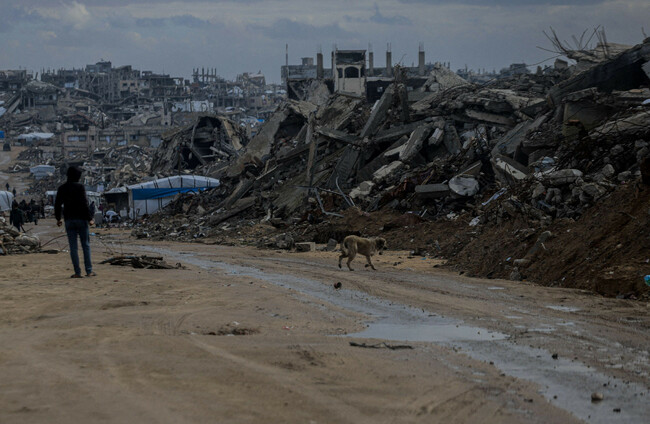
Jabalia, Jan, 2026. Scenes from daily life as winter unfolds in the north, amid the ongoing humanitarian crisis in Gaza. Alamy Stock Photo

A ceasefire in name only Israel's relentless targeting of Palestinians has not stopped

Dr Brendan Ciarán Browne says Israel’s banning of 37 humanitarian organisations exposes the grim reality behind claims of a Gaza ceasefire.

APPARENTLY, THERE IS a ‘ceasefire’ in Gaza. And Trump and his pals would have us believe that we have now reached Phase 2 of said ‘ceasefire’.

Try telling that to the families of the hundreds of Palestinians killed since 10 October 2025, during this purported period of ‘calm’. While the large-scale, indiscriminate aerial bombardments of the Strip may have partially abated, there has been a return to the everyday shootings, targeted assassinations and the routine killing of Palestinian civilians that have come to define life under occupation.

As global leaders grapple with US President Donald Trump’s latest version of ‘Make America Great Again’ — one that involves kidnapping the Venezuelan leader Nicolas Maduro and threatening to invade Greenland — the Israeli government has ratcheted up its campaign of genocide in Gaza, turning once again to target the humanitarian aid sector, those mandated to deliver lifesaving interventions for a population living under siege.

On 1 January 2026, 37 internationally renowned humanitarian aid organisations, including Medical Aid for Palestinians, Defence of the Child International, ActionAid & the Norwegian Refugee Council, were banned from operating in Gaza. It’s hard to imagine a more inhumane or cruel assault on a population that has steadfastly remained on their land, despite the best efforts of the world’s leading superpowers to make them disappear.

Relentless suffering

The humanitarian situation in Gaza remains apocalyptic. As has been the norm during the past three years, social media platforms have become saturated with images and video footage of hundreds of thousands of Palestinians living in tents, many of whom have suffered unimaginable personal loss, been forcibly displaced on many occasions, and who are now attempting to survive the harsh Gazan winter, bringing as it does flash flooding and seasonal storms.

Food insecurity and famine remain particularly acute ,with access to safe, clean drinking water a daily challenge. Those in need of essential medication continue to live without. Medical facilities that are able to partially function must do so with limited supplies and intermittent access to power. Gaza’s civilian infrastructure, including desalination plants, sanitation facilities, the electrical grid, roads and hospitals, has been systematically destroyed.

The spread of preventable illness is rife, meaning that very many more civilians will die as a result of this recent decision to ban the essential work of humanitarian aid organisations.

For those still clinging on desperately to the promise of international law, it is worth reiterating that the prevention of access to humanitarian aid to a starving and besieged civilian population is illegal and amounts to a form of collective punishment, manufacturing conditions that make civilian survival impossible.

Moreover, the starvation of civilians as a method of war was one of several charges listed in the International Criminal Court arrest warrants brought against Benjamin Netanyahu and Yoav Gallant. So too was it mentioned explicitly by the International Court of Justice in its recent 2025 Advisory Opinion.

Changing war tactics

The shift from mass military bombardment to the managed deprivation of life-saving aid follows the same genocidal logic of attempted destruction of the Palestinian population, differing now only in terms of speed. Whereas before, Western governments collaborating with the Israeli state allowed Israel to get away with massacring hundreds of Palestinian civilians on a daily basis, the Israeli government must now make do with weaponised bureaucracy and the manufacturing of scarcity of life-saving provisions in order to achieve its ultimate goal of a Gaza devoid of a Palestinian population.

The systematic targeting of humanitarian actors has long been a tactic used by Israel in order to achieve its ultimate goal. In an article published in 2024, Dr Caroline Lund and I highlighted how the stigmatisation of humanitarian organisations as “terrorist” or “terror-affiliated” has repeatedly been used to delegitimise aid efforts and deter international support, in both Gaza and the West Bank. In the aftermath of October 7th, 2023, this strategy was deployed most visibly against UNRWA, the largest provider of food, healthcare and education in Gaza.

The unsubstantiated allegations levelled against UNRWA, all of which have subsequently been debunked, had an immediate and devastating effect, with many States withdrawing funding for the organisation at a time when humanitarian assistance and support were most acutely needed. Undermining UNRWA’s mandate was never, nor has it ever been, about Israeli ‘security’ concerns. Rather, it is a central strategy used by successive Israeli governments to erase Palestinian claims to land, history and legal status, and most crucially, to deny the central issue of the ‘right of return’ for all Palestinian refugees.

Therefore, the recent extension of this approach to 37 humanitarian organisations is yet further evidence of Israel’s determination to continue its slow, systemic erasure of the Palestinian population and, whilst less bombastic than the widespread military assaults in the three years preceding, marks a dangerous escalation.

When taken together, the complete destruction of civilian infrastructure, the ongoing restriction of humanitarian aid, and the systematic delegitimisation of humanitarian aid organisations, these policies reveal the Israeli government’s true commitment to continuing the genocide of the Palestinian population in Gaza, by hook or by crook.

Ireland has a proud history of providing global humanitarian aid intervention. It must ensure that it does all it can to maintain this reputation. Such moments of man-made catastrophe require more than expressions of concern or statements of condemnation from those we have elected to represent us on the global stage.

Irish government ministers know the mechanisms available to isolate this Israeli government. So too do European leaders. Yet in continuing to prevaricate, by maintaining trade relationships, and in refusing to call for a full boycott, divestment and sanctions against this genocidal state, our government runs the risk of standing accused of complicity, not neutrality. History will not look kindly on those who failed to intervene at a time when moral courage was needed most.

Dr Brendan Ciarán Browne is Associate Professor and Fellow of Trinity College Dublin.

Readers like you are keeping these stories free for everyone...
A mix of advertising and supporting contributions helps keep paywalls away from valuable information like this article. Over 5,000 readers like you have already stepped up and support us with a monthly payment or a once-off donation.

Close
54 Comments
    Submit a report
    Please help us understand how this comment violates our community guidelines.
    Thank you for the feedback
    Your feedback has been sent to our team for review.
    JournalTv
    News in 60 seconds