Sign in. It’s quick, free and it’s up to you.
An account is an optional way to support the work we do. Find out more.
Sign in. It’s quick, free and it’s up to you.
An account is an optional way to support the work we do. Find out more.

RENTERS IN THE Republic feel worse off, have shorter tenancies and move more frequently than people north of the Border, according to a new report.
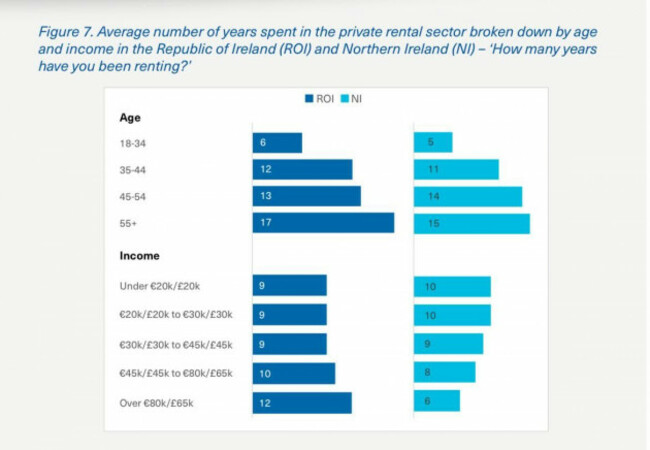
Higher earners in the Republic’s rental sector also spend a greater amount of time renting, unlike in Northern Ireland where a bigger salary means less time renting.
By contrast, those on high incomes in the Republic of Ireland have spent the most time renting, with those earning over €80,000 having rented for an average of 12.2 years.
This is twice as long for the same income bracket in the North – or over £65,000 – who spend an average of six years renting.
The striking details feature in a first-of-its-kind report by housing charity Threshold and its northern counterpart Housing Rights, who have launched the All-Island Residential Tenancy Survey examining the private rental sector in both jurisdictions.
Almost twice as many renters in the Republic – compared to those in the North – feel uncertain about remaining in their home due to high rents, evictions and poor housing standards, the report also found.
Overall, over a quarter of renters surveyed as part of the all-island research feel uncertain about their housing security, with those in the Republic of Ireland having a more pessimistic outlook about their future situation.
The report comes as Housing Minister James Browne is expected to bring major rental reforms for publication to Cabinet today.
They form the Residential Tenancies Bill, which propose the creation of rolling six-year contracts between the renter and the landlord, along with a nationwide rent cap of 2%.
The report notes that the expected pattern – whereby a person renting leaves the sector to buy a house – is transformed for people in the Republic.
As noted above, those on the highest incomes in ROI have spent the most time in the rental market, with those earning over €80,000 renting for the longest duration across all income categories for both jurisdictions.
A total of 74% of this high-income group expressed hope that they would own their own home in five years’ time, according to the report.
On this the report said:
“This reflects a different pattern in ROI, where many people on higher incomes aspire to own a home but remain in the private rental sector for a longer time, while those on lower incomes are perhaps exiting the rental market in larger numbers to return to their family home or indeed emigrate.”
The report estimates that the income difference in ROI between a current renter and a renter who has returned to the family home to be just over €9,000 per annum.
One major difference between the two jurisdictions is the average rent: a new two-bed apartment in the Republic is estimated to be €2,080, compared with £975 (equivalent to €1,125) for the equivalent in Northern Ireland.
So wile median incomes in the Republic are higher, rent is much less affordable south of the Border compared to Northern Ireland.
Dr Kevin Cunningham, author of the report and founder of Ireland Thinks, said that the report “reveals a predictability gap” facing renters in the Republic.
This included “volatile” prices and heightened anxiety over evictions, Cunningham said, but he added that Northern Ireland’s “comparatively steadier” conditions still leave too many unsure of their footing.
“The policy lesson is that design matters, but credible enforcement, clear rules on rent changes and terminations, and fast, trusted redress are what restore day-to-day certainty,” Cunningham added.
The new research shows a shorter tenancy duration in the Republic of Ireland, with the average number of years lived per property around 3.1 years compared with 4 years in Northern Ireland.
The average number of years per rental property among Dublin-based respondents is significantly lower – at 2.8 years – which the report’s authors note could be motivated by more choice in the capital.
Overall, private renters in the Republic of Ireland see a greater proportion of their income spent on rent. On average, tenants spend approximately 37% of their net income on rent in the Republic of Ireland and 32% in Northern Ireland.
While arrears levels are similar, there is some variation in the drivers.
Unexpected bills and rent increases feature more prominently for renters in the Republic of Ireland while a change in family circumstance was a more significant driver of arrears in Northern Ireland.
A notable difference between renters in both jurisdictions is the relationship between income and time spent renting.
In Northern Ireland, there is an inverse relationship between income and longevity in the rental sector, essentially meaning higher earners tend to spend less time renting.
The high cost of renting and purchase prices in the Republic of Ireland may be pricing lower-income households out of the private rental sector while keeping higher-income renters renting for longer, the report added.
Speaking on the report, Threshold CEO John-Mark McCafferty said that the report “lays bare the reality” for many renters in the Republic.
McCafferty added that it show that many report renting “out of necessity rather than choice, feeling insecure in their tenancies” and frequently moving while renting for longer and further into adulthood.
CEO of Housing Rights Kate McCauley said that both organisations are urging policymakers to ensure that “everyone is entitled to a safe, secure home”.

To embed this post, copy the code below on your site














have your say