Sign in. It’s quick, free and it’s up to you.
An account is an optional way to support the work we do. Find out more.
Sign in. It’s quick, free and it’s up to you.
An account is an optional way to support the work we do. Find out more.
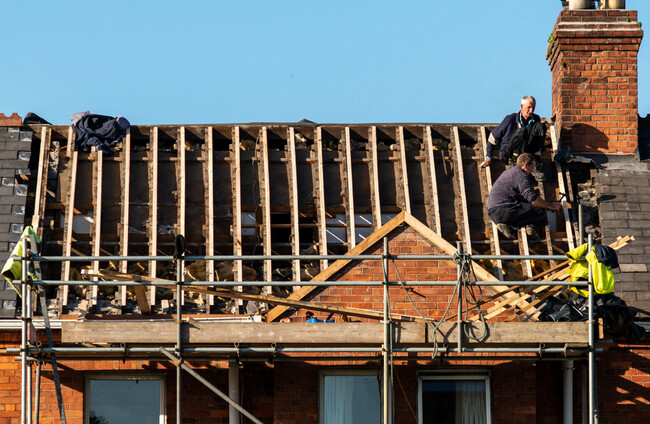
IRELAND IS NOT doing anything like as many home energy efficiency retrofits as the government has promised – and one big reason for that is likely to be the eye-watering cost.
Homeowners need to stump up anywhere from a median €16,000 for a deep retrofit on an apartment to an eye-watering €43,000 for a detached house – and that’s after government grants have been taken into account.
In a new paper on Ireland’s impending retrofit failure published this morning, the ESRI has pointed out that borrowing these amounts at 3% interest through the government-backed retrofit loan scheme hits homeowners with monthly repayments of €294 for apartments and €770 for detached houses over a five-year repayment term.
Those repayments are the equivalent of 35% of average mortgage repayments for an apartment and 98% for a detached house – effectively putting the cost of a deep retrofit on the latter at the same price as a second mortgage. Detached houses make up a quarter of Ireland’s housing stock. Average mortgage repayments were calculated based on 2023 Central Statistics Office figures.
These costs are only somewhat offset by heat and electricity bill savings. Assuming a pre-retrofit building energy rating (BER) of ‘D’, these are likely to total €700 per year for an apartment, and €900 for a detached house, the ESRI said.
The “financial burden” involved in a deep retrofit therefore represents a “significant increase” in household’s housing costs, the research institute said.
However, it’s worth noting that banks can offer lower fixed rate mortgages on homes with better BERs, including older homes that undergo a retrofit. AIB offers this if a home is renovated to at least B3 standard and the work does not require planning permission, while Bank of Ireland says it will grant a better fixed rate for energy efficiency improvements of at least one letter on the BER scale.
The ESRI said the extensive disruption involved in a deep retrofit – which can include having to vacate part or all of a home for the duration of the work – is also likely to be an important barrier. The complexity of applying for government grants also poses a problem for some homeowners.
There’s another big barrier: retrofitting requires labour and materials from the construction sector, which is already operating at full capacity. That means that, at least in the short-term, Ireland faces a trade-off between new builds and retrofits: 50,000 retrofits per year requires 15,000 workers.
A deep retrofit is an extensive insulation upgrade that brings a house up to at least B2 on the building energy rating (BER) scale. Ireland has a target of 500,000 houses undergoing this work by 2030, but that’s unlikely to happen based on current trends according to the ESRI.
Just 11.5% of Ireland’s houses had undergone a deep retrofit by the end of 2024. Many more retrofits have been done, but most were far less extensive than an upgrade to B2 standard.
All in all, this is really bad news for Ireland’s ability to meet its headline climate target of a 51% cut in emissions by 2030 relative to 2018.
The ESRI pointed to one problem in particular: the energy saving benefits of retrofitting to B2 standard may be overestimated.
That means even if we reach our retrofit target – which we won’t – we may not cut our greenhouse gas emissions enough to meet our climate target.
The ESRI noted research from both Ireland the UK indicating that homes with better BER ratings do not necessarily use less energy. It’s not clear why that is, but it could be that people living in poorly insulated homes are underheating them to save money. When insulation is improved, people can crank the heating up.
The ESRI suggested alternative plans for cutting Ireland’s home heating emissions may be needed, including a new drive to get existing houses onto the gas network if they’re unlikely to retrofit.
There are 110,000 homes in Ireland located within 30km of the gas network but not connected to it. Most of these homes are heated with oil, which causes about 30% more CO2 per unit of energy than gas. Other options include renewable biofuels – although the researchers noted the high risk of fraud in this sector.
The ESRI noted that Ireland has made even less progress on its target for heat pump installations than for retrofits.

To embed this post, copy the code below on your site















have your say