Sign in. It’s quick, free and it’s up to you.
An account is an optional way to support the work we do. Find out more.
Sign in. It’s quick, free and it’s up to you.
An account is an optional way to support the work we do. Find out more.
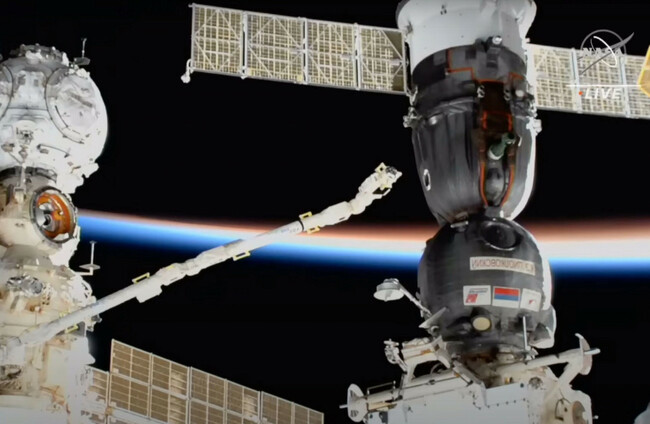
RUSSIAN OFFICIALS SAID they will send a new capsule in February for three crew of the International Space Station, after a meteorite damaged the spacecraft that was due to return them to Earth.
“The Soyuz MS-23 launch is 20 February, 2023 in an unmanned mode,” Russia’s space agency Roscosmos said.
The MS-22 spacecraft that was originally set to bring Russian cosmonauts Sergei Prokopyev and Dmitry Petelin and NASA astronaut Frank Rubio back to Earth had been damaged by a small meteorite strike, Roscosmos said, ruling out a technical fault.
“‘Soyuz MS-22′ must descend to Earth without a crew,” Roscosmos said after damage to the space capsule resulted in a coolant leak last month.
“In the event of particularly critical situations on the ISS, the possibility of using the Soyuz MS-22 to rescue the crew will be determined by a separate decision of the state commission,” Roscosmos added.
There are seven people aboard the ISS. With the MS-22 rocket now deemed unfit, it means that the ISS has just one “lifeboat” capable of carrying four people, in case it needs to be evacuated.
Roscosmos and NASA initially said the leak did not pose any danger to those on board.
The vehicle began spraying its coolant into space on December 14, with dramatic NASA TV images showing white particles resembling snowflakes streaming out of the rear.
MS-22 flew Russian cosmonauts Dmitry Petelin and Sergey Prokopyev, as well as NASA astronaut Frank Rubio, to the ISS in September.
Their mission is being extended and they will now return to Earth on board the MS-23, Roscosmos said.
Space has remained a rare venue of cooperation between Moscow and Washington since the start of the Russian offensive in Ukraine and ensuing Western sanctions on Russia.
The ISS was launched in 1998 at a time of increased US-Russia cooperation following their Space Race competition during the Cold War.

To embed this post, copy the code below on your site











have your say