Sign in. It’s quick, free and it’s up to you.
An account is an optional way to support the work we do. Find out more.
Sign in. It’s quick, free and it’s up to you.
An account is an optional way to support the work we do. Find out more.
LAST UPDATE | 31 Jul
ITALY HAS SUSPENDED its Schengen agreement with Spain, following the influx of migrants into Madrid’s Ceuta enclave in North Africa, which borders Morocco.
Italian Prime Minister Giorgia Meloni called the one-month suspension an “extraordinary measure” intended to “safeguard national security and prevent possible repercussions for our nation”.
Italy’s interior ministry confirmed to AFP that Italy had closed to Spain its maritime and air entry points but cautioned it would not impact travel for Spanish and European citizens to Italy.
A spokesman also said that following discussions with France, the two countries would reinforce the land border controls already in place.
Italy’s coalition government has sought to stop the tens of thousands of migrants who land in small boats on the country’s shores each year.
Measures include government deals with North African countries to limit departures, and restrictions on charity rescue boats trying to save migrants in the Central Mediterranean.
Italian Foreign Minister Antonio Tajani said Friday that the suspension of Schengen was “provided for by the treaties and, today, rendered unavoidable”.
According to Spanish officials, the integrity of the Schengen free-travel area was “guaranteed” after a surge of migrant arrivals in its North African enclave of Ceuta prompted Italy to announce temporary border controls with Spain.
“Practically the entirety of those who entered Ceuta have already returned to Morocco,” Foreign Minister Jose Manuel Albares said in a message on X, accusing critics of spreading “confusion”.
Albares said people could not travel from Ceuta or neighbouring Melilla to mainland Spain without passing through police identification checks.
“The integrity of the Schengen Area is absolutely guaranteed,” he added.
60,000 people crossed from Morocco into the Spanish enclave of Ceuta in the past few days, 48,300 of whom have now returned, Spain’s interior ministry said.
At least 43 people have died making the crossing by swimming around border barriers on the North African coast.
Spanish prime minister Pedro Sanchez visited the city this morning with interior minister Fernando Grande-Marlaska.
Sanchez said that a temporary reception centre will be set up to document and register people, but also to facilitate the expulsion of people with no legal claim to be in Spain.
He said that the government will also add a visible barrier – a line of buoys – to clearly demarcate the border between Spain and Morocco.
Spain will work closely with Morocco to implement these new measures, Sanchez said.
“What has happened is an attack on Spain’s territorial integrity and deserves our most resounding and energetic condemnation,” Sanchez said.
“All of Spain stands with the people of Ceuta.”
Spain deployed its military to Ceuta and its sister city of Melilla as thousands of people breached the border with Morocco, after local officials appealed to Madrid for help.
Around 300 and 400 further crossings were also reported overnight, with at least 7,000 of those who crossed into the territory in the last 24 hours being minors, officials told the BBC.
“There was a steady stream of people all night long,” and while arrivals were lower than during the day, migrants “continued to arrive overnight and are still arriving” on Friday morning, a police source told AFP.
More than 25,000 migrants have returned to Morocco from Ceuta, Spanish officials said on Friday afternoon,
The influx marks the largest arrival of migrants in Ceuta since 2021, when around 10,000 people arrived over the course of two days.
EU officials told AFP that no migrants have travelled onwards from Ceuta to Europe.
The streets of the autonomous city were quiet today and most businesses remained closed.
Shuttered storefronts lined Calle Real, the city’s main commercial artery, where the usual flow of shoppers and residents had been replaced by scores of migrants milling around the streets.
“We are running short of bread. There was no fresh bread today because the bakeries are closed,” Miguel Angel Campana, a municipal street cleaner in Ceuta, told AFP.
Some migrants were stopping cars in the road to ask for food, money or to use mobile phones to call their families, AFP reporters said.
It is not immediately clear what has prompted so many migrants to cross to Ceuta.
Ceuta authorities have linked the surge to a Spanish Supreme Court ruling earlier this month that prevents authorities from immediately returning migrants who arrive by sea to Ceuta or Melilla, another Spanish enclave, without due process.
The ruling does not apply to migrants who enter Spain by land, including by climbing over the border fence.
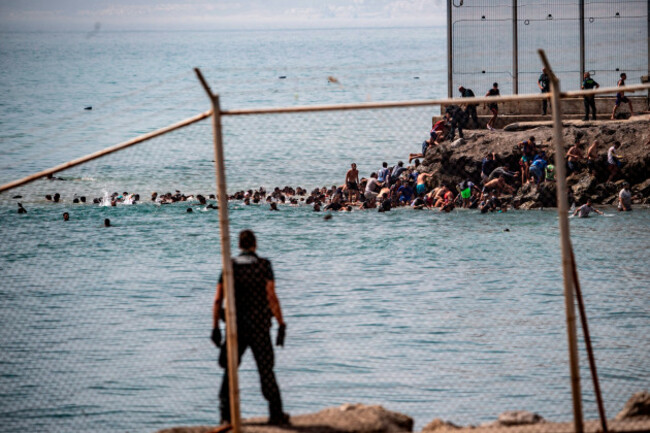
But some activists in Morocco expressed doubt that the ruling was behind the surge, arguing most migrants would have been unaware of such legal decisions.
In his address today, Sanchez said that a “self-serving” interpretation of the ruling has “spread like wildfire” within human trafficking networks, and that there had been a subsequent “surge” in attempted crossings.
The ruling has drawn criticism from right-wing parties regarding Spain’s pro-migrant policies.
In a post on X, Santiago Abascal, the head of Spain’s far-right Vox party, described the crossing as an “invasion”.
“They’re not coming fleeing from any war or poverty. It’s an invasion.
“They are men of military age called by Pedro Sánchez’s corrupt government to storm our borders so they can then roam the streets of Spain shouting ‘Viva Pedro Sánchez.’”
Another recent move by the Sanchez government has been blamed by anti-immigration parties and activists.
In January, Spain announced it would regularise the status of half a million undocumented immigrants. As of the end of June, more than one million people had applied.
¡SOS Ceuta!
— Santiago Abascal 🇪🇸 (@Santi_ABASCAL) July 30, 2026
No vienen huyendo de ninguna guerra, ni de la pobreza. Es una invasión. Son hombres en edad militar llamados por el Gobierno corrupto de Sánchez para que asalten nuestras fronteras para que después deambulen por las calles de España diciendo "Viva Pedro Sánchez".… pic.twitter.com/Vuk2PeSIsb
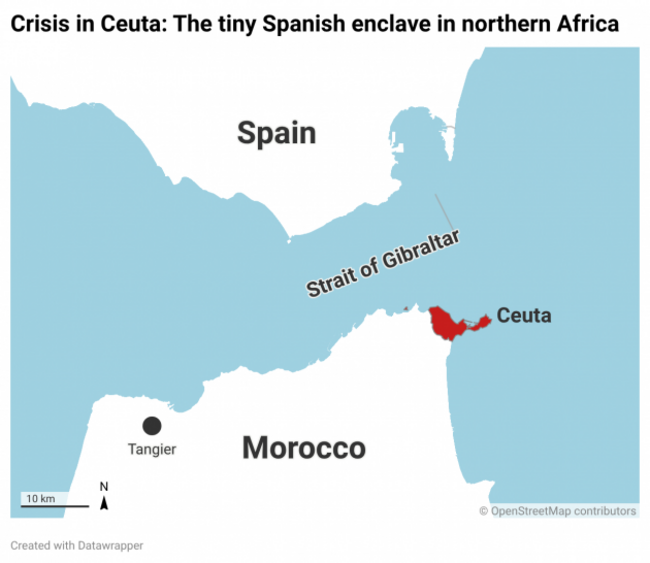
Ceuta is a Spanish enclave on the north-western coast of Morocco. It shares its only land border with the North African nation.
To reach Ceuta, migrants often swim from the neighbouring Moroccan town of Fnideq, covering about 5 km to reach Spanish territory. Others attempt the crossing from the nearby town of Belyounech, where the distance is shorter.
Ceuta and another Spanish enclave, Melilla, are the European Union’s only land border with Africa. Melilla is about 300 km east of Ceuta.
Spain is one of the main points of arrival into Europe for migrants seeking better economic opportunities or an escape from violence in their home countries.
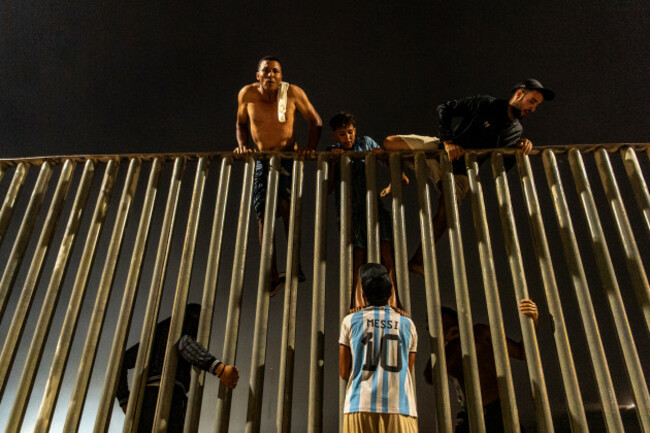
Rachid Sbihi, who leads a local workers association representing Civil Guard officers, described the situation as a “serious humanitarian crisis”.
He said: “People are still entering. The reinforcements that have arrived are only helping the injured and other humanitarian efforts.”
Without shelter, thousands of migrants, including unaccompanied children, were left sleeping in parks and on pavements, with others roaming the streets aimlessly, he said, adding: “It’s chaotic.”
Among the 18 who died, many have drowned.
Some were also killed in the crush to cross the breakwater fence at Tarajal beach, Sbihi said.
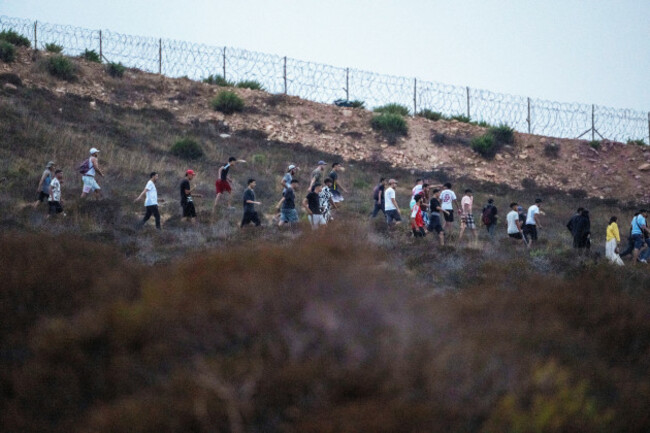
Video footage on Thursday showed crowds of people, mainly Moroccans, walking around the breakwaters at Tarajal beach onto local roads.
While most appeared to be young men, there were also families with women and small children.
The chaos has had ripple effects in the politics of other European countries, as well as in the United States.
Denmark’s prime minister Mette Frederiksen has also urged the bloc to consider the suspension of Spain from Schengen.
France has also announced stricter controls at its border with Spain.
In a post on X, France’s interior minister Laurent Nuñez said: “In response to the situation observed in the Ceuta enclave, I gave instructions as of last night to immediately strengthen the controls at the Spanish border. Furthermore, I am activating the Rapid Intervention Border Force for in-depth checks.”
German Chancellor Friedrich Merz demanded today that Morocco “take back illegal migrants immediately”.
Merz said in a statement that he welcomed “Spain’s intention not to allow the illegal migrants onto the European continent” and added that “we expect Morocco to take the illegal migrants back immediately”.
Magnus Brunner, EU Commissioner for Home Affairs and Migration, said on X that he has conveyed “the EU’s readiness to increase support to Spain, including through Frontex, to control the situation”.
Frontex is the EU’s border control agency.
“The protection of the Union’s external borders is a crucial part of our efforts to fight illegal migration,” the post added.
“We are in contact with the relevant authorities on the evolving situation in Ceuta.”
The European People’s Party (EPP), the largest grouping in the EU parliament, said the images of people entering Ceuta were “shocking”.
Fine Gael MEP Maria Walsh, whose party is part of the EPP group, expressed concern about some of the reactions to the crossings.
“We must avoid language which has the potential to ignite division, and always keep the importance of humanity and fundamental rights at the forefront of our words and actions,” she said.
The EU must respond but it cannot and should not further weaponise innocent people seeking refuge.
EU Commission president Ursula von der Leyen said that the images coming from Ceuta are “unacceptable”.
“Dangerous crossings must stop immediately. Smuggling networks must be dismantled. And returns must be swift, as our rules allow,” she said in a post on X.
Moroccan authorities have not publicly commented on the crossings, and Morocco’s interior ministry did not respond to requests for comment.
US President Donald Trump has also said that the “terrible” migrant crisis facing Spain is what the United States will face if the opposition Democratic Party wins elections.
“It’s terrible. Remember that picture. That’s going to be us in three years if the wrong side gets in,” he was quoted as saying by Fox News.
“If the Democrats get in, you will not live a very good life.”
The US Department of State said the US “stands with the people of Spain, and all Europeans, against this egregious violation of their sovereignty and human rights”.
It said the situation in Ceuta was “the direct result of the Spanish Government’s deliberate efforts to enable and facilitate mass illegal migration into Europe”.
“We are considering actions to defend Americans at home and abroad from this threat and stand ready to assist other European allies considering similar options,” it said in a social media post.
The White House account on X said the incident was “a stark reminder of the consequences of mass migration and the radical left-wing globalist policies”.
Additional reporting by David Mac Redmond, PA and AFP
To embed this post, copy the code below on your site













have your say