Sign in. It’s quick, free and it’s up to you.
An account is an optional way to support the work we do. Find out more.
Sign in. It’s quick, free and it’s up to you.
An account is an optional way to support the work we do. Find out more.
LAST UPDATE | 31 Jul
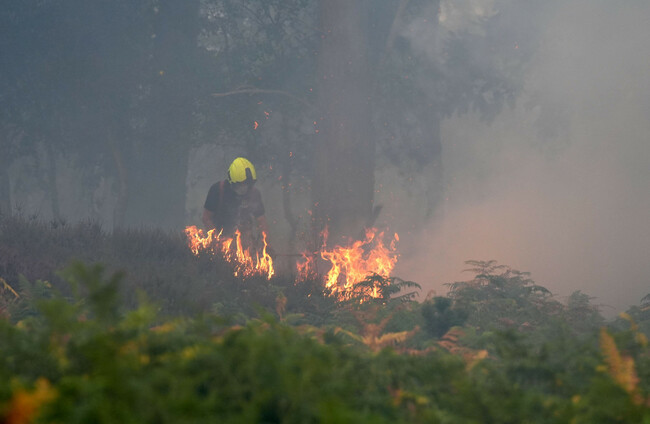
FIRE CREWS BATTLING a large wildfire near Britain’s biggest nuclear power station have said the blaze is “stabilising”, as firefighting efforts enter their third day.
Suffolk Fire and Rescue Service said late on Thursday night that they were in a “better position” than they were a few hours earlier, although they warned that the blaze near Sizewell B was still a “dynamic incident”.
An update early this morning said that “crews and officers remained at the incident overnight” and that they “maintained a watching brief during darkness”.
Speaking to BBC Breakfast this morning, deputy chief fire officer for Suffolk Fire and Rescue Service Henry Griffin said an investigation had been launched into the cause of the fire and that the blaze had “stabilised”.
“Due to the scale and unpredictable nature of the wind direction… I would not use the word to say it is ‘under control’ but I am confident we have the resources in place and a plan in place to mitigate any risks of this fire.”
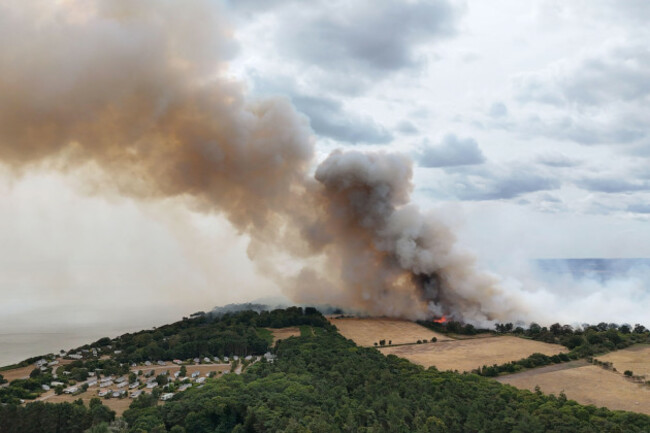
Firefighters have been tackling the blaze in Dunwich Heath, near Leiston, since Wednesday evening, with more than a hundred firefighters and a helicopter on site.
The fire is a few miles away from Sizewell B and the construction site for the new Sizewell C, though authorities said there is no concern of the fire spreading towards the power station.
The service said at least 12 fire engines will remain at the scene overnight into Friday in order to manage smaller fires that are breaking out, adding that electricity had returned to 111 of the 116 properties affected by earlier power cuts.
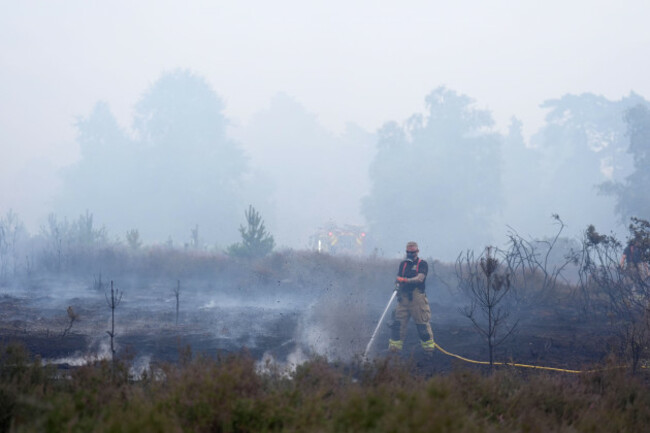
Earlier on Thursday, the service said the area affected had grown to 150 hectares – the equivalent of approximately 210 football pitches – with 18 fire engines and more than 100 firefighters at the scene.
It also revealed that six fire appliances from London Fire Brigade will be joining the firefighting efforts.
Around 50 people have been evacuated from their homes and a local holiday park to Westleton, whose village hall now serves as a rest centre.
British Prime Minister Andy Burnham said the county’s fire service will have “all of the support” they need in tackling the blaze.
Temperatures soared across parts of the UK on Wednesday, reaching into the 30s in some places.
According to the Met Office, Suffolk has only received 2% of its average monthly rainfall for July so far.
The forecaster said on Thursday afternoon other counties have recorded as low as 1% or 0% of average rainfall for July, with Friday being the last day of the month.
Meanwhile, Greek firefighters are continuing to battle a wildfire ravaging parts of the tourist island of Crete, although conditions had improved.
“The situation around Rethymno is better,” a fire department spokesperson said.
But the blaze “has not yet been contained, there are still many hotspots,” he added.
Fires are also burning on the islands of Paros, Kalymnos and Andros in Aegean Sea but “the situation is better”, according to the fire service.
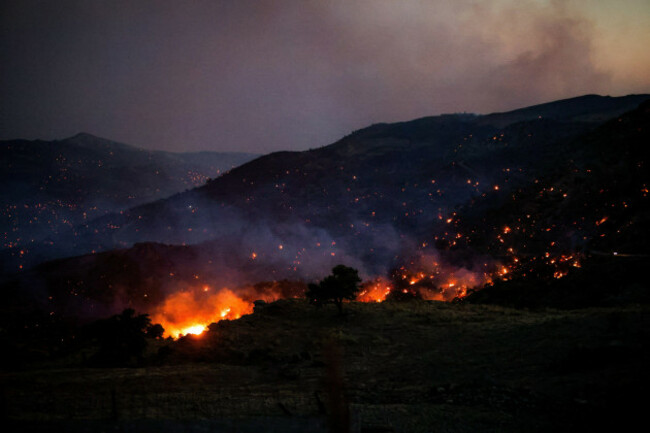
About 11,120 acres had been scorched on Wednesday and Thursday south of the tourist town of Rethymno, according to meteo.gr, the weather service of the National Observatory of Athens, citing an analysis of satellite imagery from the European Union’s Copernicus programme.
Strong, persistent winds, combined with the area’s rugged terrain, continued to complicate firefighting operations, authorities said.
Across Greece, firefighters and civil protection services have been placed on general alert, fire brigade spokesman Vassilis Vathrakogiannis said at a briefing on Thursday.
Many parts of the country, including the Athens region, Crete, numerous Aegean islands and parts of the Peloponnese, face a “very high” wildfire risk today, the second-highest level on Greece’s five-point scale, according to Greek civil protection.
Greece’s geography, made up of hundreds of islands, complicates the rapid deployment of emergency responders, Vathrakogiannis said.
Additional firefighting resources have been dispatched to Crete.
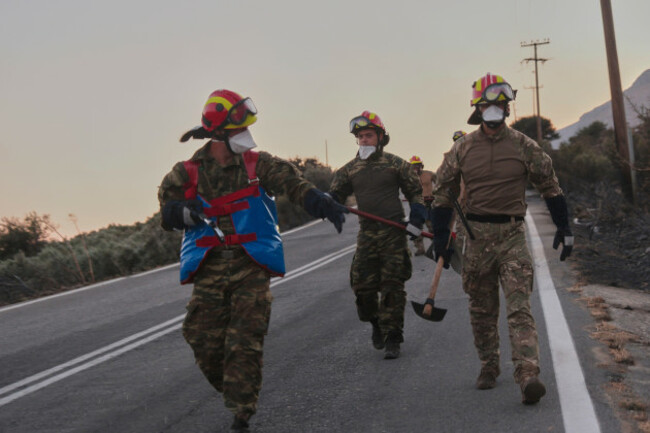
“Strong winds and dense smoke are creating conditions of near-zero visibility and severe turbulence, making aerial water drops extremely difficult, if not impossible,” he said, particularly in Crete.
Greek authorities on Wednesday ordered the evacuation of around 8,000 residents and tourists from the coastal resort of Agia Galini.
Most evacuees have since returned to their homes and hotels as Crete’s peak tourist season continues.
Prime Minister Kyriakos Mitsotakis warned on Thursday that Greece, which had largely avoided the severe heatwaves and major wildfires seen earlier this summer in countries such as France and Spain, was entering a challenging period.
“August … is traditionally a difficult month,” he said.
“Conditions are expected to worsen further in the coming days,” the fire department spokesperson also warned.
Three firefighters have died this week while battling wildfires in Crete and the Peloponnese, according to Greek authorities.
-With additional reporting from © AFP 2026

To embed this post, copy the code below on your site















have your say