Sign in. It’s quick, free and it’s up to you.
An account is an optional way to support the work we do. Find out more.
Sign in. It’s quick, free and it’s up to you.
An account is an optional way to support the work we do. Find out more.
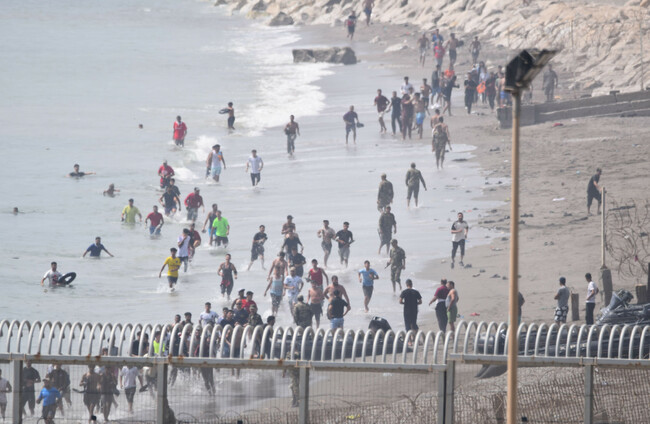
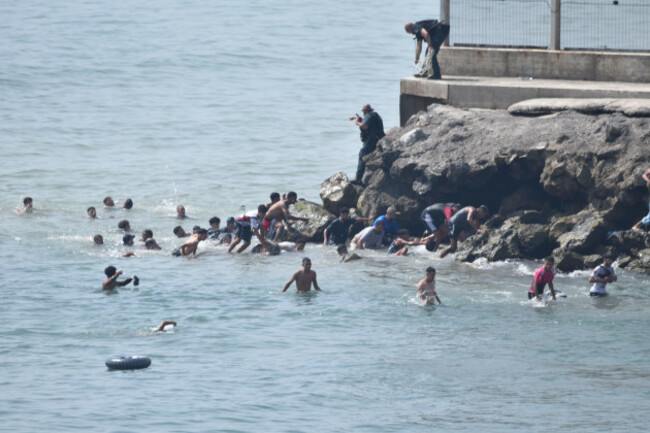
HUNDREDS OF PEOPLE have entered the Spanish territory of Ceuta today, a small exclave on the North African coast, by swimming around border barriers in large crowds.
Spanish president Pedro Sanchez said the government was “mobilising all necessary resources” and was in contact with the government of Morocco, which neighbours Ceuta.
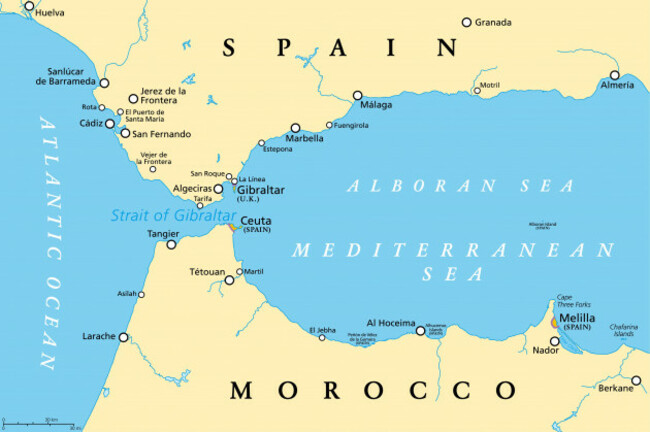
It is one of two Spanish territories located on Morocco’s coast. The other is Melilla, which is to the east.
“We are in a situation of total humanitarian and social emergency,” said the president of the territory, Juan Jesus Vivas, in comments broadcast by Spanish television.
“In the past few days more than 1,500 migrants, both adults and minors, have come to Ceuta by sea,” he said in other televised comments on Wednesday.
“The reception centres are saturated. There is no more room for anyone in them and according to yesterday’s figures the number of people entering is more than 200 a day.”
Most of the people entering Ceuta from the sea in videos from the scene appear to be young men and teenage boys.
Migrants walked cheerfully through the streets of Ceuta, thanking the Spanish police and calling out: “Bye bye, Morocco, hello Spain.”
Police and Civil Guards in Ceuta appeared to do little to intervene, though some officers attempted to direct the arrivals to the local migrant reception centre.
On the Moroccan side of the border, an AFP reporter saw hundreds of people including children gathered near the border between Ceuta and the local town of Fnideq this afternoon, waiting to cross into the Spanish territory.
Some of them said they had come after hearing rumours that the border was going to be opened this morning.
Moroccan authorities did not comment.
The crossings coincided with Morocco’s Throne Day, a national festival.
“We are mobilising all necessary resources, working with Moroccan and international authorities, and preparing the necessary measures to restore normalcy as soon as possible,” Sanchez said in a post on social media.
“This is the moment to build solutions, with responsibility and cooperation.”
Spain’s interior ministry said in a statement that several ministries were “acting in coordination to respond with the utmost speed and efficiency to the situation in Ceuta”.
Interior minister Fernando Grande-Marlaska would travel to Ceuta on Friday “to monitor the situation” and meet officials, it said.
It said the government had increased its resources “to guarantee security and control of migration as well as the necessary humanitarian aid, so that no lives are put in danger at sea”.
It said the Moroccan government was working “faithfully and permanently with Spain and collaborating closely to deal with the situation”.
“Moroccan security forces are preventing the arrival of numerous people who are trying to reach Ceuta from Morocco.”
The leader of Spain’s conservative opposition People’s Party, Alberto Núñez Feijóo, said the situation in Ceuta was “desperate”.
“The government cannot look the other way on its obligations because we are facing a national security crisis,” he said.
The situation has already become a political issue at European Union level as well.
The European People’s Party (EPP), the largest grouping in the EU parliament, said the images of people entering Ceuta were “shocking”.
“Uncontrolled borders demand immediate action,” it said in a post on social media.
“We urge Spain to act NOW to secure our external borders and the European Commission to take appropriate action,” the post said, adding that the EPP would “demand answers” at the next plenary session of the EU.
The EPP, of which Fine Gael is a member, is a conservative grouping in the European Parliament led by Commission president Ursula von der Leyen.
Shocking images of massive and uncontrolled arrivals of illegal migrants at the Spanish border today.
— EPP Group (@EPPGroup) July 30, 2026
Uncontrolled borders demand immediate action. The EU Migration Pact and the Return Regulation can’t wait.
We urge Spain to act NOW to secure our external borders and the… pic.twitter.com/dyhwkj5H84
The border crossing between Ceuta and Morocco is heavily fortified and policed.
Many Moroccans routinely cross into the Spanish territory to work.
Morocco’s northern coast is also a point of departure for some migrants seeking to enter the EU by crossing the Strait of Gibraltar.
The Ceuta-Morocco border has long been a point of tension between the two governments.
Last year, Spanish police discovered a tunnel connecting Ceuta to Morocco that was used to smuggle drugs.
Also last year, the two countries signed a number of agreements to strengthen ties. At the time, Moroccan trade minister Ryad Mezzour told El Mundo newspaper that his country was “making every effort” to combat illegal immigration.
With reporting from AFP
Need more clarity and context on how migration is being discussed in Ireland? Check out our FactCheck Knowledge Bank for essential reads and guides to finding good information online.

To embed this post, copy the code below on your site












have your say