We need your help now

Support from readers like you keeps The Journal open.

You are visiting us because we have something you value. Independent, unbiased news that tells the truth. Advertising revenue goes some way to support our mission, but this year it has not been enough.

If you've seen value in our reporting, please contribute what you can, so we can continue to produce accurate and meaningful journalism. For everyone who needs it.

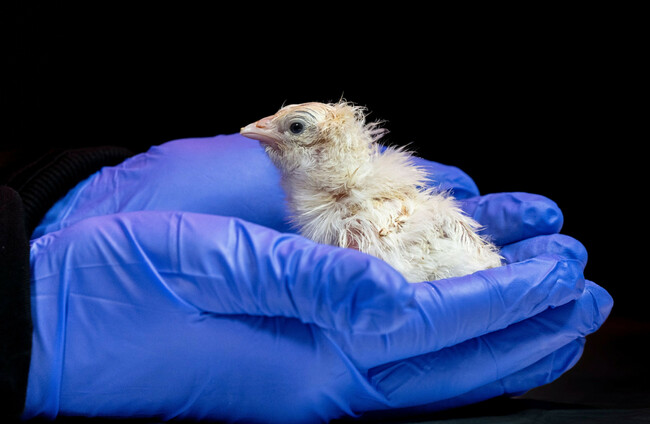
A chick hatched from an artificial environment. (Colossal Biosciences via AP)

Scientists sceptical as biotech company claims it hatched chicks from artificial eggs

Independent scientists say the technology, while impressive, lacks some components to be truly considered an artificial egg.

A BIOTECH COMPANY that aims to resurrect lost creatures said it has hatched live chicks in an artificial environment — a development that was met with mixed reviews from scientists and critics of its de-extinction mission.

Twenty-six baby chickens — ranging from a few days to several months old — were born from a 3D-printed lattice structure that mimics an eggshell, according to Colossal Biosciences.

Colossal previously announced it had genetically engineered living animals to resemble extinct species, including mice with long hair like the woolly mammoth and wolf pups that take after dire wolves.

Colossal’s chief executive Ben Lamm said the artificial egg technology could one day be scaled up to genetically tweak living birds to resemble New Zealand’s extinct South Island giant moa, whose eggs are 80 times the size of a chicken’s and would be difficult for any modern bird to lay.

“We wanted to build something that nature has done a pretty good job of developing and make it better and scalable and even more efficient,” Lamm said.

Independent scientists say the technology, while impressive, lacks some components to be truly considered an artificial egg.

And they said the idea of reviving extinct beasts is likely impossible.

“They might be able to use this technology to help them make a genetically modified bird, but that’s just a genetically modified bird. It’s not a moa,” said evolutionary biologist Vincent Lynch with the University at Buffalo.

To hatch the chicks, Colossal scientists poured fertilised eggs into the artificial system and placed them in an incubator.

They also added calcium, which is normally absorbed from the eggshell, and imaged the embryos’ development and growth in real-time.

Scientists say Colossal has designed an artificial eggshell with a membrane that allows the right amount of oxygen to get in, just like a real egg.

But other components of an egg — like temporary organs that form to nourish and stabilise the growing chick and remove waste — were not included.

“That’s not an artificial egg because you’ve poured in all the other parts that make it an egg. It’s an artificial eggshell,” said Lynch.

In decades past, researchers have used cruder technology to create transparent eggshells that hatched chicks from plastic films or sacks.

Such technologies are useful to study chicken development and glean insights that can also be applied to other mammals and even humans.

“Producing a chick from an artificial vessel is not necessarily new,” said Nicola Hemmings, who studies bird reproductive biology at the University of Sheffield.

Hemmings is not part of the Colossal team.

There is a long road ahead before Colossal attempts a moa resurrection using this artificial egg system.

Scientists first need to compare ancient DNA from well-preserved moa bones to genomes of living bird species. And they need a bigger eggshell.

“We didn’t want to wait till we were ready to birth a giant moa. We actually wanted to start working on the engineering challenges for surrogacy and birth now,” Mr Lamm said.

Even if Colossal succeeds in creating a tall bird similar to the moa, some scientists are concerned about what happens after — including how it would survive in a landscape that looks nothing like that past.

“The big challenge is, what environment is this animal going to live in?” said bioethicist Arthur Caplan with New York University’s Grossman School of Medicine.

Such de-extinction efforts may make more sense with currently endangered species, where scientists could preserve sperm and egg cells from living members to attempt to bring more back, Hemmings said.

“My personal interests lie more in preserving what we’ve got than trying to bring back what is already gone,” Hemmings added.

Close
JournalTv
News in 60 seconds