We need your help now

Support from readers like you keeps The Journal open.

You are visiting us because we have something you value. Independent, unbiased news that tells the truth. Advertising revenue goes some way to support our mission, but this year it has not been enough.

If you've seen value in our reporting, please contribute what you can, so we can continue to produce accurate and meaningful journalism. For everyone who needs it.

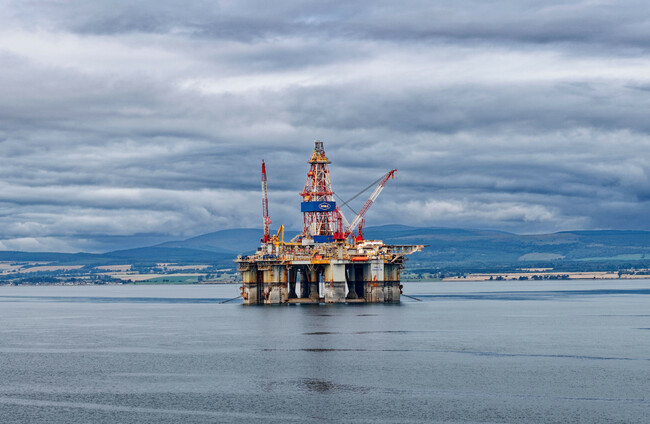
An oil rig off the coast of Scotland. Alamy Stock Photo

Are the fuel protestors right - should Ireland drill for oil?

Various bodies have previously estimated that there could be billions of barrels worth of the black stuff buried in the Irish seabed.

DURING A TIME of fuel insecurity, why is Ireland not drilling for oil?

That was one of the questions posed by fuel protestors during recent demonstrations, as they called for exploration off Ireland’s west coast.

Ireland still uses oil for around half of its energy needs. We don’t have any ourselves and have to import it all.

Various bodies have previously estimated that there could be billions of barrels worth of the black stuff buried in the Irish seabed. So why not dig it up?

Farmer and Fuel Price Protest PRO James Geoghegan told various media that fossil fuel companies contacted demonstrators, telling them “how much oil is off the west coast of Ireland”.

He said a ban on exploration and drilling, introduced in 2021, should be lifted “for the good of the nation”.

With prices surging and concern about Ireland’s energy security, do demonstrators have a point?

To get to the nub of it – Ireland may have lots of oil off the west coast. But getting it out of the ground has proven to be extremely challenging.

Research published by the government before the financial crisis suggested that there could be ten billion barrels of oil equivalent in the frontier basins west of Ireland.

However, despite exploration companies drilling nearly 200 times in Irish waters since the 1970s, the country has never developed a commercial oil field (and only three gas fields).

This immediately puts that 10 billion figure into question. The government said in 2011 that this number was in fact a very loose one, and it was “simply an estimate of unproven potential”.

It was essentially calculated by looking at the size of the potential area off the Irish coast and then making a guesstimate based on the scale of oil finds in other parts of the world.

It cautioned that ‘It is not a detailed estimate based on comprehensive survey and exploration’ adding that actual reserve figures are “likely to vary widely from these estimates”.

This brings us back to the unsuccessful drilling attempts. There are a few geographical factors which complicate exploration – the Atlantic sea off the west coast has rough waters, with frequent storms. It is also likely that any oil field would be far away from the Irish coast and in extremely deep water.

This all makes the area less attractive for drilling, and goes some way towards explaining the relatively low level of activity.

That figure of about 200 wells ever being drilled in Irish waters compares to thousands in the North Sea, the waters between the UK and Norway. There, shallower water and closer proximity to infrastructure on the coast are two large bonuses. Combined with the fact that chances of a commercial find are much higher, and it makes it much more attractive.

But even if we accept that there may be decent oil reserves in Irish waters. The problem is finding and then getting it out of the ground in a way that makes economic sense.

That problem of a find being commercially viable is clearly visible in the handful of Irish projects which have shown some promise. Most notably, the proposed Barryroe field off the coast of Cork, which is estimated to hold around 300 million barrels of recoverable oil.

Developer Providence Resources announced the find in 2012 to great fanfare, with its share price soaring and the company once considered for a €1 billion takeover.

However, the company was wound up in 2023 after raising €270 million from investors, and without ever producing a single drop of oil from Barryroe.

A key reason for this is that Providence could never secure a committed partner for the project. Building an oil well is an expensive business. Smaller exploration-focused companies like Providence may be able to locate promising oil finds. But typically, they need a major international energy company with deep pockets to develop the project, referred to as a ‘farm out partner’.

Despite looking for over a decade, Providence couldn’t find one. Some commentators have suggested that Barryroe hasn’t been developed due to climate change legislation.

But Providence had already been searching for years for a farm out partner long before the drilling ban came into effect in 2021. And during all that time, it couldn’t find a company with suitable interest.

Providence also had other promising projects located in the Atlantic, Druid and Drombeg, which the company said could hold as much as 5 billion barrels.

However, drilling at the sites revealed just water. It showed yet again how rare it has been for any kind of promising finds at supposed oil-rich sites in Irish waters.

Many fuel protestors might say – why not let companies take the chance?

There is logic to that. The drilling ban in 2021 honoured existing licences. This meant that development work could continue at projects which were already started before the measure came into place, like Barryroe.

But all new drilling was banned, putting a freeze on exploration in Irish waters.

The ban was a move spearheaded by the Green Party, which wanted to shift to a carbon-free economy.

Fianna Fáil and Fine Gael, the other parties in government at the time, likely saw it as an easy win. Keep a coalition partner onside, boost your green credentials, while not impacting many businesses.

With oil still being so important for Ireland’s energy mix, it would seem logical to want to have our own supply. But it’s extremely unlikely we would ever be self-sufficient.

Finite supply

Ireland uses almost 150,000 barrels of oil per day. It’s estimated that, at its peak, Barryroe could produce about 20,000 barrels per day – about 13% of the country’s oil demand.

And this is the best case scenario from the best potential project from almost 50 years of exploration in Irish waters. While it could somewhat help, Ireland would still be extremely reliant on imports.

Hypothetically speaking, if we could extract all of Barryroe’s oil at once, it would meet Ireland’s oil needs for about five years. Helpful, but very much finite.

Funnily enough, there is also an environmental argument in favour of drilling. The logic is that it is more environmentally friendly to use ‘locally produced’ fossil fuels, rather than shipping or piping them in from abroad.

But given the difficulty with finding oil in Irish waters, it is risky, with exploration companies potentially polluting waters and damaging seabeds for no gain.

Looking at Ireland’s exploration history as a whole, it’s clear that the country has a vanishingly small chance of ever being self-sufficient for oil.

Analysts say the country’s future energy reserves will instead likely be our natural resources, such as the wind. Because even if Ireland manages to finally develop an oil field or two, they would meet a small part of the country’s overall demand before running dry.

Readers like you are keeping these stories free for everyone...
A mix of advertising and supporting contributions helps keep paywalls away from valuable information like this article. Over 5,000 readers like you have already stepped up and support us with a monthly payment or a once-off donation.

Close
31 Comments
This is YOUR comments community. Stay civil, stay constructive, stay on topic. Please familiarise yourself with our comments policy here before taking part.
Leave a Comment
    Submit a report
    Please help us understand how this comment violates our community guidelines.
    Thank you for the feedback
    Your feedback has been sent to our team for review.

    Leave a commentcancel

     
    JournalTv
    News in 60 seconds