We need your help now

Support from readers like you keeps The Journal open.

You are visiting us because we have something you value. Independent, unbiased news that tells the truth. Advertising revenue goes some way to support our mission, but this year it has not been enough.

If you've seen value in our reporting, please contribute what you can, so we can continue to produce accurate and meaningful journalism. For everyone who needs it.

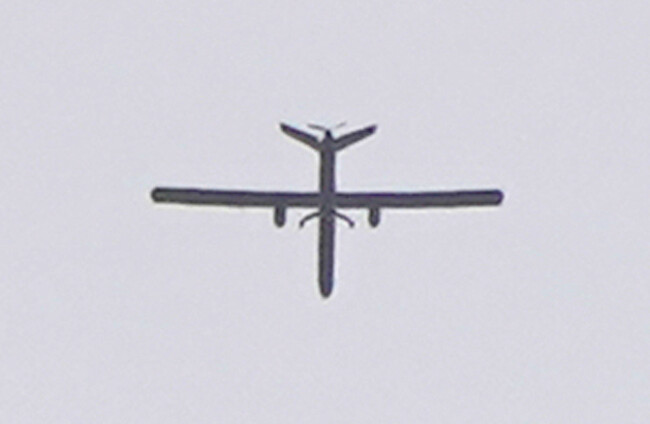
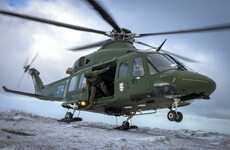
The drone above Camp Shamrock photographed by Niall Carson. Alamy Stock Photo

Diplomacy through other means: Why this drone shadowed the Tánaiste's every move in Lebanon

The IDF drone followed Harris much of the way from Beirut to the Irish base this week – a provocative display by Israel.

AS TÁNAISTE SIMON Harris made his way through the devastated villages of South Lebanon he was shadowed overhead by an Israeli drone.

Drone flights by Israel are nothing new in the area and are an almost daily reality for Lebanese citizens and Irish soldiers – but this was a provocative display by Israel.

Harris was inside a blacked-out, heavily armoured SUV in a convoy of vehicles surrounded by elite military special forces operators from the Army Ranger Wing. 

This was an Irish show of force but still, above them, the drone – sounding like a lawnmower – kept watch, feeding back images to an Israeli Defence Forces command centre. 

Earlier on Wednesday Harris had met senior players in the Lebanese Government in Beirut and had discussed the murder of Private Sean Rooney by Hezbollah among other secret issues.

Those meetings had a large number of officials present, including Lt General Seán Clancy, the head of the Defence Forces, and senior Foreign Affairs and Department of Defence civil servants.

The journey south from Beirut to Ireland’s Camp Shamrock took about three hours – but as he met with officials at the Irish base and chatted to soldiers the drone was back, orbiting above. 2-45, as the Irish camp is known, is just eight kilometres from Israel. 

Sources have said the Harris convoy was pursued by the drone which was unarmed. Those sources said that the unmanned propellor driven aircraft can be put on silent mode. 

It was clear, this week, that silent mode had not been engaged – and our sources said it was clear that this was a deliberate choice, and a way to communicate the Israeli presence to Harris and the Irish government. 

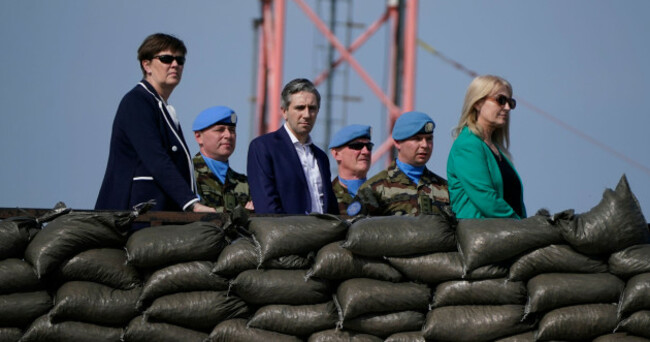
tanaiste-simon-harris-during-his-visit-camp-shamrock-near-the-border-with-lebanon-and-israel-to-visit-defence-forces-troops-serving-with-the-unifil-peacekeeping-mission-amid-escalating-clashes-between Tánaiste Simon Harris centre, with Irish military officers Department of Defence Secretary General Jacqui McCrum left and right Ambassador Nuala O'Brien. Alamy Stock Photo Alamy Stock Photo

Clear and present dangers

The route south and back north is through hugely damaged towns – the Tánaiste himself described scenes where one side of the village was destroyed while the other was unaffected. 

The security situation and danger is three fold and the threat is very real – a Finnish soldier lost his foot when a mine concealed under an arms stash blew up as he moved into seize on 19 March.

The Hezbollah are still a formidable force and despite the slaughter of their membership by Israel they still pose a threat. In the villages dotted across winding mountainous roads heading south towards Camp Shamrock there are so-called martyrs posters to fallen fighters.  

Denial of Freedom of Movement or ‘DFOM’ is a regular occurence where Hezbollah members block the road for the troops moving around. 

The second threat is Israeli action – Irish soldiers narrowly avoided serious injury when a convoy of patrolling vehicles drove through a village just as an Israeli bomber struck a building recently. The Journal obtained exclusive video of that incident. 

The third threat is from a very aggrieved local population – this was confirmed to us by Lt Col Shane Rockett who said Civilian Military Cooperation teams were trying to solve that problem. It has meant that United Nations forces have come under attack by stone throwing youths and operate carefully to prevent physical violence. There is a general sense of outrage that has erupted in communities as they return home to find villages razed, their homes gone, and the smell of decomposing bodies. 

The Journal saw some of that damage en route in – there was largescale devastation. The most notable however is the village of Yaroun which has been razed completely and only exists now as rubble.

The victims of that violence, the local people, have turned against the United Nations who they have said failed to stop the killing and destruction. The unfortunate reality is that the soldiers cannot act due to the text of Resolution 1701. The problem is with the type of mission it is – under Chapter six of the UN Charter it is a peace monitoring mission. It is not a peace enforcement mission as would occur under Chapter seven.

Beyond those direct threats there is also the risk of unexploded ordnance and improvised explosive devices – every rock, cedar grove, dry river bed and culvert is a threat to the Irish.

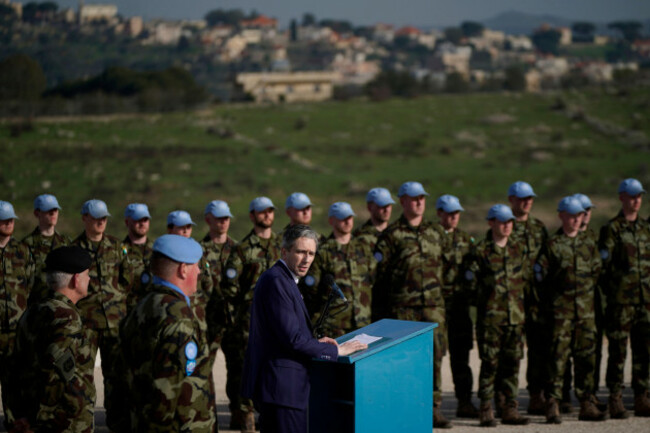
tanaiste-simon-harris-addresses-troops-during-his-visit-camp-shamrock-near-the-border-with-lebanon-and-israel-to-visit-irish-defence-forces-troops-serving-with-the-unifil-peacekeeping-mission-amid-esc Tánaiste Simon Harris speaks to troops in Camp Shamrock on Wednesday with the village of Ain Abel behind. Alamy Stock Photo Alamy Stock Photo

Tribe and creed

The area itself is a patch of ground in Lebanon by name only – it is really a place where religious or tribal allegiance matters more. Sunni, Shia and Christian sects live in de facto segregated villages.

Hezbollah runs a system of clientelism in which they provide services to the community like education, shops, medics – the community depend on them to supply what the poorly equipped State does not. 

They are still strong in the south but in the southern suburbs of Beirut sources have said that Hezbollah’s losses during the recent war has seen another group, the Amal Movement grow, in strength. 

In the Irish camp we spoke to soldiers who said the drone incursions by Israel are a very regular occurrence. The flights are monitored by a massive French Radar system. 

As one soldier put it: “we get worried when we don’t hear it because that means something bad is about to happen”.

During the Tánaiste’s visit there were real concerns from the Irish military that Israel or Hezbollah could try to embarrass the Irish Government – but that never materialised. The theory was that they may launch a rocket or artillery shell to cause a “groundhog” shelter – meaning troops would have to take cover in bunkers. 

As one source put it: “the drone is diplomacy through other means” – a play on the quote from military theorist Carl von Clausewitz who said “war is a continuation of politics through other means”.  

The Tánaiste flew out of Beirut on Thursday morning, leaving behind the city and Lebanon after successful meetings. 

Just 24 hours later Israel bombed Beirut and hit multiple targets across the south as close as At Tiri – the town just a few hundred metres from Camp Shamrock.

The Israelis show of lethal force was carried out after two rockets were launched into northern Israel. 

Readers like you are keeping these stories free for everyone...
A mix of advertising and supporting contributions helps keep paywalls away from valuable information like this article. Over 5,000 readers like you have already stepped up and support us with a monthly payment or a once-off donation.

Close
JournalTv
News in 60 seconds