We need your help now

Support from readers like you keeps The Journal open.

You are visiting us because we have something you value. Independent, unbiased news that tells the truth. Advertising revenue goes some way to support our mission, but this year it has not been enough.

If you've seen value in our reporting, please contribute what you can, so we can continue to produce accurate and meaningful journalism. For everyone who needs it.

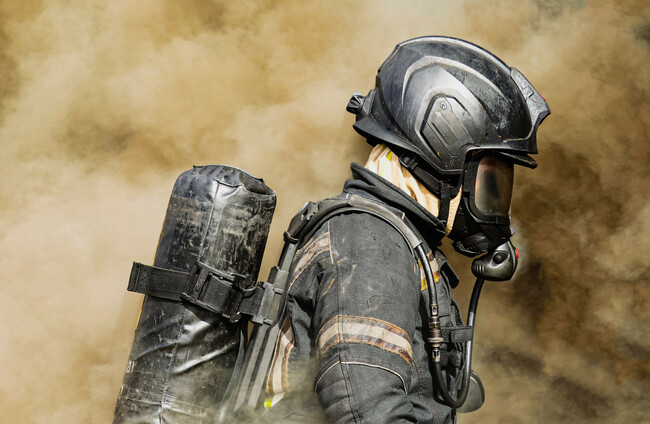
An Air Corps firefighter in the smoke. Irish Defence Forces

The Government has held multiple exercises to deal with major disasters including rail crashes

Today, The Journal, visited the National Emergency Coordination Centre and spoke to the senior officials who run the facility.

MULTIPLE HIGH LEVEL exercises have been undertaken to prepare Ireland for a variety of disasters including a rail crash, an attack on a gas pipeline, cyber attack and a radiological incident. 

The exercises were carried out inside the National Emergency Coordination Centre (NECC), which is Ireland facility for managing major crises.

Today, The Journal, visited the centre and spoke to the senior officials who run the facility. 

As reported previously Exercise Púca was held at the NECC which studied the State’s response to a scenario if multiple undersea internet cables were severed. 

The NECC is located inside a secure floor of the Department of Agriculture building on Kildare Street. It is a large board room with banks of television screens where, during a major incident, more than 30 officials manage the disaster. 

Most recently it was here that the Irish State managed its response to Storm Eowyn – it was also where the Army Ranger Wing and Department of Foreign Affairs mission to rescue Irish citizens in Kabul was managed.

The centre has specialist communications and multiple electricity back ups including two seperate power generators. 

Emergency services as well as specific Government departments are represented on the committee. There is also weather forecasters and, at times, representatives of major national infrastructure companies such as ESB.

Kealan McMoreland is the lead civil servant at the Office of Emergency Planning in the Department of Defence.  He said that the current system was created in october 2001, just weeks after the September 11 on American cities to manage a disaster on that scale. 

McMoreland said that at the time the Government convened a task force to look at how Ireland would respond to major terror attacks. 

It is convened when the threshold is met for a major, country-wide incident. This, the senior official said, includes widespread flooding and weather incidents. 

He said the NECC and the Office of Emergency Planning are both designed to give a dedicated way to declutter the response on the ground. 

“Basically we’re gathering information, and we’re removing bottlenecks that may exist for the operational responders.

“That’s one of the key roles of this group is to remove any bottlenecks that might exist to actually delivering the response on the ground,” he said. 

The Journal / YouTube

‘Mandate’

The specific response is managed with publicly available documents on the Office of Emergency Planning website.

Departments such as Health, Housing and Communications are involved as well as the oversight of the Department of the Taoiseach. 

Everyone in the room has a “mandate” to make decisions as incidents develop. 

Keith Leonard is the National Director of Fire & Emergency Management. He said that the key to Ireland’s response is that local coordination groups then feed into the national picture at the NECC.

He said communications from the regional teams is made virtually and they feed in critical information “on the common incident picture” to determine what is the best course for the NECC.

In the centre there is a press room where press conferences are held to update the public – they can be broadcast live through social media to keep the public updated.

 The exercises run in the centre have had key impacts on how Ireland manages key infrastructure. 

One of those exercises, Cathal, looked at the gas pipeline to the island of Ireland from Scotland being severed. This, the officials said, contributed to government support for a planned Liquid Natural Gas (LNG) terminal.    

John Burke from the Department of the Environment, Climate and Communications said the exercise last December fed into the government’s thinking on LNG.

He said that any damage to the pipeline, the Moyle Interconnector, would adversely impact Ireland’s ability to provide energy to the population and it was identified as a major risk. Burke added that if it was damaged, there would be at least a six months repair operation in the Irish Sea. 

“In terms of national exercises, I’ve been involved in a few of them, and they’re fairly time consuming to prepare for them. They are very resource intensive, but they’re quite rewarding in terms of the outputs and the learnings that you can get,” Burke said.

“Certainly, from our perspective, we’ve got a renewed focus within our own department and for emergency planning. We’ve beefed up our own team a little bit. I think other departments are realising this is an area that each department needs to build their base,” he added. 

Readers like you are keeping these stories free for everyone...
A mix of advertising and supporting contributions helps keep paywalls away from valuable information like this article. Over 5,000 readers like you have already stepped up and support us with a monthly payment or a once-off donation.

Close
10 Comments
This is YOUR comments community. Stay civil, stay constructive, stay on topic. Please familiarise yourself with our comments policy here before taking part.
Leave a Comment
    Submit a report
    Please help us understand how this comment violates our community guidelines.
    Thank you for the feedback
    Your feedback has been sent to our team for review.

    Leave a commentcancel

     
    JournalTv
    News in 60 seconds