We need your help now

Support from readers like you keeps The Journal open.

You are visiting us because we have something you value. Independent, unbiased news that tells the truth. Advertising revenue goes some way to support our mission, but this year it has not been enough.

If you've seen value in our reporting, please contribute what you can, so we can continue to produce accurate and meaningful journalism. For everyone who needs it.

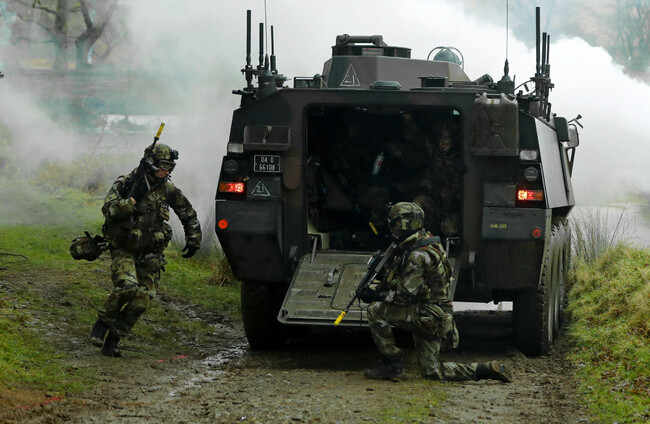
2017 file image of Irish soldiers taking part in final phase of training in Glen of Imaal, ahead of deployment to peacekeeping mission in Golan Heights Alamy Stock Photo

Simon Harris wants to remove the 'Triple Lock' - but what is it and what could replace it?

A draft proposal to change the ‘Triple Lock’ will be brought before Cabinet tomorrow.

TÁNAISTE SIMON HARRIS will bring a draft proposal before Cabinet tomorrow which will seek to alter the ‘Triple Lock’.

But what is the Triple Lock, and what could its replacement look like?

Triple Lock

The “Triple Lock” is a mechanism that sets out the conditions under which more than 12 Irish troops may participate in overseas peace support operations.

The operation must be mandated by the United Nations, approved by the Government, and approved by Dáil Éireann. 

As it stands, 12 members of the Irish Defence Forces can be sent on an overseas mission without triggering the Triple Lock.

So what measures are being brought before Cabinet tomorrow?

Harris will tomorrow bring measures to Cabinet that will seek to change the number of troops that can be deployed without prior approval from 12 to 50 and remove the requirement for approval from the UN body.

Removing the requirement for approval from the UN would turn the Triple Lock into a double lock.

This double lock would mean that only Government and Dáil approval is needed to send more than 50 Irish troops on overseas missions – 50 being the new proposed upper limit.

However, Harris rejected claims that Ireland was seeking to remove the UN from its deployment decisions.

Harris, who is also Defence Minister, added that Ireland has previously been prevented from joining operations after the state failed to receive a mandate from the UN.

What has the Opposition been saying about the proposed changes?

Senator Tom Clonan – a retired Army Officer and security analyst for The Journal - said that the limit of 12 troops before the Triple Lock is required should be increased to around 120, as opposed to 50.

“That could deal with very quick responses required for getting our citizens out of an airport or responding to a humanitarian disaster,” said Clonan.

He added that any government vote under a double lock mechanism should be a free vote.

“They should not be whipped, it should be a vote of conscience, and no TD or Senator should be whipped into sending Irish men and woman into harm’s way.”

Jennifer Whitmore, Social Democrats TD for Wicklow, said the inclusion of the UN mandate for the Triple Lock acts as a preventative measure against future governments seeking to approve the deployment of troops without public consensus.

Labour’s foreign affairs spokesperson, Duncan Smith, also expressed concern at the proposed measure.

“Labour has consistently said that any veto over Ireland’s foreign policy, whether from Russia, China, or a future Trump-led America, is concerning,” said Smith.

“However, simply scrapping the Triple Lock without a full public and political debate is not the answer.”

Sinn Féin has said the proposed changes are a “risk to our neutrality”.

Speaking to RTÉ, Sinn Féin’s Donnchadh Ó Laoghaire said of the proposed change: “The government of the day will be in a position to deploy Irish troops to any mission that they wish, to any location that they wish, provided they have a majority.

“We believe that that causes significant risk to our neutrality.”

He also noted that “a lot of store” was put in the Triple Lock by previous governments.

So what have previous governments said about the Triple Lock?

In June 2013, Micheál Martin – then the leader of the opposition – warned that Fine Gael, in government with Labour, was planning on “loosening” the Triple Lock with the publication of a Green Paper on Defence.

At the time, the coalition government was led by Enda Kenny as Taoiseach.

“It appears that Fine Gael is arguing that Ireland is failing in its European responsibilities and is allowing Russia and China to have a veto over our peacekeeping activities,” said Martin in the Dáil in 2013.

“This is nothing more than an out-of-touch ideological obsession on the part of Fine Gael which ignores the facts of Ireland’s international standing.”

The following month, then-Defence Minister Alan Shatter published the Green Paper on Defence that Martin spoke of in the Dáil – a Green Paper is a Government proposal on how to improve something or solve a problem.

In his Green Paper on Defence in 2013, Shatter argued that the positives of the Triple Lock system outweighed the negatives and he recommended that the government retain the policy, further adding that there is “substantial public support” in favour of it.

In the years since, Martin’s views on the Triple Lock have undergone a marked shift and in 2023, he announced plans to bring forward legislation to get rid of the Triple Lock.

In 2013, Martin said Fine Gaal was “arguing” that Ireland was allowing Russia and China to have a veto in peacekeeping activities and that this was an “out-of-touch obsession”.

But last summer, it was Martin who was making this argument, telling the Dáil: “The idea that we would depend on Russia, China or the US to decide on whether Ireland should send troops to a peacekeeping mission, particularly given the role of like Russia, is completely outdated and absurd.”

The Russian invasion of Ukraine prompted this change in direction, with Martin telling the Dáil in November 2023 that the “bottom line” is that Russia should not “dictate our foreign policy”.

“I believe there’s something morally wrong with the fact that an authoritarian and aggressive neo-imperialist power has de facto veto on elements of how we react to any given situation,” said Martin.

“They’ve invaded Ukraine and they violated the UN charter.”

Elsewhere, a change to the system was mooted by then-Foreign Affairs Minister Simon Coveney in November 2022.

At the time, the Fine Gael Ard Fheis voted overwhelming in favour of a motion calling on the Government to remove the Triple Lock and replace it with a double lock mechanism.

Coveney said that moving away from the Triple Lock would be a “sensible change” and wouldn’t be a “radical change”.

“Don’t forget that one of the elements of the Triple Lock is that we are required to have a UN mandate,” said Coveney at the time.

“That effectively means that a country like Russia can veto what Ireland chooses to do. Is that neutrality?”

Speaking yesterday, Tánaiste Simon Harris also pointed to concerns that Russia may seek to veto plans at the UN to deploy peacekeeping troops to Ukraine in the future.

Last month, The Journal reported that the Irish Government would consider sending Irish troops as part of a multinational peacekeeping mission.

However, Harris last week said that Irish troops will not participate in a peacekeeping mission in Ukraine if it would put them in a situation where they would have to fight to enforce the peace.

Last month, both British prime minister Keir Starmer and France president Emmanuel Macron said that they would consider deploying troops to Ukraine in the event of a lasting peace agreement.

Readers like you are keeping these stories free for everyone...
A mix of advertising and supporting contributions helps keep paywalls away from valuable information like this article. Over 5,000 readers like you have already stepped up and support us with a monthly payment or a once-off donation.

Close
70 Comments
This is YOUR comments community. Stay civil, stay constructive, stay on topic. Please familiarise yourself with our comments policy here before taking part.
Leave a Comment
    Submit a report
    Please help us understand how this comment violates our community guidelines.
    Thank you for the feedback
    Your feedback has been sent to our team for review.

    Leave a commentcancel

     
    JournalTv
    News in 60 seconds