We need your help now

Support from readers like you keeps The Journal open.

You are visiting us because we have something you value. Independent, unbiased news that tells the truth. Advertising revenue goes some way to support our mission, but this year it has not been enough.

If you've seen value in our reporting, please contribute what you can, so we can continue to produce accurate and meaningful journalism. For everyone who needs it.


The Lancet said the rise of ultra processed food is 'driven by corporate profit, not nutrition or sustainability' Alamy Stock Photo

Ultra-processed foods are fuelling chronic diseases, says new Lancet report

A new Lancet series on ultra-processed foods has warned that a unified global response is needed to ‘confront corporate power’.

COUNTRIES NEED TO band together to deal with ‘corporate power’ behind the rise of ultra-processed foods that are fuelling chronic diseases.

That’s according to a new Lancet series on ultra-processed foods and its impact on human health.

The Lancet is a peer-reviewed medical journal and one of the highest-impact academic journals worldwide.

Its new three-paper series published today finds that ultra-processed foods (UPFs) are displacing fresh and minimally processed foods, worsening diet quality, and are associated with an increased risk of multiple chronic diseases.

Its authors warn that improving diets can’t rely on only on consumers changing their behaviour; it requires coordinated global policies to reduce UPF production, marketing, and consumption, alongside improving access to healthy food.

An Irish professor has told The Journal that the government should apply these warnings to the hot school meals programme to ensure schoolchildren are eating healthy food.

What ultra-processed foods are doing to us

The new series concludes that UPFs are the product of a food economy “driven by corporate profit, not nutrition or sustainability” and that political lobbying is the “largest barrier to implementing effective policies” to tackle the rise of UPFs.

The new series is authored by 43 global experts who have warned that the rise in UPFs is “supported by extensive marketing and political lobbying to stop effective public health policies to support healthy eating”.

UPFs are made from inexpensive industrial ingredients such as hydrogenated oils, glucose/fructose syrup and cosmetic food additives, such as dyes and artificial sweeteners.

They are designed and marketed to displace fresh and minimally processed foods and traditional meals.

Examples include soft drinks, hot dogs, sweet or savoury snacks, and ready-to-heat pizzas. Some UPFs are better than others, like yoghurts and breakfast cereals. 

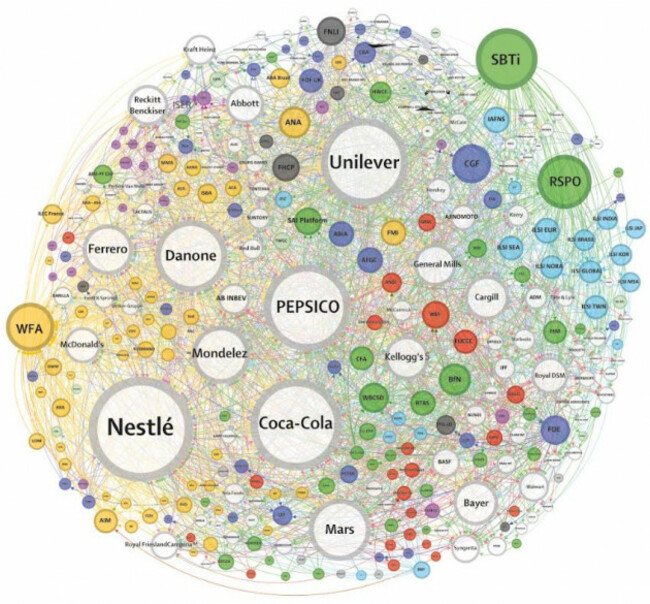
Lancet UPF graph A graph from the Lancet study illustrating the ultra-processed food industry’s global political influence network of corporate interest groups. The Lancet The Lancet

A 2018 study found that in Ireland, UPFs make up 45.9% of the average household’s food purchases.

Evidence reviewed in the Lancet series shows that diets high in UPFs are linked to overeating, poor nutritional quality and higher exposure to harmful chemicals and additives.

There is an associated risk of one or more chronic diseases with UPFs, including obesity, type 2 diabetes, cardiovascular disease, and depression.

While the series’ authors acknowledge a lack of long-term clinical and community trials and call for further research, they warn these concerns “must not delay immediate and decisive public health action justified by the current evidence”.

Tackling the problem

A second paper outlines policies to regulate and reduce UPF production, marketing, and consumption.

One of the policies suggested is front-of-package labelling for ingredients that are markers of UPFs, such as colours, flavours, and sweeteners, as well as placing limits on UPFs sales and shelf space in supermarkets.

The Lancet series also calls for stronger marketing restrictions, particularly on adverts directed at children and online.

Dr Norah Campbell, an assistant professor at Trinity Business School who researches the food industry, told The Journal that she welcomes such policies around labelling and advertising and remarked that Ireland “hasn’t done enough” around advertising.

Elsewhere, the series also calls for UPFs to be banned in public institutions like schools and hospitals.

One success story The Lancet pointed to was Brazil’s national school feeding program which has eliminated most UPFs and will require 90% of the food to be fresh or minimally processed food by 2026.

Campbell said this is something Ireland should also target through its Hot School Meals programme.

“Government can play a really positive role in saying that all school lunches have to be produced locally and it has to be whole foods or minimally processed,” said Campbell.

It would be a win-win, because we should be putting taxpayer money into those communities who can make food locally and provide our children with food that’s healthy.

“But at the moment in our public procurement systems, it’s just crap food from the lowest bidder.”

Political Playbook

A third paper in the series looks at the global corporations behind the rise in UPFs and the aggressive marketing and appealing designs used to boost consumption.

With global annual sales of $1.9 trillion, UPFs are the most profitable food sector and eight multinational corporations, including Nestlé, PespsiCo, Unilever, and Coca-Cola account for 42% of this sector. 

The authors say these profits result in an expansion of UPF production, marketing, and political influence.

The series reveals how UPF companies use “sophisticated” political tactics to protect profits by “blocking regulations, shaping scientific debates, and influencing public opinion”, much like the tobacco industry did decades ago. 

“They coordinate hundreds of interest groups worldwide, lobby politicians, make political donations and engage in litigation to delay policies,” said the series’ authors.

Campbell warned that Ireland is also subject to lobbying within the industry, pointing to lobbying against the introduction of the sugar sweetened drinks tax in 2018.

The authors have called for a coordinated global public health response to protect policymaking from industry interference and to end industry ties with health professionals and organisations.

“Just as we confronted the tobacco industry decades ago, we need a bold, coordinated global response now to curb the overproportionate power of UPF corporations,” said the reports authors. 

Campbell suggested that Ireland could take the lead globally on UPFs like it did with tobacco in being the first country to ban smoking indoors in public spaces.

“There are really good levers we can use, like the school meals programme and put down the foundations of good food for our kids.”

Readers like you are keeping these stories free for everyone...
A mix of advertising and supporting contributions helps keep paywalls away from valuable information like this article. Over 5,000 readers like you have already stepped up and support us with a monthly payment or a once-off donation.

Close
29 Comments
This is YOUR comments community. Stay civil, stay constructive, stay on topic. Please familiarise yourself with our comments policy here before taking part.
Leave a Comment
    Submit a report
    Please help us understand how this comment violates our community guidelines.
    Thank you for the feedback
    Your feedback has been sent to our team for review.

    Leave a commentcancel

     
    JournalTv
    News in 60 seconds