Sign in. It’s quick, free and it’s up to you.
An account is an optional way to support the work we do. Find out more.
Sign in. It’s quick, free and it’s up to you.
An account is an optional way to support the work we do. Find out more.
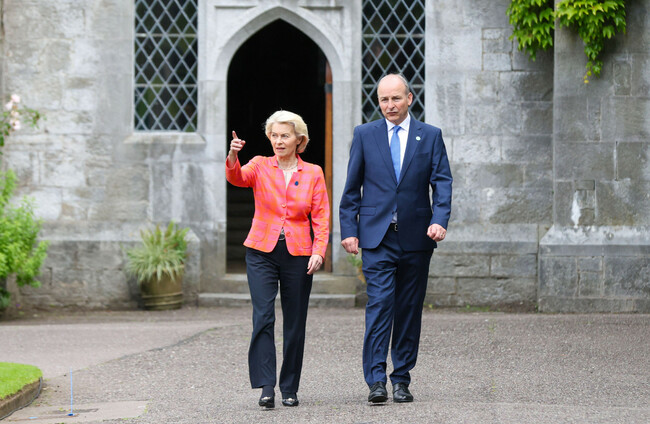
“IT IS A cause of deep and justified sadness and anger to many that Europe has not done enough to put pressure on Israel in the light of its egregious actions.”
These were remarks made by Taoiseach Micheál Martin during his address to the European Parliament in Strasbourg on Tuesday.
He called on the EU to do more to support peace in the Middle East and a two-state solution in Palestine.
“I fully respect and understand that this is a difficult topic for many countries and is challenging many long-established connections and policies. But we simply must do more,” the Taoiseach said.
His comments were in stark contrast to the comments made by European Commission President Ursula von der Leyen last weekend in Cork.
According to von der Leyen, Europe has done plenty.
In fact, she told the crowd gathered in University College Cork to the beginning of Ireland taking on the EU presidency that “no-one” has done more than Europe.
The Journal (this reporter) asked von der Leyen about McEntee’s remarks about an EU-wide occupied territories bill and about how it has been independently verified in a UN report that children are being targeted by Israeli soldiers in Gaza right now.
Why was she and the commission dragging their feet on the issue, and when would action be taken?
Seemingly well aware that the Irish media might raise this issue, and not a fan of being unscripted in any way, von der Leyen reached for a sheet in her notes.
“So, first of all, perhaps to set the record straight, we are the world’s largest provider of assistance to the Palestinian people, the largest,” she said.
She then began listing off a ream of stats and numbers.
“No one does more than us. Since 23 October we have earmarked over €2.7 billion in humanitarian aid and budget support. We have organised 85 humanitarian aid bridge flights and delivered more than 5,600 tonnes of essential supplies, so this I think is important to know. No one does more than us,” she said.
One figure that was not mentioned was the 70,000 Palestinians who have been killed to date. There was also no mention of the children who continue to be killed even after the ceasefire, as set out in the UN report this publication had asked Von der Leyen about.
Typically, how these press conferences generally work when a foreign dignitary is in town is the travelling press get two questions and the Irish media pack get two questions.
Apparently not a fan of talking on the hoof, it is understood there were some inquiries made about what the Irish contingent of the press pack might ask.
It’s believed there was a bit of consternation when it was relayed back to von der Leyen’s side that it would be the Irish reporters that would be choosing the topics and there would be no advance warning of what the questions might be.
In the end, Irish reporters asked about the Aughinish Alumina plant in Limerick that has the Irish government in hot water, and about the possibility of a social media ban for children.
Given the level of criticism against von der Leyen when it comes to some of the positions she has taken on Israel in the past, and the impact it has had in terms of Irish public support for the EU, the issue of Palestine is one that had to be raised with the European Commission president on her visit.
Unfortunately, there is little room for back and forth in these press conferences, with the microphone quickly whipped from your hand once you have asked your question, so coming back to her with further questions was not feasible.
The Taoiseach chose not to jump in to offer a viewpoint. Given his strong words in Strasbourg this week, any remarks might have had even more resonance had they been uttered in the presence of von der Leyen last week.
The European Commission president did say that the ball is in the court of the EU member states when it comes to sanctions against Israel.
Appealing to those member states this week, the Taoiseach said:
“I fully respect and understand that this is a difficult topic for many countries and is challenging many long-established connections and policies. But we simply must do more.”
Ireland has an opportunity to repeat that call now that it is hosting the EU presidency, European leaders, ministers and diplomats due to descend on the country.
McEntee, the foreign affairs minister, has already been vocal about pushing for an EU-wide occupied territories and how she wants countries to unite behind it.
Key foreign affairs meetings with her European counterparts will be held in Ireland in September, offering a unique opportunity to communicate Ireland’s message on our home turf.
Before that, McEntee will attend the Foreign Affairs Council meeting of ministers on Monday. Recent developments in the Gulf and Iran, as well as the situation in Palestine, are expected to be discussed.
The council will take stock of the further deteriorating situation in the West Bank regarding the illegal settlements, and discuss options as put forward by the commission as to what steps can be taken.
“We’ve obviously been advocating for the strongest possible response that would be the suspension of the association agreement,” McEntee said in Cork last week. “You could suspend the trade element of the association agreement, but I don’t agree that banning goods or services, trade overall in the occupied territories is simply symbolic.”
She said 27 member states deciding that they would ban trade in the occupied territories would be a significant move, and is not something that has ever happened before.
“I will be saying this at the next meeting – we have a UN report, an independently verified report that is now saying that the Israeli Defense Forces, that the Israeli government are targeting children, not prior to the ceasefire, but post the ceasefire. We all have to stand up and listen to this. We have to take action.”
Whether the message will result in action or movement by other nations, we will have to wait and see.

To embed this post, copy the code below on your site




have your say