We need your help now

Support from readers like you keeps The Journal open.

You are visiting us because we have something you value. Independent, unbiased news that tells the truth. Advertising revenue goes some way to support our mission, but this year it has not been enough.

If you've seen value in our reporting, please contribute what you can, so we can continue to produce accurate and meaningful journalism. For everyone who needs it.

TG4/YouTube

Sports News: 'I always compare handball to a secret society'

With the Wallball Nationals coming up in September, here’s what you need to know about this Irish sport.

THERE ARE AROUND 900 handball courts in Ireland, but according to the TG4 documentary Hit the Wall, 800 of them are abandoned.

Yet GAA Handball has a fiercely passionate fan and player base – and the upcoming Wallball Nationals will be broadcast on TG4′s YouTube page this September. Last year, TG4 announced its collaboration with GAA Handball to promote the sport through its digital platform Spórt TG4 YouTube

Handball player, coach and Anglo Celt reporter Paul Fitzpatrick describes handball as “a secret society”. But if you’d like to join the fanbase and check out the live games on YouTube, what should you know? Let’s take a look at the basic facts to get you started.

Handball history – Stair Liathróid Láimhe

As a sport, handball has a global history that stretches back centuries, with some version of it existing across multiple countries under different names. Here in Ireland, the sport is seen as an ancient one. It was included in the GAA Charter of 1884, and four decades later the Comhairle Liathróid Láimhe na hÉireann (the Irish Handball Council) was established. 

Driving throughout the country today, you can spot the empty and abandoned stone handball alleys that haven’t been used for decades. But across the country there are also now courts in schools, community centres and GAA facilities, alongside a fervent fanbase eager to watch this high-energy sport played live. 

How it works – Conas a oibríonn sé

GAA Handball TV / YouTube

There are four main ‘codes’ or games of handball, two of which are domestic and two which are international.

4-Wall is an international game, and is played in a four-walled court which is 40 feet long by 20 feet wide, says Fitzpatrick. 

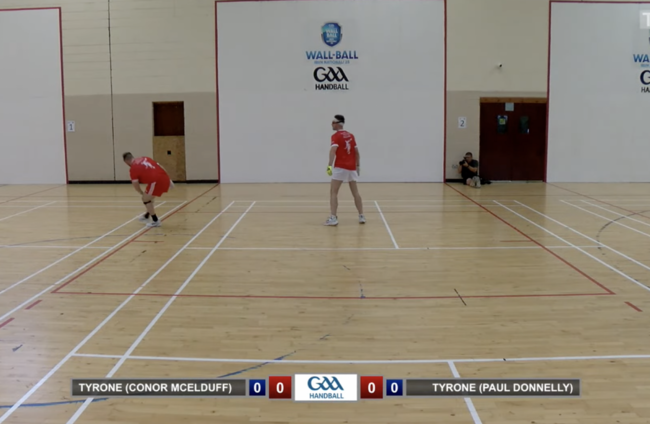
“Then you have another code called Wallball, which was formerly called 1-Wall handball. And it’s played with one wall. So the lines are marked up on the wall, the playable area, and then lines on the floor.” 

Wallball is also international and is the fastest growing code, says Fitzpatrick. It is relatively easy to put up a Wallball court, and the barriers to entry are quite low, mainly due to the softer ball.

“The fact that the ball is a little bit slower, you can get into rallies, and there’s a received confidence – you can feel that you’re actually quite good at it fairly quickly, whereas the other forms of it are difficult.”

There is another handball code called Softball, which is a domestic game and played in a four-walled court which is 60 feet long by 30 feet wide. “It’s a traditional Irish version of handball. It’s a brilliant game,” says Fitzpatrick.

The fourth code is the domestic and traditional game of Hardball. “It was probably the original form of handball. It’s played with a cork centre wrapped up in leather, like a small sliotar,” says Fitzpatrick. 

There can be two or four players of the game (singles or doubles). It’s similar to squash, in that after the player serves, the ball can only bounce once in a rally.

A game is first to 21 points, and it’s the best of three games. If it’s one game each, then the third game is a tie breaker to 11. A game would take an hour on average, says Fitzpatrick. “It’s not timed as such, it’s just whoever can get to the last point first.” 

Wallball nationals

The Wallball nationals will take place 26 – 28 September, while Hardball doubles will take place from 5 – 7 September and singles and She’s Ace (female event) from 12 – 14 September.

Last year, a record-breaking 265,000 viewers tuned into TG4 to watch the World Wallball Championships, which took place at University of Limerick. There were almost 900 entries, with players not just from Ireland but from the USA, Canada, France, Japan and the Basque Country.

GAA Handball TV / YouTube

The top men’s Wallball player in Ireland is Conor McElduff, from Tyrone. “He’s an interesting character in his own right – he calls himself TGO, which is ‘the great one’,” says Fitzpatrick. McElduff is among those who appears in Hit the Wall, and talks about the sometimes dismissive attitudes he encountered towards the niche sport while he was growing up. 

“He’s like a little legend within our small sport. I always compare handball to a secret society. It’s a lot bigger than people [realise],” says Fitzpatrick. “You’d be amazed at how big it is, but at the same time, it’s totally underground. Even if you look at inter-county footballers and hurlers at the minute, there’s loads of them that have played a high level of handball.”

Because of the changing popularity of the sport over the years, Fitzpatrick says: “It’s left a funny situation where in a big town there might be no handball club. And then there might be a village out the road that has 90 members.

It’s stronger in the rural counties now, probably the last 20, 30, years. So Kilkenny is particularly strong at the moment; Galway is strong, and Tipperary, Wexford and Tyrone.

Skills

Spórt TG4 / YouTube

Handball is a highly skilled game, says Fitzpatrick. 

“You’re using both sides of the body, and there’s a lot of strategy to it as well. The funny thing about handball is it’s unbelievably addictive.

“You can play handball forever. We had a fella in his 80th year, Ned Flynn, who won an All-Ireland medal in 2023. 

“So we have players that are playing competitively into their 80s. And then we have kids playing at six or seven years old. So it’s a game for life.”

Fitzpatrick also points out that handball “is probably one of the few sports that has complete equality between between male and female players”. In the All-Ireland finals, the top grade is the senior championship. Both the men’s and women’s senior championship games share equal billing.

One other thing to watch out for during the games is its commentators, particularly Ollie Cassidy and Chris Gavaghan. 

“Chris Gavaghan and Ollie Cassidy really add a lot to the coverage. People will enjoy listening to the commentary, because it’s good craic,” says Fitzpatrick.

As to why Fitzpatrick himself is so into the sport, he says:

“I like the gladiatorial aspect of it. You go into the court, you close the door behind you, and it’s sort of one-on-one combat. You don’t walk back out of there until you’re either victorious, or you’re defeated.”

More sports on screen

For more GAA on screen, check out the two-part mini-series Iománaíocht Hollywood on TG4 on 4 and 11 September. It will give a fascinating insight into how Ireland, Irish people and indigenous Irish Gaelic games have been depicted in the cinema since the beginning of the last century, including in Hollywood productions. 

Close