We need your help now

Support from readers like you keeps The Journal open.

You are visiting us because we have something you value. Independent, unbiased news that tells the truth. Advertising revenue goes some way to support our mission, but this year it has not been enough.

If you've seen value in our reporting, please contribute what you can, so we can continue to produce accurate and meaningful journalism. For everyone who needs it.

Alamy Stock Photo

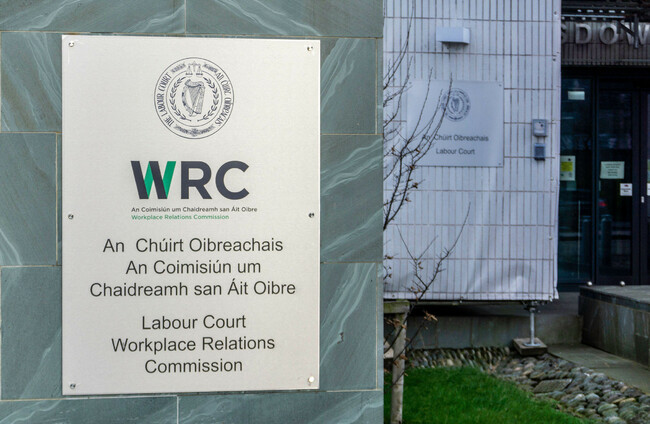
Deaf job applicant awarded €40,000 after not being shortlisted by special education quango

The National Council for Special Education did not shortlist a fluent Irish Sign Language (ISL) user over not having an academic job qualification in ISL.

THE STATE BODY set up to improve the delivery of education services to people with additional educational needs has been ordered to pay discrimination compensation of €40,000 to a deaf job applicant.

This follows Workplace Relations Commission (WRC) adjudicator Jim Dolan ordering the National Council for Special Education (NSCE) to pay €40,000 to Noel O’Connell after it did not shortlist him for an Advisor role at the NCSE over not having an academic job qualification in Irish Sign Language (ISL).

O’Connell applied for the post of Advisor Deaf/Hard of Hearing with the NCSE in March 2022 and believed that he was well qualified given that he has a PhD in deaf education and is a fluent ISL user.

Dolan found that the NCSE’s actions amount to indirect discrimination against O’Connell under the Employment Equality Act.

On behalf of O’Connell, Michael Kinsley instructed by Sinead Lucey, Free Legal Advice Centres (FLAC) argued that O’Connell, like most deaf users of ISL, does not have an academic qualification in ISL, it being his daily language.

O’Connell was successful in a formal review of the NCSE not to shortlist by the Commission for Public Service Appointments which later found that he met the requirements for the role.

O’Connell had successfully argued that the criteria contained in the NCSE Candidate Information Booklet were discriminatory and that deaf people were far less likely to hold an academic qualification in ISL.

However, he was informed by the NCSE at that stage that the recruitment process had closed.

Kinsley argued that O’Connell was uniquely qualified for the position being advertised and suffered significant losses as a result of not being shortlisted and interviewed.

Kinsley contended that O’Connell “would have been successful in the absence of the discriminatory requirement”.

However, Dolan noted that no remedy was offered by the NSCE and the rejection of his application was not overturned.

The NSCE denied that indirect discrimination had taken place. In a legal submission, Mary-Paula Guinness, instructed by Eversheds Sutherland for the NCSE it stated that O’Connell is asking Dolan to determine his qualifications and experience meet the requirements without reference to any other candidates.

McGuinness submitted that this is fundamentally flawed and outside the jurisdiction of a discrimination claim where Dolan’s only role is to ensure that the essential criteria is not tainted by unlawful discrimination.

Commenting on the outcome, O’Connell said today: “I am very pleased with the outcome in my case against the NCSE.”

He said: “The decision recognises that my exclusion from the recruitment process was unlawful and discrimination against me as a deaf person. This unlawful conduct was carried out by a public service employer.

He said: “I hope that this case will prompt all employers to reflect on their recruitment practices and policies and to ensure that they are compliant with the rights of people with disabilities. I would like to thank FLAC and the team who assisted me with the case.”

FLAC Managing Solicitor Sinéad Lucey commented today that FLAC “very much welcomes today’s decision of the WRC which is an important reminder of the equality obligations on employers, including public bodies, towards applicants for employment and people with disabilities”.

Lucey said: “People with disabilities experience multiple barriers to accessing employment. The employment participation rate of disabled people of working age in Ireland is only 49%, compared to 71% for the wider working population.”

She said: “For equality law to be effective, the remedies (including the amount of compensation) available to victims of discrimination must be adequate.

Lucey said: “In this case, FLAC argued that the evidence showed that our client had suffered losses ‘far in excess of the €13,000 limit [on compensation provided for in Irish law for cases concerning access to employment].’ The WRC Adjudicator accepted our argument that he should set aside the national legislation and apply EU law to ensure that our client receives an effective and proportionate remedy.”

Lucey said that the WRC decision “confirms that the compensation limits in Irish anti-discrimination law are not consistent with EU law”.

“This is one of the reasons why FLAC campaigned for a comprehensive review of the equality legislation and for the removal of the compensation caps altogether. The level of compensation provided for in Irish anti-discrimination law at present is so low that it does not act as a deterrent against discrimination or promote a culture of compliance with the law”.

Lucey said that she “would like to commend our client Noel O’Connell for his persistence in pursuing this difficult case over a number of years”.

Close
JournalTv
News in 60 seconds