We need your help now

Support from readers like you keeps The Journal open.

You are visiting us because we have something you value. Independent, unbiased news that tells the truth. Advertising revenue goes some way to support our mission, but this year it has not been enough.

If you've seen value in our reporting, please contribute what you can, so we can continue to produce accurate and meaningful journalism. For everyone who needs it.


The app feature was announced by the banks back in September 2025. Zippay

Zippay is rolling out on Irish banking apps tomorrow - here’s what to know before using it

Zippay will be rolled out across the PTSB, AIB and Bank of Ireland apps this week.

IRELAND’S MAIN BANKS are finally rolling out their own version of a very familiar feature.

Zippay, a new payment service being introduced by AIB, Bank of Ireland and PTSB this week, is designed to make sending money between bank accounts as simple as using a mobile phone number.

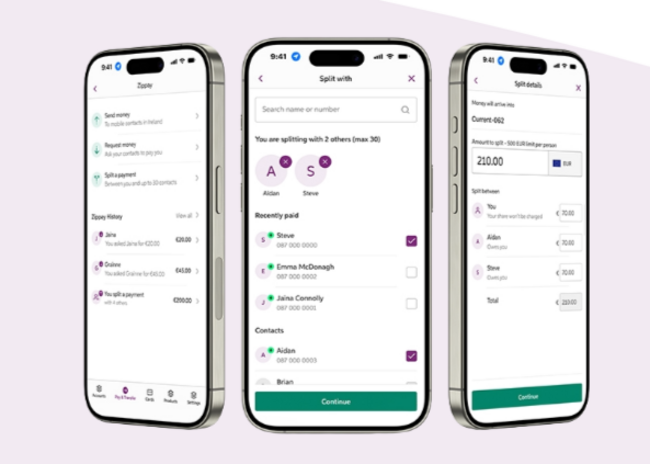
The feature will appear within the banks’ existing mobile banking apps and allows customers to send, request and split payments with contacts who are also using the system (similar to the instant payment tools that have been available for more than a decade on apps such as Revolut).

So how does it actually work?

Instead of entering an IBAN or account number, Zippay links a customer’s bank account to their mobile number.

When sending money, the banking app checks a user’s contact list to see who else is using the service.

If the recipient is registered with Zippay, users can send money directly to that phone number. From the customer’s perspective, the payment appears immediately in the recipient’s account and can be used straight away.

Screenshot (391) A previw of the service on the AIB app. AIB AIB

The idea is to make everyday transfers such as paying back friends or splitting bills quicker than the traditional process of setting up a new payee and entering bank details.

Are there limits on payments?

Yes. Customers will be able to send up to €1,000 per day using Zippay, with a minimum payment of €1.

Users can also request up to €500 in a single payment request and split bills with up to 30 contacts at once.

As with other banking services, individual bank transaction limits may also apply.

Who can actually use it?

At launch, the system will only work between customers of participating banks, which means around five million people will be eligible to use the service, according to AIB.

That currently includes AIB, Bank of Ireland and PTSB, although the Banking and Payments Federation Ireland has said the service could later be expanded to other financial institutions that offer Irish IBAN accounts and mobile banking apps.

Customers will also need to have a verified mobile number linked to their bank account.

What if you send money to the wrong person?

Banks say the system includes a basic check to help reduce that risk.

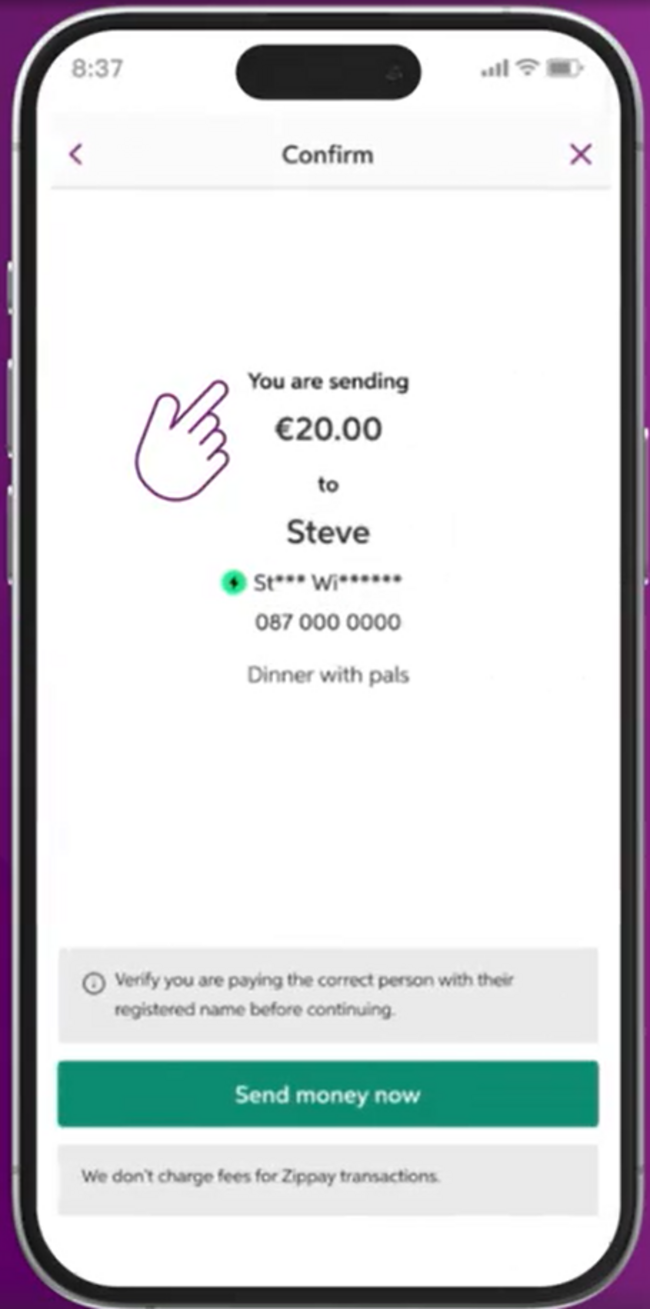
Before confirming a payment, the app will display a partially masked version of the recipient’s name linked to the account. For example, someone listed as John Smith may appear as ‘Jo** Smi**’.

Screenshot (393) A preview of the service on the AIB app. AIB AIB

If the name doesn’t look right, users are advised to cancel the payment before completing the transaction.

However, if money is sent to the wrong account, banks warn they may not always be able to recover it.

Do you have to use it?

Short answer – no.

Customers who do not want to use Zippay can opt out of the service through their banking app.

Those who leave the service will no longer appear as a Zippay contact to other users and will not be able to send or receive payments through the system.

Why are the banks launching this now?

The rollout comes as traditional Irish lenders try to keep pace with digital banking services.

The banks have tried something like this before. In 2020 they announced plans for a payments app called Yippay, a project that was eventually abandoned after several years of delays.

Zippay appears to be a more modest second attempt (with a very similar name), this time built into the banks’ existing apps rather than launching as a standalone platform.

Apps such as Revolut, which has been available for Irish customers since 2015, have made instant phone-number transfers a standard feature for years, helping them build a large customer base in Ireland.

Zippay is essentially an attempt by the country’s main banks to offer a similar function within their own apps, without customers needing to sign up to a separate payment platform.

Daragh Cassidy, head of communications with price comparison site Bonkers.ie, reckons that “the jury is still out” as to whether Zippay will be a big success.

“Most of us are now extremely familiar and comfortable with using Revolut. And as the saying goes, old habits die hard,” Cassidy said.

He added that Irish banks have been “clever” in how they’ve delivered Zippay.

“It will be embedded directly into customers’ existing banking apps and users will have to actively opt out of the service if they don’t want it,” Cassidy said.

“This means millions of people will effectively have it on their phones from day one almost, which should certainly help with adoption.”

Despite the widespread rollout, Cassidy said he is not sure if Revolut “will be too worried about the new service just yet”.

“And of course, Revolut, as well as any other bank, is free to join Zippay if it wishes,” Cassidy added.

Readers like you are keeping these stories free for everyone...
A mix of advertising and supporting contributions helps keep paywalls away from valuable information like this article. Over 5,000 readers like you have already stepped up and support us with a monthly payment or a once-off donation.

Close
17 Comments
This is YOUR comments community. Stay civil, stay constructive, stay on topic. Please familiarise yourself with our comments policy here before taking part.
Leave a Comment
    Submit a report
    Please help us understand how this comment violates our community guidelines.
    Thank you for the feedback
    Your feedback has been sent to our team for review.

    Leave a commentcancel

     
    JournalTv
    News in 60 seconds