Sign in. It’s quick, free and it’s up to you.
An account is an optional way to support the work we do. Find out more.
Sign in. It’s quick, free and it’s up to you.
An account is an optional way to support the work we do. Find out more.
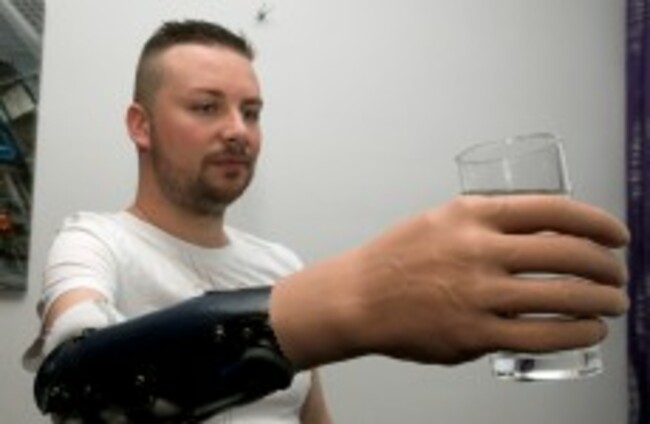
THREE AUSTRIAN MEN have undergone “bionic reconstruction” on their hands, fitting them with a robotic prosthetic that is mind-controlled.
According to new research in The Lancet, the three men had suffered with brachial plexus injuries and poor hand function as a result of motor vehicle and climbing accidents.
Brachial plexus injuries occur when the nerves of the brachial plexus – the network of nerves that originate in the neck region and branch off to form the nerves that control movement and sensation in the upper limbs, including the shoulder, arm, forearm, and hand – are damaged.
The injuries often occur as a result of trauma from high speed collisions, especially in motorcycle accidents, and in collision sports such as rugby and American Football.
A new technique to help these patients was developed by Professor Oskar Aszmann, Director of the Christian Doppler Laboratory for Restoration of Extremity Function at the Medical University of Vienna.
Under the system, the men chose to have their arms amputated.
The method combines selective nerve and muscle transfers, elective amputation and replacement with an advanced robotic prosthesis (using sensors that respond to electrical impulses in the muscles).
Following comprehensive rehabilitation, the technique restored a high level of function, in all three recipients.
Three months after amputation, robotic prostheses gave all three recipients substantially better functional movement in their hands, improved quality of life, and less pain.
For the first time since their accidents, all three men were able to accomplish various everyday tasks such as picking up a ball, pouring water from a jug, using a key, cutting food with a knife, or using two hands to undo buttons.
Professor Aszmann said that the system represents a step forward on existing “crude” techniques.
In effect, brachial plexus avulsion injuries represent an inner amputation, irreversibly separating the hand from neural control. Existing surgical techniques for such injuries are crude and ineffective and result in poor hand function.
“The scientific advance here was that we were able to create and extract new neural signals via nerve transfers amplified by muscle transplantation. These signals were then decoded and translated into solid mechatronic hand function.”

To embed this post, copy the code below on your site
















have your say