Sign in. It’s quick, free and it’s up to you.
An account is an optional way to support the work we do. Find out more.
Sign in. It’s quick, free and it’s up to you.
An account is an optional way to support the work we do. Find out more.
LAST UPDATE | 4 Apr 2025
A CAUTIOUS BUDGET is on the cards this October with government reluctant to make any spending and taxation decisions that “create new risks”.
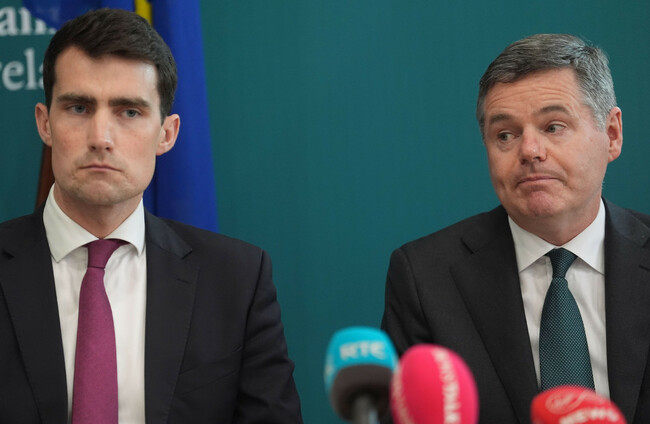
Finance Minister Paschal Donohoe and Public Expenditure Minister Jack Chambers said yesterday that the tariffs that were announced by the US President Donald Trump have not been seen for 100 years.
Specifically asked about what impact the trade war could have on this year’s Budget and whether the government remains confident in can deliver on the big ticket items contained in the programme for government, Donohoe said:
“The last thing I want to do, we want to do, is make budget decisions in a few months time that involve us making spending and tax commitments that then create new risks.”
Donohoe said the government will outline its economic forecast for the budget in a few weeks time.
Taoiseach Micheál Martin, when asked about the delivery of the programme for government promises, said “we will follow through on some of those commitments”.
He went on to state that it is “early yet to be sort of taking things off the table… We’re not at that stage quite yet, but we do have to keep a focus on this, an eye on this as we go forward”.
“We did say all along, if there was fundamental shifts or changes, we would adapt. That was always said,” the Taoiseach added.
Donohoe said similar yesterday when speaking to reporters, stating that that during the election campaign, both he and Minister Chambers said that if Ireland were to face an economic shock the budgerty landscape might need to change.
“I said that in the event of our country facing a big economic shock, that we would have to take measures that would protect the taxes that are coming into our country,” he said. stating that public services would also have to be protected.
“Because what we don’t want to do is make decisions in October 2025 that means that we have to make harder decisions in October 2028 or 2029. This is going to take time for our country to experience the effect of this big change in the world.
“I believe we will be able to help our country adjust and get through it. And the last thing I want to do, what we won’t do, is make budget decisions in a few months time that involve us making spending and tax commitments that then create new risks,” he said.
Donohoe went on to state that this cautious approach is laid out in the programme for government, pointing out that it references specifically a scenario of an economic shock.
“Mr Chambers and I drafted this, we said, in the event of a shock, this is what we will do,” he said, stating that if the country found itself in a new environment, different decisions would need to be made.
“We hoped we wouldn’t be [in a different environment],” Donohoe said.
Speaking today in front of Government Buildings, Chambers reiterated that Budget 2026 will see the government moving away from “temporary one off” measures , as inflation is currently below 2%.
He added that social protection measures in the next budget will have to be targeted:
What we’re trying to do in a new medium-term fiscal plan is to make sure we can make decisions that are sustainable and can be continued into the long term.
“What we do in the context of Budget 2026, in terms of social protection and other areas of intervention will have to be targeted and focused on,” he said.
“But we’re not going to repeat the one off type of packages we saw in recent years.”
Speaking yesterday, Chambers also warned about steps being taken that “could narrow our tax base” in the context of uncertainty.
“We want to make sure that decisions we take can be sustained into the longer term,” said the public expenditure minister who added that protecting capital investment “is going to be really important for growth and prosperity”.
He added that it is a five-year government that wants to make cumulative progress over successive budgets.
“We’ll be able to make progress on a number of the priority areas that government has set out, but that is in the context of a level of uncertainty that we haven’t seen now for a period of time,” said Chambers.
Martin said today that the government’s priorities “will not change”.
“But obviously we’re going to keep a very watching brief on revenue flows. Yesterday’s figures were good, but it’s in the early part, the first quarter of this year,” said the Taoiseach.
“We’re not going to make any rushed decisions, but we do have to be sensible in terms of what may transpire next year and the year after that, in terms of revenues resulting from this. So it is early days. It is uncertain. So we don’t want to make hasty decisions, but we will do everything we can as a fundamental principle to protect the public finances,” said Martin.
- With reporting by Sam Starkey

To embed this post, copy the code below on your site











have your say