Sign in. It’s quick, free and it’s up to you.
An account is an optional way to support the work we do. Find out more.
Sign in. It’s quick, free and it’s up to you.
An account is an optional way to support the work we do. Find out more.
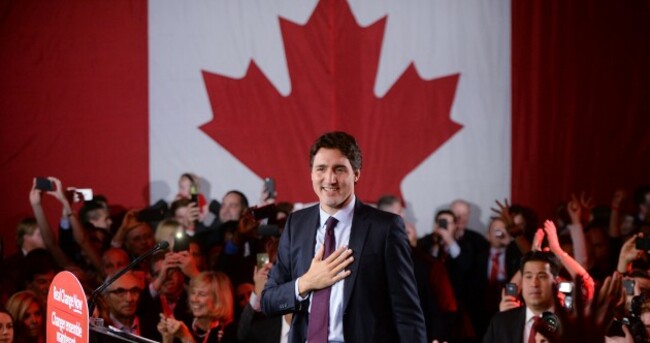
CANADA’S LIBERAL LEADER Justin Trudeau, son of a popular former prime minister, has won the country’s general election in a landslide that ended nine years of Stephen Harper’s Tory rule.
For many Canadians the vote was a referendum on Harper’s management style, criticised as aloof and autocratic, and on who was better placed to put a struggling economy back on track.
Trudeau campaigned on a pledge to raise taxes on the richest Canadians and lower them for the middle class.
The 43-year-old Trudeau will form a majority government with 184 of the 338 seats in the House of Commons, according to Elections Canada.
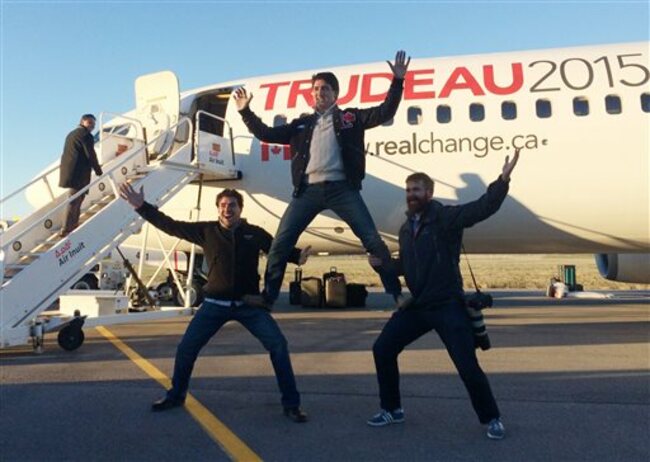
Public opinion had swung wildly during the hard-fought campaign, one of the longest in the country’s history. But final polling showed Trudeau’s Liberals eight points ahead of Harper’s Tories — an edge apparently borne out at the ballot box.
Early results showed the Liberals swept all 32 seats in Canada’s Atlantic provinces, doubling their popular support in the region, scored well in key Ontario and Quebec battlegrounds, and made gains throughout the western provinces.
The party came from behind late in the campaign, with Trudeau – the eldest son of Pierre Trudeau, considered the father of modern Canada – promising “not just a change in government, but a better government.”
“Tonight Canada is becoming the country it was before,” Trudeau said in his victory address.
“Canadians from across this great country sent a clear message tonight — it’s time for a change in this country, a real change,” he said.
Trudeau was elected Liberal leader only two years ago, coming after two past leaders failed to unseat Harper in 2008 and 2011 and subsequently resigned.
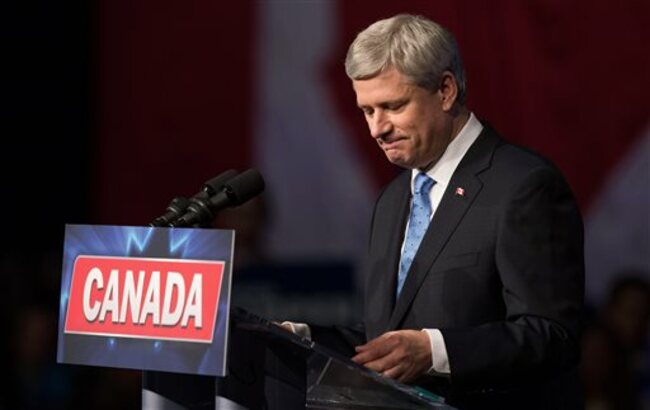
He appears to have made good on his hope to recreate the “Trudeaumania” that swept his charismatic father to into office in 1968.
Harper, who took power in 2006, had been seeking a fourth term in office.
But Trudeau tapped into a strong desire for change in administration, and took advantage of an all-time low in Harper’s popularity.
At times, the battle descended into personal attacks, with Tory ads suggesting that Trudeau — with his youthful good looks — was “just not ready” to be prime minister.
But arguably, the long contest gave him time to sharpen his campaign skills, and give Canadians a chance to get to know him better. His colourful past includes work as a snowboard instructor, a bartender and a bouncer.

To embed this post, copy the code below on your site













have your say